

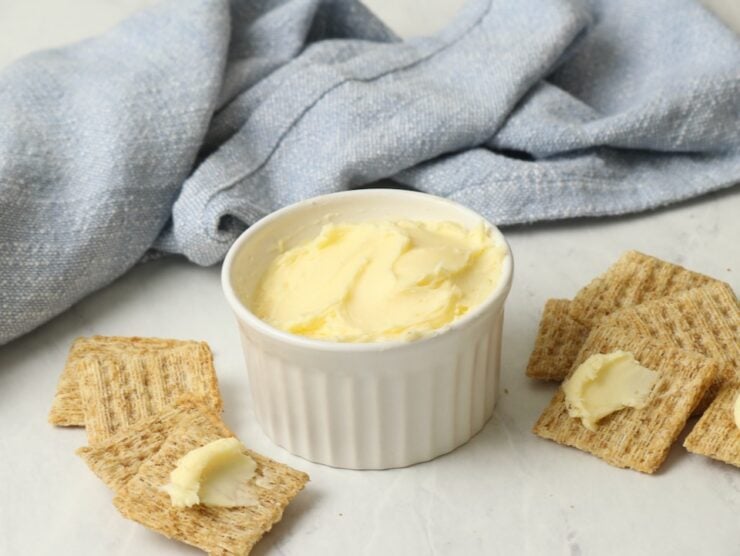
In this post my friend Sharon Biggs Waller, a historical novelist, shares her recipe and method for making homemade butter. Rich, delicious butter can be made using heavy cream and a few simple kitchen items. No churn is required. Read on for the method, or watch the video for a tutorial!
Whenever I tell people I make my own butter they tend to look at me in wonder. “Making butter? Sounds like alchemy,” one person said. Invariably I’m asked if I use a butter churn.
Although the idea of sitting on my porch using an old-fashioned churn appeals to my inner Little House on the Prairie, I don’t collect enough cream from my dairy goat to use such a device, nor do I possess the funds to buy one.
The truth is, butter is a simple thing to make with ordinary kitchen tools, and you don’t even need to own a goat or a cow. You can make butter with store-bought whipping cream. But before we get into the details, let’s talk a bit about the history of butter.
People have been making butter for centuries throughout Europe and Asia. Humans initially used butter as a way of preserving the fat in milk.
Butter rose to prominence as a spread and cooking fat in northern Europe during the Middle Ages, when it was eaten by peasants. The upper classes also ate it periodically, because it was the only animal fat allowed by Rome on days when meat was forbidden. In the 16th century it was allowed during Lent.
In the early days, it took a little while to get enough cream to churn, and so it was collected over various days. Because the milk in these small old-timey dairies was not refrigerated, the lactic acid bacteria inherent in dairy would ferment slightly.
This cultured butter has a very tangy and rich flavor, and is my personal favorite. Spread cultured butter on sourdough bread or a crusty baguette and you’ll know what heaven tastes like. Most butters made in Europe still taste this way, although they are made from pasteurized cream inoculated with lactic acid.
Uncultured butter made from straight-up pasteurized cream is called sweet cream butter, and is what we’re used to in the United States. Pasteurization of the cream kills the lactic acid bacteria, however butter made from such cream lasts longer. True cultured butter, made from raw cream, turns rancid after ten days.
If you want your butter to taste cultured, Ricki Carroll, author of the book Home Cheese Making, advises using unpasteurized cream and letting it ripen at room temp (72 degrees) for several hours. Or use pasteurized cream, let it sit for 12 to 24 hours, add mesophilic starter and let the cream set out overnight before churning.
If you’d like to taste European-style butter without making your own, try the brand Plugrá. Although technically not a cultured butter, Plugrá uses natural flavors from cultured milk.
At its very essence, making butter requires nothing more than agitation. What you’re doing is separating the fat from the milk.
You can use a blender, a stand mixer or hand mixer, or just shake by hand (if your child has a lot of energy, enlist their help; kid-power goes a long way!).
I usually use my stand mixer with the whip attachment for making butter. I’ve also used a blender in the past and it worked just as well. If you use a stand mixer, be sure to place a kitchen towel over the mixer and the bowl to stop the buttermilk from flinging all over your kitchen, which will happen when the butter globules form.
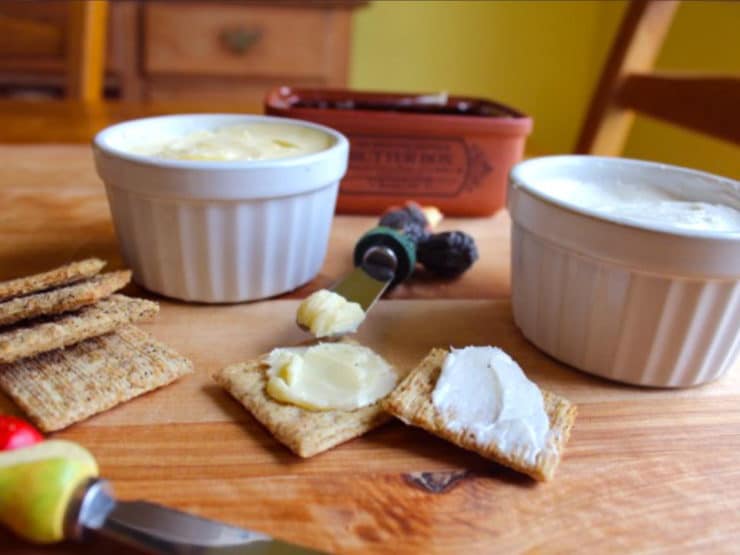
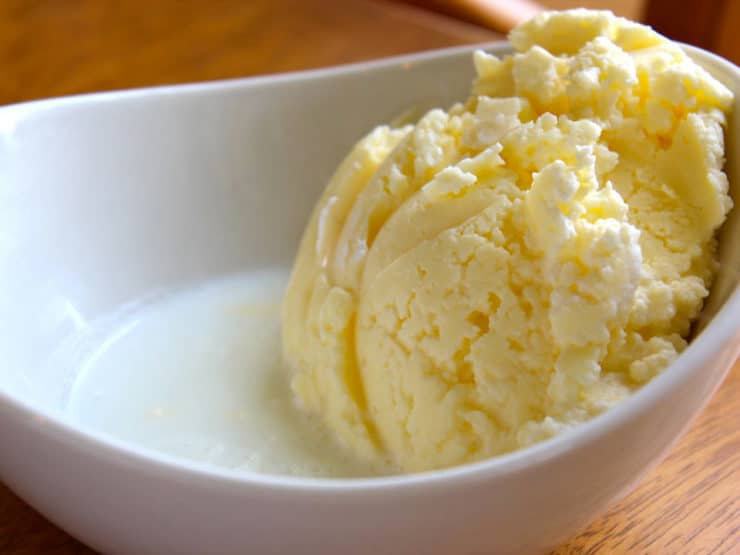
You’ll notice in the pictures below that some of the butter is white, not yellow. That’s because I have a herd of goats, so I usually use the cream we collect to make my homemade butter.
Goat’s milk is white because it doesn’t have the beta carotene that causes the yellowish blush in cow milk. A goat turns the carotene present in her fodder into vitamin A, which is colorless.
Here is the process for making homemade butter, step-by-step!
Recommended Products:
We are a participant in the Amazon Services LLC Associates Program, an affiliate advertising program designed to provide a means for us to earn fees by linking to Amazon.com and affiliated sites. As an Amazon Associate I earn from qualifying purchases.
How to Make Homemade Butter
Ingredients
- 1 pint heavy whipping cream
- Large bowl of ice water
- Salt to taste (optional)
- Stand mixer, hand mixer or blender, or a jar with a tight fitting lid
Instructions
- Pour a pint of heavy cream or whipping cream into your device or into a jar with a tight-fitting lid. If using a machine, turn on low speed, then raise to medium speed. If you're using a jar, start shaking (you'll need some serious elbow grease if doing it by hand). First, the cream will turn into whipped cream with soft, then stiff peaks. Keep going until the cream breaks. If you’re shaking the cream by hand, you’ll hear a sloshing, then you’ll begin to feel something more solid hit the sides of the jar. If you’re using a stand mixer, you’ll see the butter clinging to the beater. This usually takes anywhere from 5 to 10 minutes -- by hand may take longer. In this process, you are separating the butterfat from the liquid.

- Once the butter has solidified, pour off the buttermilk and save it for baking (or drink it!). Scoop the butter into a bowl. Rinse the butter by pouring ice water over it and pressing the remaining buttermilk out with a small spatula or a spoon. Pour off the water and repeat the process. Keep rinsing and squishing the butter with the ice water until the water runs clear. Then add some salt if you like and work that through the butter.
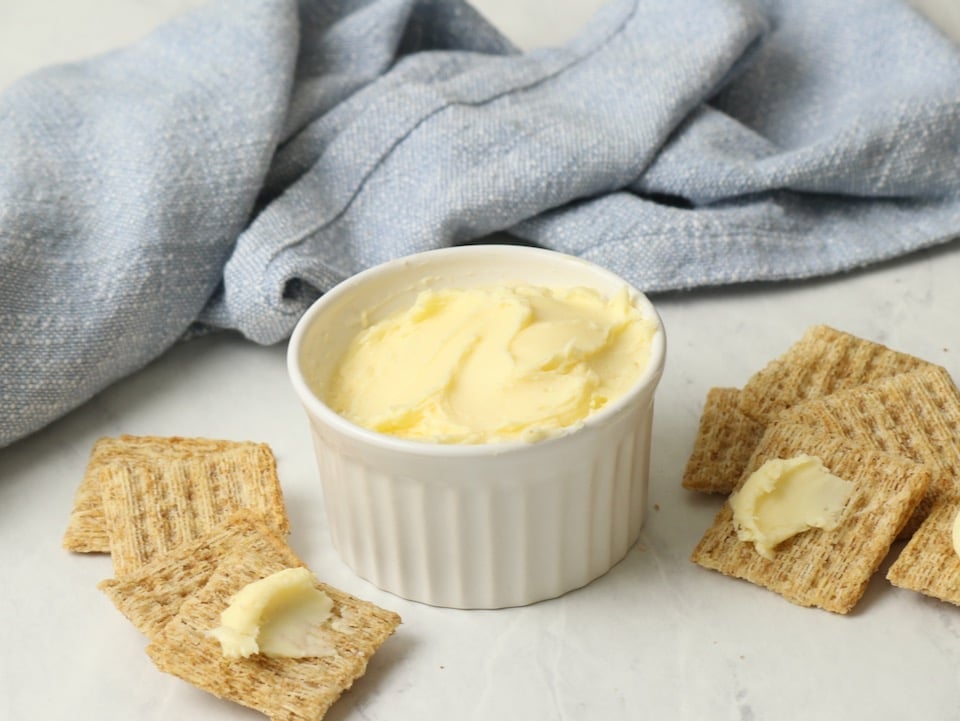
- There you have it-- old-fashioned butter, no churn required! Spread on toast, corn on the cob, a baked potato, or whatever you like and enjoy!


Nutrition

tried this recipe?
Let us know in the comments!
Research Sources
Belanger, Jerry (2001). Storey’s Guide to Raising Dairy Goats. Storey Publishing, North Adams, MA
Carroll, Ricki (2002). Home Cheese Making: Recipes for 75 Homemade Cheeses. Storey Publishing, North Adams, MA
McGee, Harold (2004). On Food and Cooking: The Science and Lore of the Kitchen. Scribner, New York, NY



This was simple and great!
I asked one of our Mennonite lady’s in our town how to make it and she gave me the cream from one of her cows so I just made it I love it I forgot to ask how to add salt. Thank u for the help!
After the water runs clear, work the salt into the butter by massaging it in.
What’s the best way to store the butter once it’s made?
I would store it in the refrigerator covered with plastic wrap, or in a butter bell.
Thank you so much for showing how to do this. It was so easy with my Ninja. I don’t know why I would ever buy margarine or butter again in the store when this is so easy to do.
I made and let me tell u i love cooking and lots of recipes need butter but in my country its really expensive for a14y.o girl and i thank u for this awsome recipe
I’ve traveled all over the world and the butter I enjoyed the most was butter made in Mexico. Why it seems better to me, I have no idea but I loved it. Wish I could have brought it home.
Thank you so much. I have now made homemade butter. Thank you for easy to follow instructions. The only way things could have went smoother is if you were here showing me in person.
Can u add seasonings while shaking to it, that way it is completely mixed in and then continue doing the rest of the process??
Hi Sam– I am not sure how this would affect the process. It will probably work, but I can’t guarantee if having never tried it myself.
I did try adding salt to the cream before churning it-the flavor of the salt came out in the buttermilk.I ended up adding salt to the butter afterwards anyway.
I watched a video of the French performing their “French magic” on making butter. Now the butter was already made (churned). They were softening the butter and salting it and then made it pretty. So, what I got out of that video was after the butter is formed, then you can salt it. I would think if you did it before you would be salting or seasoning the buttermilk that is separated from it and you may not want to do that.
I made this today and it turned out awesome! no need to order from outside. Thanks
Those of you who feel like your failing at making the butter,remember to keep shaking fast and it will thicken and eventually clump into the butter.After following instructions I added garlic,salt and some parsley.
Sure enough, it does indeed make butter. Nice, flavorful butter too!
Can I simply just say what a relief to uncover somebody who really understands what
they are talking about on the web. You certainly know how to bring a problem to light and make it important.
More and more people must check this out and understand this side of the story.
It’s surprising you aren’t more popular given that you surely possess the gift.
Magnificent site. A lot of useful info here. I am sending it to some buddies ans also sharing in delicious.
And obviously, thanks on your sweat!
Thank you for posting this! We made butter tonight to go along with the bread we baked today. It was so fun to make this butter. I’ll definitely be doing it regularly now. My two year old was a pro at pressing the buttermilk out of the butter.
Followed the procedure by putting ½ pint of refrigerated heavy whipping cream (from Walmart) into a pint jar. Secured the lid and shook the jar vigorously for about 15 minutes while watching the Tour d’ France. I’m not sure which was more boring, but I wound up with a nice little batch of home made butter and some buttermilk that my kitty thoroughly enjoyed. Note: the key words here are “refrigerated” and “heavy.”
Please note that all cows in the UK are fed, by government order with GM animal feed. So only truly organic milk will be free of GMO’s
Love making homemade butter. My family and I were visiting my family during the holidays two yrs. ago, when my lil sister (age 23), wanted to show how to make homemade butter. What a treat, and so much fun. My daughter and I have done it a few times since then. Having read most of the comments and replies, I was wondering, how can you make it more like a spreadable butter? Oh, yeah, we never squeezed the excess buttermilk out of the butter, will that cause any issues?
Hi Tamron, you can make a more spreadable butter using the tips here: https://toriavey.com/toris-kitchen/2013/04/homemade-spreadable-butter/
Although I am yet to try this, I would like to ask… …how long will the butter continue to be edible in this pure form?
I couldn’t believe how good homemade butter tastes! I like salty butter, so made one batch with sea salt crystals in, and another with chilli and coriander – that’s delicious on fish or steak. Or crackers. Definitely won’t be buying butter again.
I’m confused. On the part where it says when the butter is solidified pour off the buttermilk- I didn’t have any buttermilk????? What did I do wrong?
you have to keep shaking (if by hand) or mixing, and then buttermilk will appear because it will get separated out from the butter.