

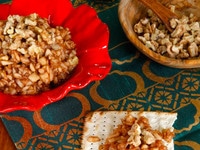

Charoset is a fruit and nut mixture that is used as a blessing for the Passover Seder. The texture of charoset symbolizes the mortar used by the ancient Israelite slaves of Egypt when they toiled under the rule of Pharaoh. Most Jews have a soft spot for charoset; eating it signifies the end of the long Haggadah blessings and the beginning of the Seder feast. In our home, we make extra charoset for the Seder and nosh on it all week!
My family’s charoset recipe is pureed to a paste before serving, Sephardic-style. Many of my Seder guests prefer the chunkier Ashkenazi style, so over the years I have created my own version.
Most Ashkenazi charoset recipes are pretty simple, a mix of apples, sweet kosher wine, walnuts and spices. Of course I wanted to create my own spin on this concept. I developed a basic apple charoset, heavy on cinnamon and spice, sweetened with wine and honey.
Then, rather than integrating walnuts into the charoset, I candied them with cayenne for a crunchy finish with a kick of spice. The walnuts here are served as a topping to the charoset; you shouldn’t mix them in or they’ll lose their delicious candied crunch.
This charoset can be made ahead– in fact, I encourage you to marinate it overnight before serving to improve the flavor. The nuts can also be candied ahead of time and stored separately from the charoset. Sprinkle on the candied nuts just before you put it on the table, or serve the nuts alongside the charoset and allow people to sprinkle their own onto each serving.
Note: this is an updated version of a recipe I posted back in 2010, not long after I started this blog. I like this new version much better than the original! I hope you will too. 🙂
Recommended Products:
We are a participant in the Amazon Services LLC Associates Program, an affiliate advertising program designed to provide a means for us to earn fees by linking to Amazon.com and affiliated sites. As an Amazon Associate I earn from qualifying purchases.

Apple Cinnamon Charoset with Candied Walnuts
Ingredients
Apple Cinnamon Charoset
- 1 1/2 pounds Gala or Fuji apples (about 4 medium apples)
- 5-6 tablespoons sweet kosher wine
- 1 tablespoon honey (use agave to make vegan)
- 1 1/2 teaspoons cinnamon
- 1/4 teaspoon ginger
- 1/4 teaspoon allspice
- Salt to taste
Candied Walnut Ingredients
- 1 cup raw walnuts (no shell)
- 1/2 egg white
- 3 tablespoons sugar
- 1/4 teaspoon salt
- 1/4 teaspoon cayenne
- Dash cinnamon
- Dash nutmeg (optional)
Instructions
To Make Charoset
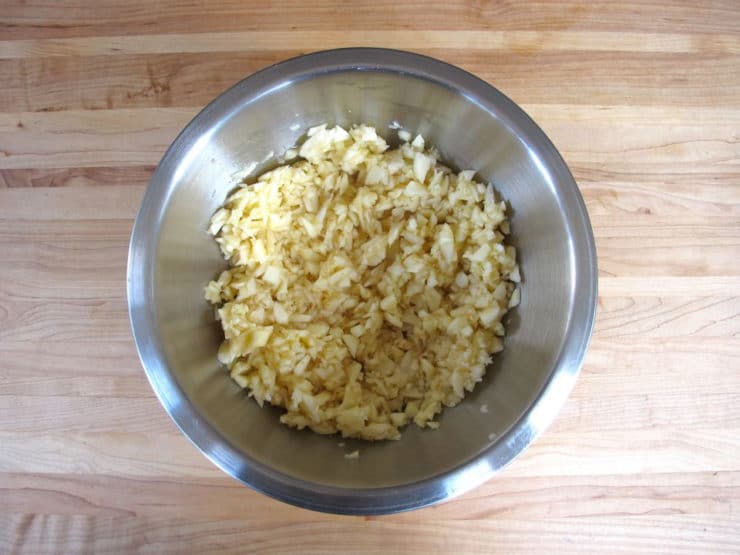
- Peel and core the apples, then chop them fine. I usually put them in a food processor and pulse a few times till they're chopped fine but with texture. Careful, it's easy to over-chop if you go this route and you could end up with applesauce!

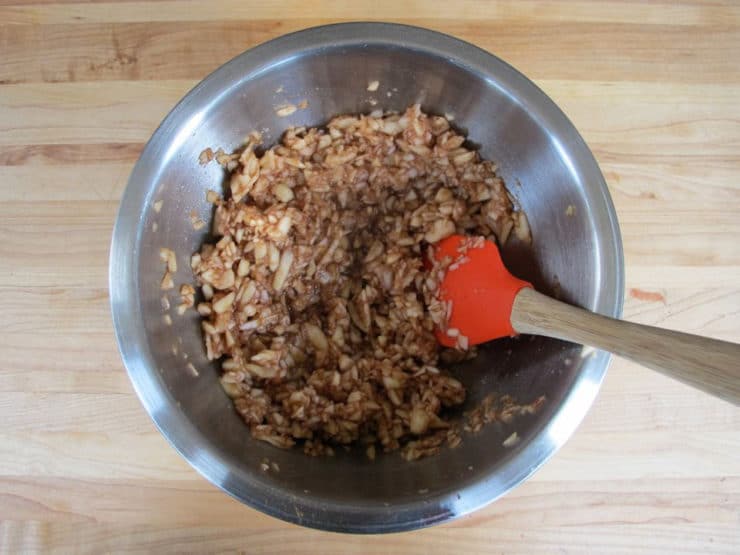
- Place the chopped apples in a bowl. Stir in 5 tbsp sweet kosher wine, honey, cinnamon, ginger, allspice and a pinch of salt (to taste). Taste the mixture; if you feel it needs more moisture or sweetness, add a bit more kosher wine. The wine will be soaked up a bit as the charoset marinates, but you don't want it puddling too much at the bottom of the bowl... a little puddling is fine.Cover the bowl, place in the refrigerator, and allow the mixture to marinate for 24 hours.
To Make Candied Walnuts
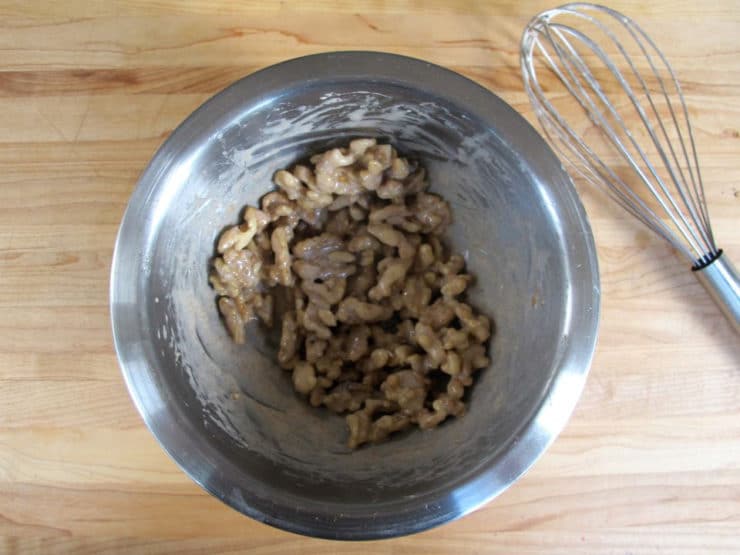
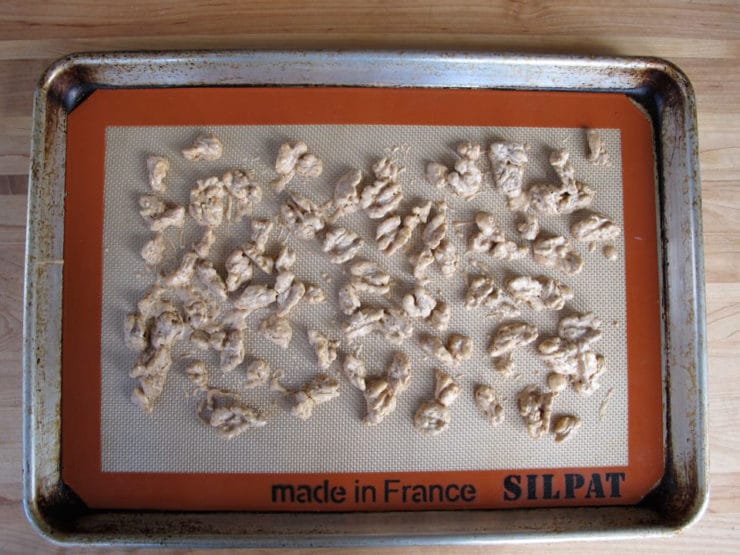
- Preheat oven to 300 degrees F. Separate egg white from yolk, then pour half of the egg white into a mixing bowl (just eyeball this, it doesn't half to be exact). Use a whisk to beat the egg white till frothy, then beat in the sugar, salt, cayenne, cinnamon and nutmeg. Add the walnuts to the egg mixture and stir till the walnuts are fully coated in the seasoned egg white mixture.
- Spread the walnuts out on a baking sheet lined with parchment or a silpat. Bake for 15-20 minutes till crisp. Remove sheet from the oven and allow the nuts to cool on the sheet.
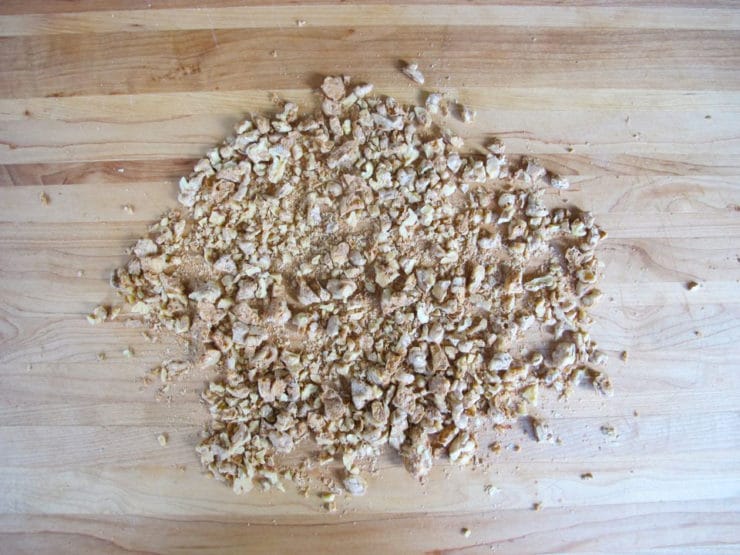
- Pour the candied nuts onto a cutting board and roughly chop them into smaller pieces.
- Sprinkle on the candied nuts just before you put it on the table, or serve the nuts alongside the charoset and allow people to sprinkle their own onto each serving. The walnuts here are served as a topping to the charoset; you shouldn't mix them in or they'll lose their delicious candied crunch.
Nutrition

tried this recipe?
Let us know in the comments!
i like the traditional charoset…sweet…at least for seder…BUT in the days after sure i would try something different…
Our charoset comes out like a kind of jam, delicious. Just raisins slacked in water, cooked. Blended and nuts added. Delish. Of Lebanese origin.
We are having Seder with neighbors. For my contribution, I am making a Persian Charoses or Halleq, a Persian-style leg of lamb, and Israeli salad with crumbled feta.
Yum…
this sounds good!
What kind of wine do you use Tori? When I see sweet kosher wine I think Mogen David.
Nancy Mogen David works. Any kind of sweet red or concord wine will do. If you have strictly kosher guests coming to Seder, make sure the wine is kosher for Passover.
i like Moroccan charoset or Polish style
I use Mogen David and Honey.
oh I LOVE this stuff !!
I use dates and figs to replace apples. Or pears
A friend in Dallas always shared her special charoset made with cayenne for a Texas kick. Yummy!
For sure going to make this.
I love my charoset recipe but adding cayenne candied walnuts sound awesome.
Oh nice change up! Gonna have to do this this year! looks YUMMY! TY
Love your website and all of the fabulous info and recipies! I am making a Sephardic Passover Seder this year and would love your families Charoset recipe. Where can I find it? Thanks and happy Passover!
Thanks Lynn! Here you go: http://theshiksa.com/2010/03/19/ashkephardic-charoset/ These are good too: http://theshiksa.com/2010/03/26/sephardic-charoset-truffles/
I second those emotions, Nancy S! My family is from Minsk and Pinsk (originally) and these recipes really take me back to when I was a little girl driving up to Chicago for Pesach with Bubbe! Happy Pesach, everyone! Thanks for this blog, Tori.
Nancy
Not only do I love the recipes, I love the lessons in conjunction with them (or, as Phil refers to them, the midrash). Food certainly has a way of telling a great deal about different people and different cultures and I guess that’s one of the things I find so enjoyable about it, not to mention the gastric satisfaction. I’m really enjoying your blogs. Thanks
Learn something new every day! I had not met a Haroset without apples. Anyway, mine is date based as well, and will be up on my blog next week!
My family is from Syria.We don’t add apples to our haroseth,ours has dates,figs, prunes and raisins.This recipe looks delicious though maaybe I’ll try making two this year!
Candied walnutes is such a cool idea! thank you tori!!! will try this
We also use a Sephardic Haroset in our home (one of the few things that we specifically use a sephardic recipe!). I can’t wait to see your recipe. My next blog entry will be food based, so watch for it!
Anyway, something interesting about Haroset. The Talmud give two reasons why we have Haroset on the seder plate. Zekher l’teet and Zekher L’tapuakh, in remembrance of the mortar and in remembrance of the apple. Remembrance of the mortar is obvious, as it is the reason everyone knows. The Talmud tells a little story to explain the apple. The midrash tells us that when killing the children did not work, Pharaoh decreed that the men and women should be kept separate so that no more babies could be born. But during the heat of the day, when the people would rest from work, the women would go under the apple trees and entice their husbands to lie with them. The midrash then tells us it is due to the efforts of the women that Jewish people survived slavery. So in remembrance of the apple, we have Haroset. Perhaps that is why ALL Haroset recipes have apples in them.
Barb, let me know how it turns out for you!
Phil, great info! Figs, pomegranates, and dates are also traditional charoset ingredients, because of references throughout the Song of Songs and Passover’s association with the season of spring (fertility, rebirth). While it is true that most (if not all) Ashkenazi charoset recipes contain apples, Sephardic charosets are usually apple-free. Sephardic charoset is usually date-based with additional dried fruits, figs, and nuts like pistachios. While some contain apples, it is not required by Sephardic tradition. In fact, I’ve even tasted a Sephardic charoset made from oranges! (It was really tasty!) There are many cultural food differences between Ashkenazi and Sephardic Jews (like kitniyot, for example). That’s one of the reasons I love Jewish cooking so much… the methods of preparing traditional dishes are so diverse! Take cholent, for example– or as some refer to it, chamin– I have no less than 20 different ways of making cholent. Every country uses different spices and regional ingredients for creating the same basic dish. I find it all fascinating, don’t you? 🙂
Thank you for this one! I like your spin on it, and I’ve been getting tired of mine the same every year. Fingers crossed!!!
Barb