

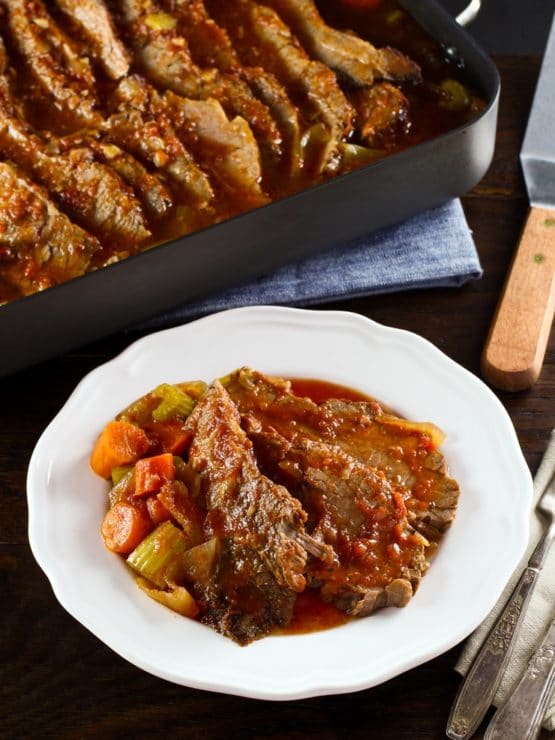
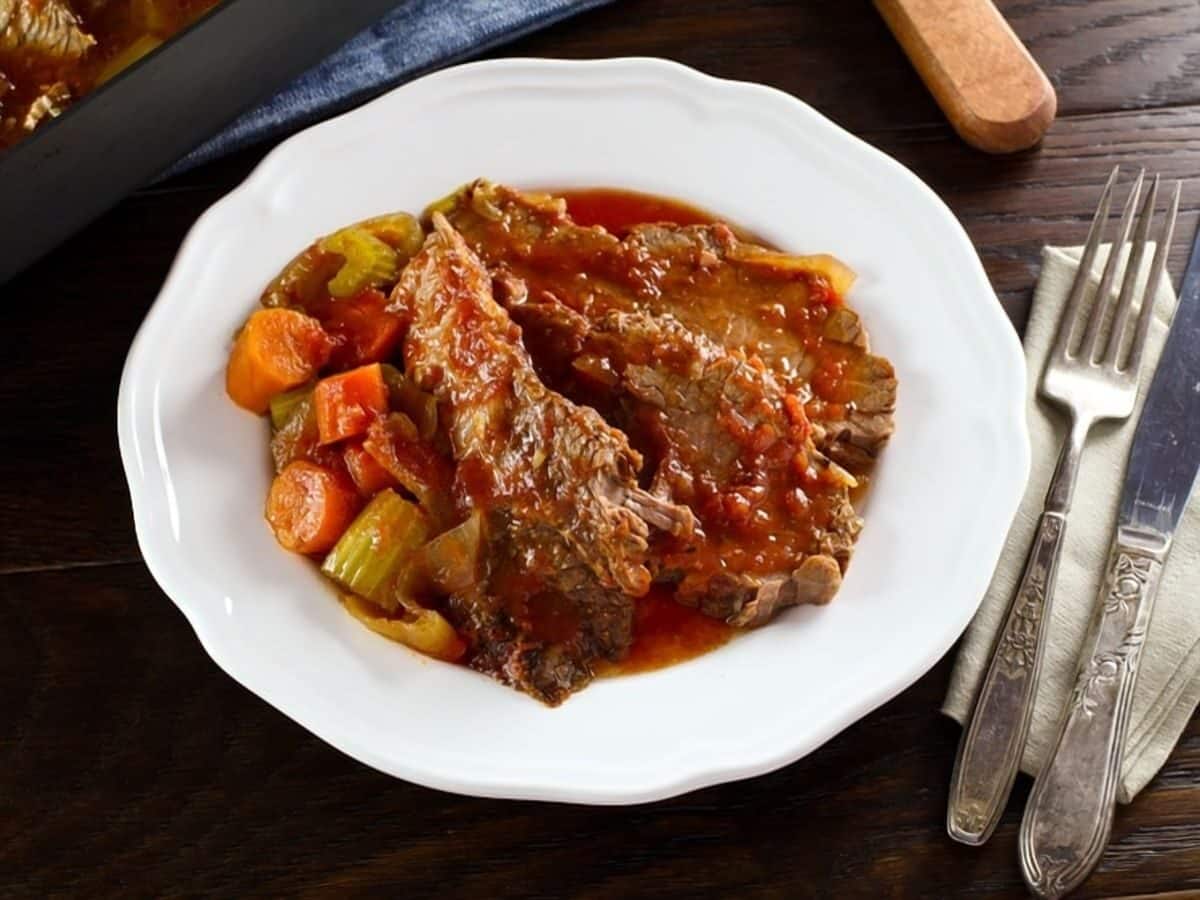
This Holiday Brisket is one of my more popular brisket recipes for the Jewish holidays. It is inspired by a classic Ashkenazi sweet-and-sour brisket, but the flavors here are more subtle.
This brisket is savory, aromatic, and subtly sweet with just a touch of tang. It’s always a crowd pleaser!
Jews living in Eastern Europe rarely had the money to buy better cuts of meat. They learned to make do with cheaper kosher cuts, like brisket, oft overlooked for its toughness. Cooking the brisket low and slow breaks it down, resulting in a tender piece of meat.
This Jewish tradition continues today, and brisket is often served for special holidays and occasions. On Shabbat, it is added to a pot with vegetables and potatoes to make a slow-cooked meaty stew known as cholent.
At Rosh Hashanah, it is added to root vegetables with sweet dried fruits and slow cooked into tzimmes.
When Ashkenazi Jewish immigrants came to the United States, they brought their love of brisket with them. Jewish deli owners pickled the brisket to make corned beef or pastrami. But for the holidays, nothing could replace the comforting, hearty flavor of an oven-roasted brisket.
How to make brisket tender
The secret to a cooking brisket is twofold– brisket fat and time are key for tender and delicious results. Choose a cut with nice marbling; the more fat you can see, the more tender the meat will be.
If buying grass fed (which tends to be leaner), make sure there is a fat layer and don’t let the butcher trim it. And of course, allow yourself plenty of time to cook your brisket.
If you can, make it a day or two ahead– the flavor will improve with time. More tips here: How to Cook Brisket – Tips and Recipes
My Holiday Brisket slow cooks for hours, so the final product flakes tenderly and simply melts in your mouth. The sauce is rich and flavorful, and the slow cooked vegetables are soft, like butter. The flavor is perfect for any special celebration, but particularly suited to the Jewish holidays. Enjoy!
What is traditionally served with Brisket?
Olive Oil Mashed Potatoes with Garlic and Rosemary
Roasted Rosemary Balsamic Tzimmes
Butternut Squash and Crispy Kale Bake
Green Beans with Balsamic Date Reduction Feta and Pine Nuts
Kale and Roasted Beet Salad with Maple Balsamic Dressing
Throwback Recording: In this radio interview with Joan Hamburg, we talked about this very brisket recipe, as well as Passover cooking. You can listen by clicking the triangle “play” button below.
Recommended Products:
We are a participant in the Amazon Services LLC Associates Program, an affiliate advertising program designed to provide a means for us to earn fees by linking to Amazon.com and affiliated sites. As an Amazon Associate I earn from qualifying purchases.
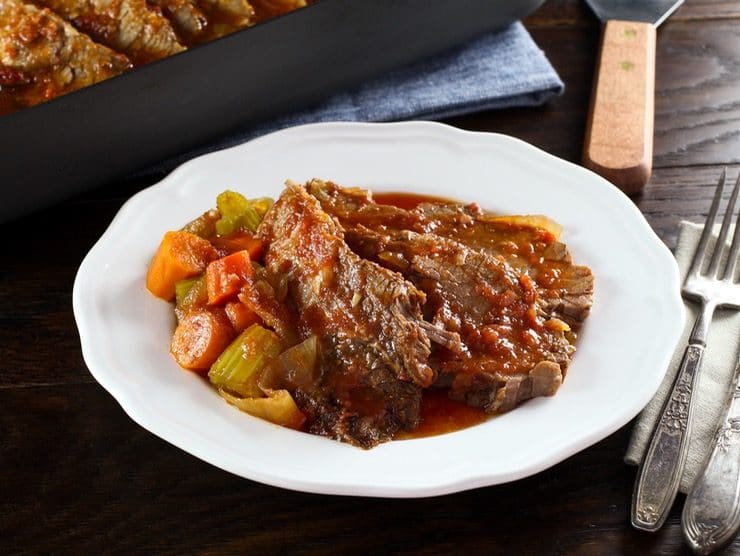
Food Photography and Styling by Kelly Jaggers
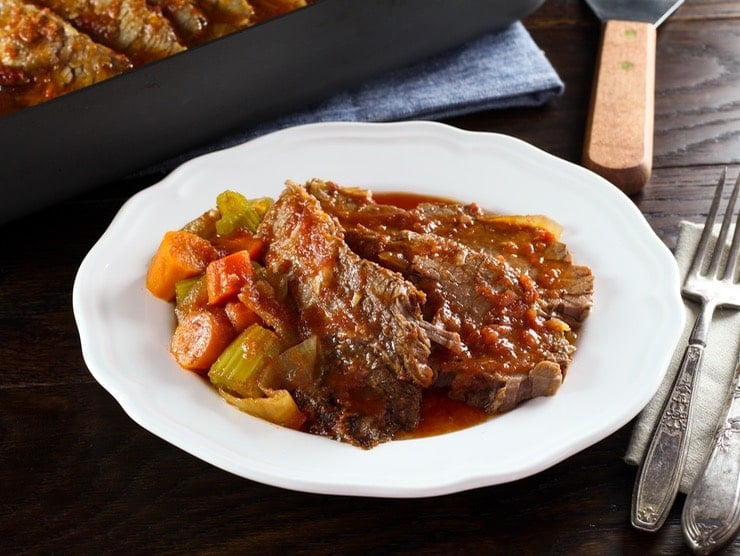
Holiday Brisket
Ingredients
- 5-7 pounds brisket, first or second cut (do not trim fat - especially if it's grass fed)
- 1/4 cup extra virgin olive oil, divided
- 2 large brown onions, peeled and sliced
- 1 pound carrots, peeled and sliced
- 1 pound celery, peeled and sliced
- 28 ounces tomatoes - whole, diced, or crushed (1 large can)
- 10 peeled whole garlic cloves
- 1/2 cup brown sugar
- 1/4 cup vinegar (I like apple cider vinegar, but white vinegar works too)
- 2 cups beef or chicken broth, divided
- Salt and pepper
Instructions
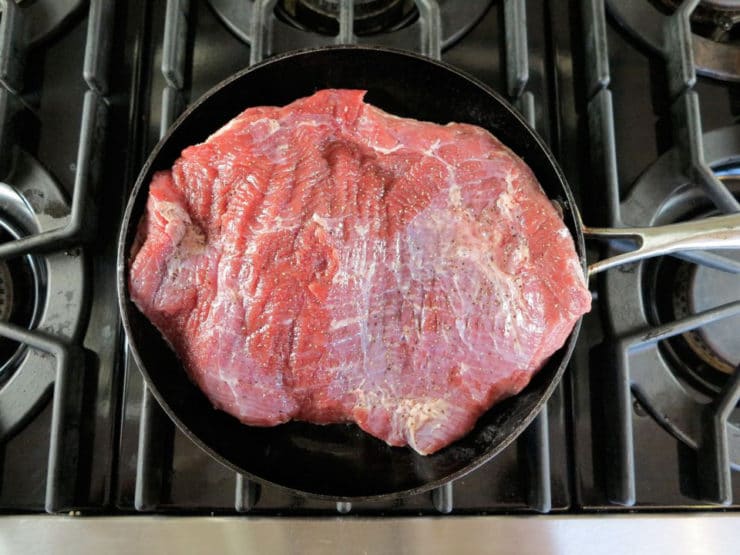
- Preheat oven to 300 degrees F. Rinse the brisket and pat dry. Rub both sides of the meat with black pepper and salt. Heat a large skillet over a medium flame on the stovetop. Drizzle 2 tbsp of olive oil into the pan. Brown the brisket on both sides—it will take 4-5 minutes per side. A large brisket may overlap the edges of the skillet; you can brown it in stages, letting half the brisket overlap the edge, then adjusting it to brown the other half.

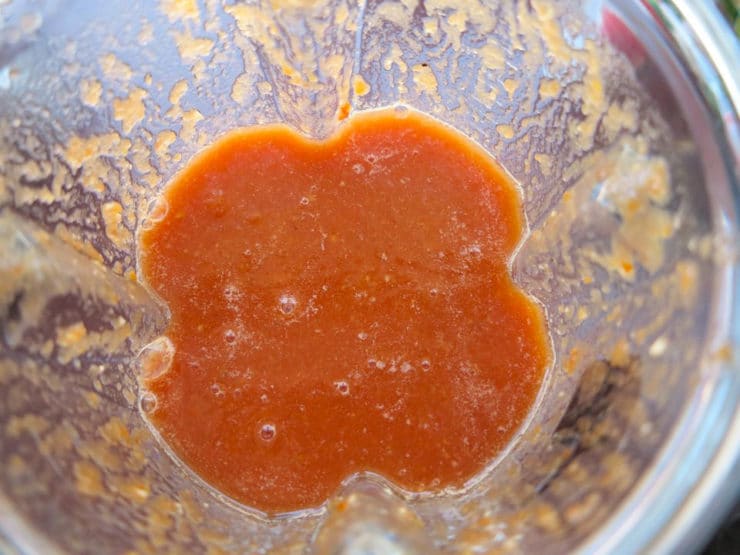
- While brisket is browning, pour canned tomatoes, garlic, brown sugar, apple cider vinegar, and 1 ½ cups broth into a blender or food processor. Add 2 tsp of salt (or 1 tsp if using a salted kosher cut of brisket) and ¼ tsp of black pepper. Pulse till garlic is chopped small and all ingredients are combined.
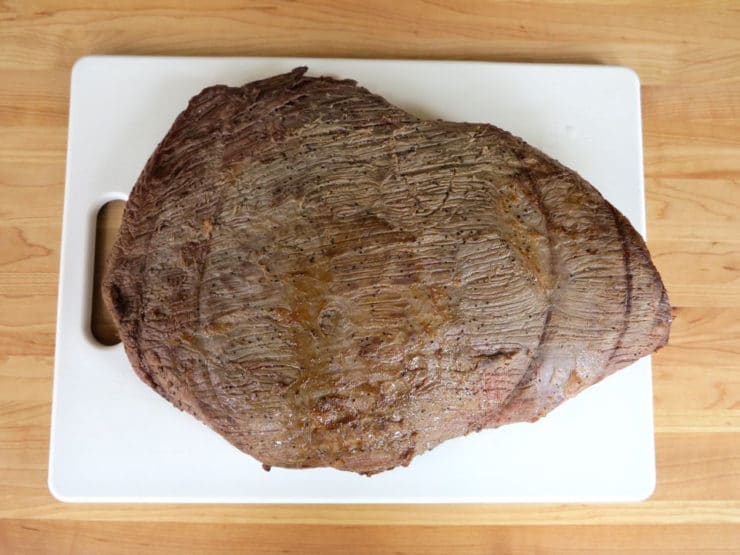
- Remove the browned brisket from the skillet.
- Drizzle 2 tbsp more olive oil in the pan and add the sliced onions. Saute them over medium high for a few minutes until they begin to soften and shrink in size.
- Add the carrot and celery slices. Sauté for another 5-6 minutes until the onions are soft and browning and the vegetables are fragrant.
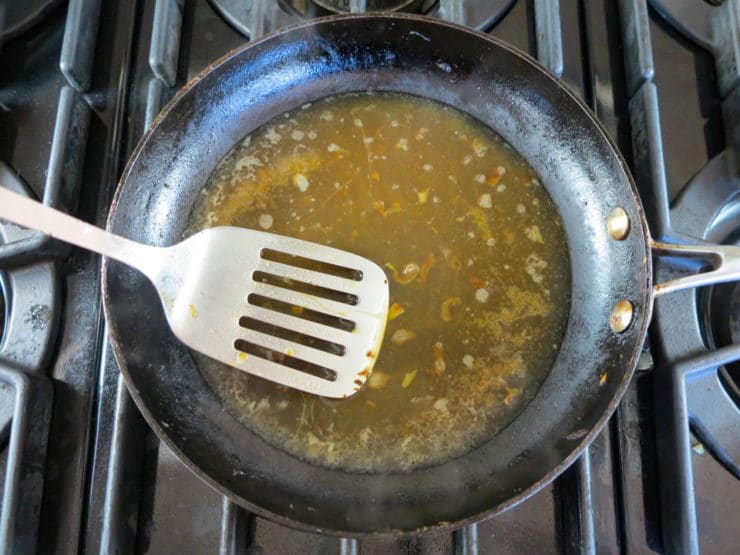
- Pour the vegetables out of the skillet and onto a plate, reserve. Add 1/2 cup beef stock or chicken stock into the skillet and let it heat up. Use a spatula to gently scrape up any brown bits and pan juices that are clinging to the skillet. Turn off heat.
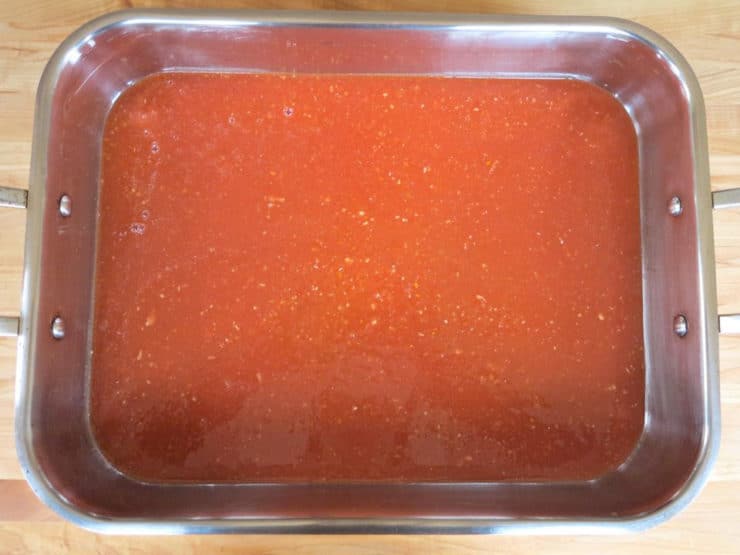
- Pour half of the tomato mixture into a large roasting pan.
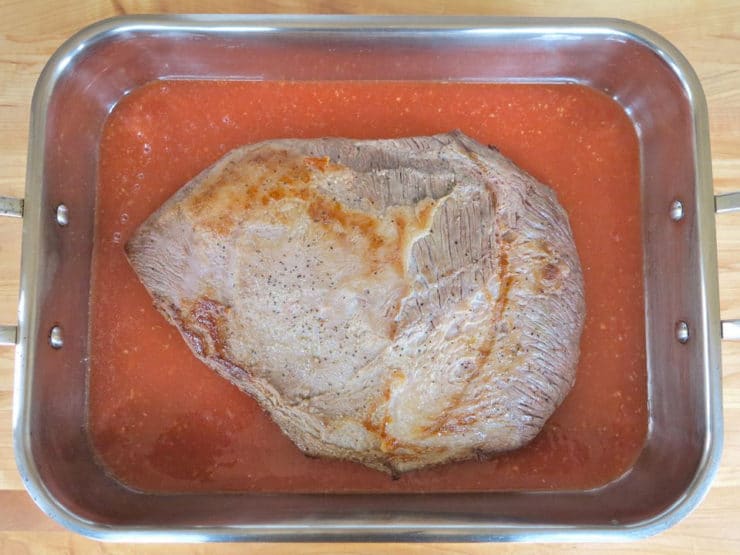
- Place brisket on top of the tomato sauce, fat cap facing up.
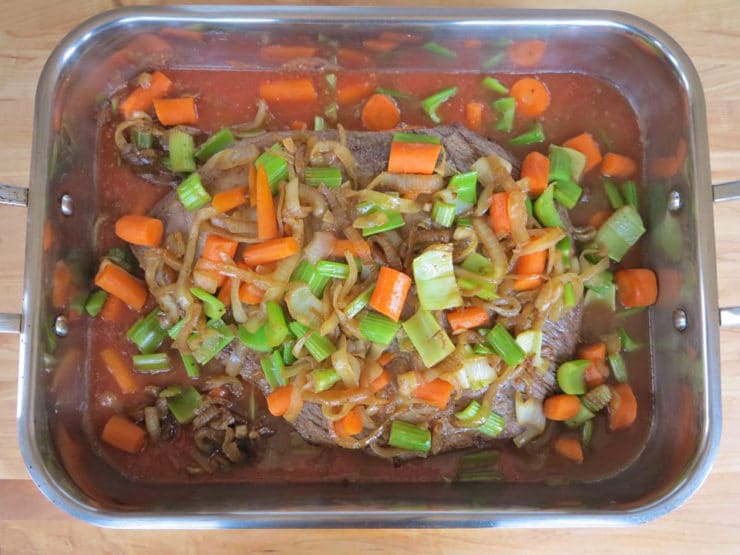
- Pour the sauteed vegetables across the top of the brisket, along with the broth and brown bits.
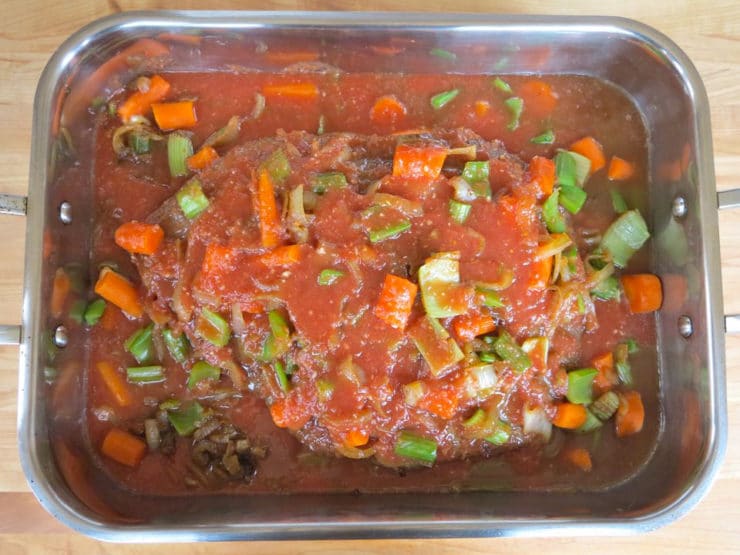
- Pour the remaining tomato sauce over the top of the vegetables and brisket.
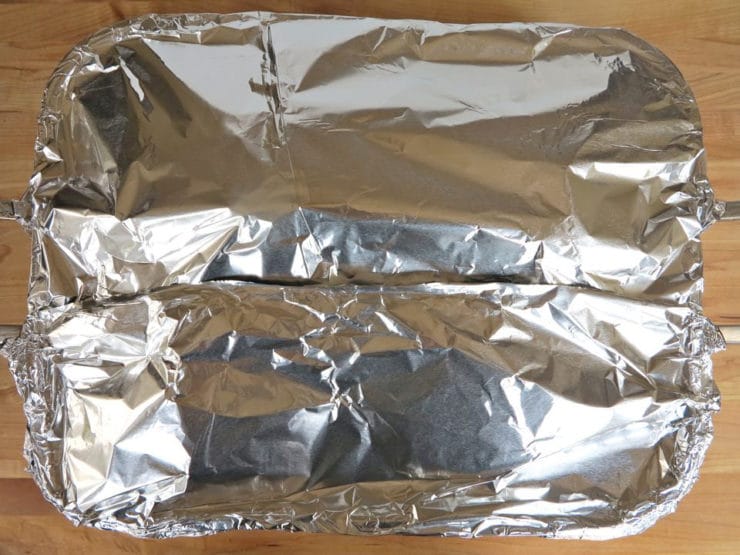
- Cover the roasting pan tightly with a layer of parchment paper followed by a layer of foil. The parchment forms a protective layer between the meat and sauce (which is acidic) and the foil.
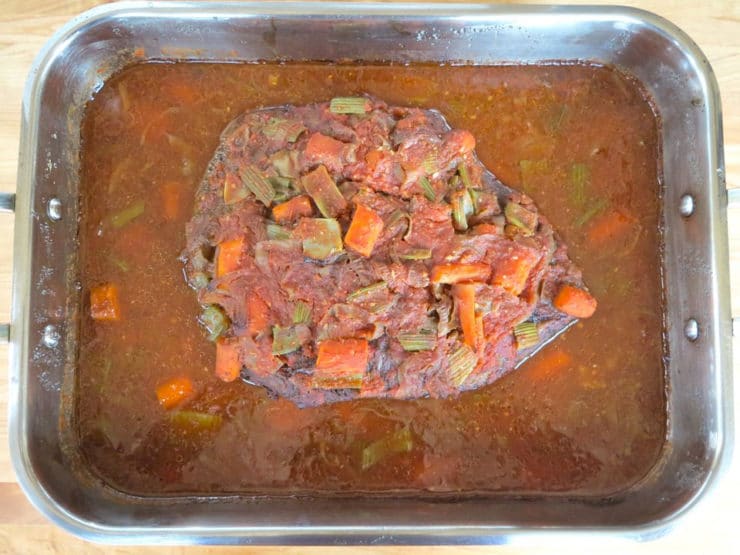
- Place brisket in the oven. Let it roast undisturbed for 5 to 7 hours. It will take about 1 hour per pound of meat (leaner cuts of meat like grass fed may take longer—test for doneness). Brisket is ready when it flakes tenderly when pierced with a fork. You can let it cook even longer for a soft, shredded texture if that’s what you prefer. When fully cooked, the brisket will have shrunk in size.I recommend making this brisket ahead; allowing it to sit in the refrigerator for 1-2 nights will improve the flavor. If you would like to do this, skip ahead to where it says “Make Ahead Directions.” If you are not making ahead, continue reading.
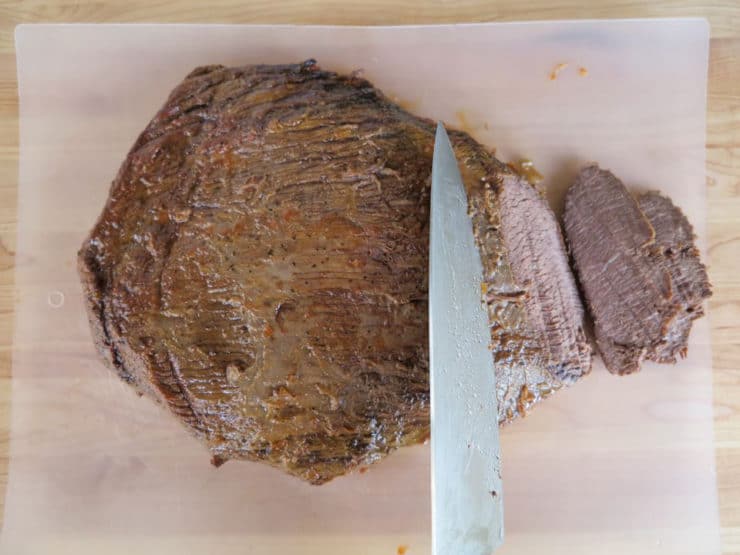
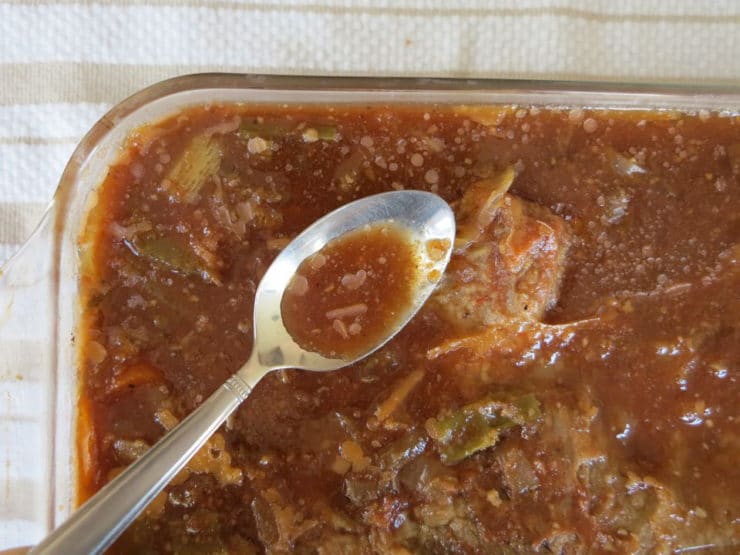
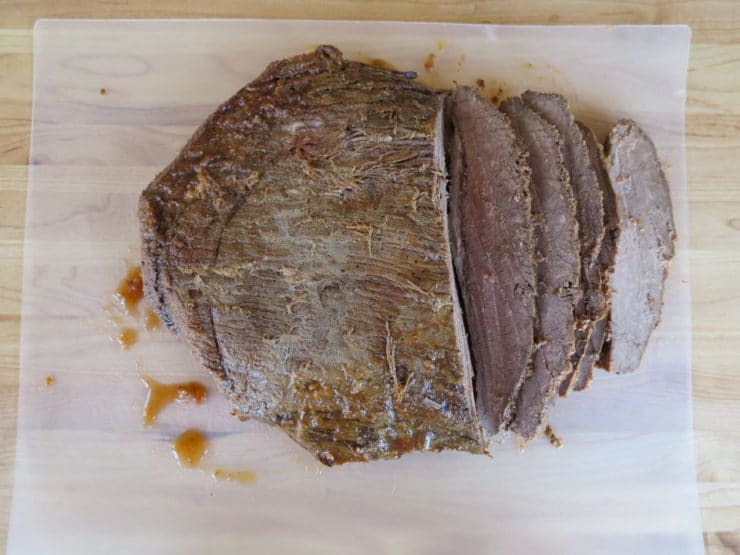
- Remove brisket from the pan and let it rest on the cutting board fat-side up for 20-30 minutes. Meanwhile, pour the sauce and vegetables from the roasting pan into a smaller saucepan. Skim fat from the surface of the cooking sauce, then reheat the sauce till hot (not boiling).Cut fat cap off the brisket, then cut the brisket in thin slices against the grain. Serve topped with hot tomato sauce and softened veggies.
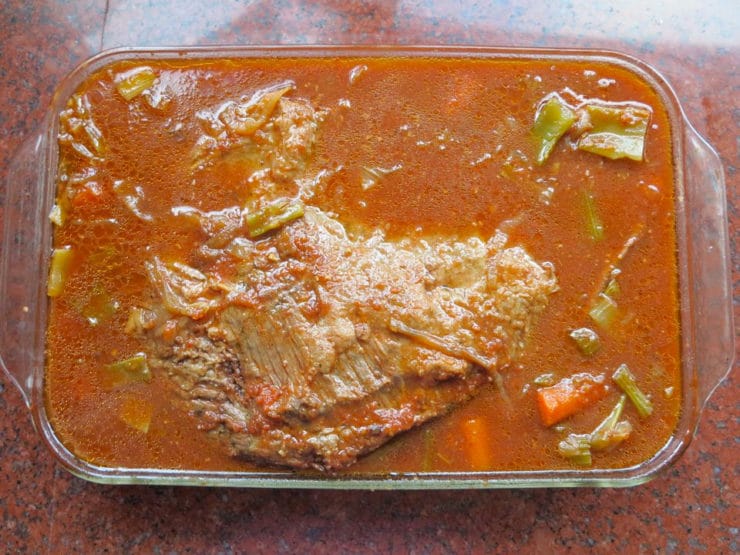
- Make Ahead Directions: Open the foil to vent and let the brisket slowly return to room temperature. Switch the brisket and sauce to a ceramic or glass dish (metal from the roasting pan can react with the acid in the sauce, which can cause an off taste if left to sit). Cover with plastic wrap and place in the refrigerator. Let the brisket chill overnight, or up to two days. You can also freeze the brisket if you prefer.
- 1-2 hours before serving, remove the brisket from the refrigerator and preheat your oven to 350 degrees F. The fat in the sauce will have risen to the top, turned white, and solidified. Use a spoon to scoop the fat bits out of the sauce and discard.
- Take the brisket out of the dish and brush any excess sauce back into the dish. Place brisket on a cutting board, fat-side up. Slice the meat cold—first cut the fat cap off the brisket, then cut the brisket in thin slices against the grain.
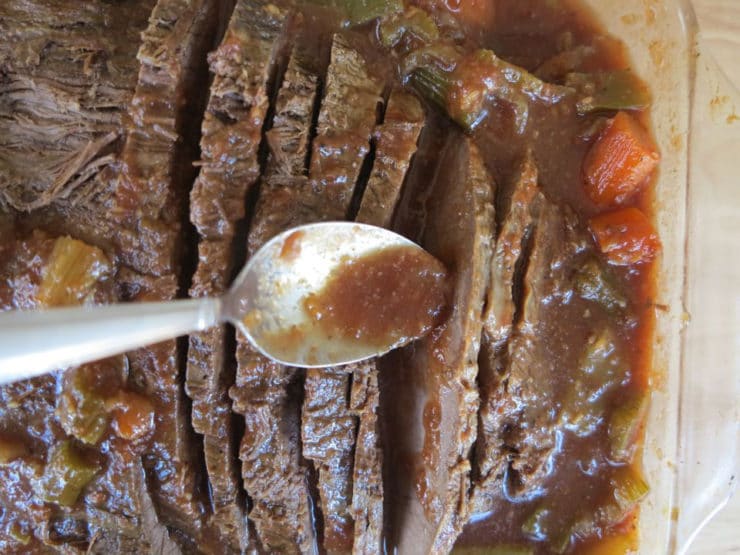
- Return the sliced meat to the dish and spoon sauce over it, making sure to spoon a little sauce between each slice. Cover the dish with a layer of parchment paper, then with foil, and place it in the oven.
- Let the brisket roast for 45-60 minutes until heated through. You can cook the brisket even longer to let it become more tender, if you wish. Serve with hot sauce and softened veggies. If you prefer, you can use a slow cooker to reheat. Set the slow cooker to high heat and cook until heated through, about 1 hour.



NOTES
Nutrition



Hi Tory, I made this for Friday night Seder and it was delish!!! I had a 6 lb brisket that was for 10 people and I thought there would be plenty left over for lunch the next day and i was wrong. We ate the whole thing as it was so incredibly good and tender. My only question is some of the sauce around the edges of the pan were almost burned and although they tasted good still they were incredibly salty. The rest of the near and the veg on the top of the meat didn’t get like that. Any idea as to why that would happen to those bits? I had to cook the meat in 2 pans because British ovens are not very big sadly…
love your recipes!!!
Hi Lynn! Not sure why the sauce thing happened, did you keep it covered while cooking? Oven temps vary and the fact that you used two pans may have contributed to some of the sauce becoming over-done. At any rate, I am pleased you enjoyed the brisket! Hope you are having a wonderful holiday.
I just made your holiday brisket for our seder last night and it was a major hit. 14 pounds of it! Thank you for recipe. The only modification that I made was to use the food processor slicing blade which made very thin vegetables for the sauce. I then took half of the sauce (after it cooked come overnight) and puréed it, and then poured it over the sliced meat and non-puréed sauce. I preheated everything together. The thinly cut veggies kind of melted into the sauce. Best brisket ever.
So happy you enjoyed it Michael! Chag Sameach 🙂
Perfect! I made it following the exactly.
Wonderful Susan! Thanks for writing.
Hi Tori. I am making your holiday brisket (oven recipe) as I type. What is the difference in taste between the slow cooker version and this one? Also, for first night I will make your Kugel so I was wondering if I could reheat your oven brisket in the slow cooker. And if yes, what temp and time? Thanks!!
This one has a hint of sweet and sour taste, and the tomatoes add acid to the sauce. It’s a more tomato-y brisket. The slow cooker version is more savory with Middle Eastern spices. Both are excellent in different ways. Yes, you can reheat the oven brisket in the slow cooker, reheat it on high for 45 minutes-1 hour until heated through and bubbly.
This looks tasty. I’ve heard that its customary to have wine in the passover brisket. Thoughts on adding wine to this?
I’m not sure how “customary” it is. Certainly many families add wine to their brisket, but it’s more a family recipe/flavor preference thing than a Jewish custom or tradition, as far as I know. At any rate, I would not add it to this particular recipe, it will throw off the flavor balance of the sauce. You could add it to my Savory Herb Braised Brisket, if you really wanted wine– it would work better with the balance of flavors there: https://toriavey.com/savory-herb-braised-brisket/
Can you substitute something for the tomatoes? I really hate tomatoes.
Hi Kerry– I highly recommend this recipe if you’re not into tomatoes: https://toriavey.com/savory-slow-cooker-brisket/ You can make it in the oven instead of the crock pot if you prefer.
Hi. I want to make this to freeze ahead but am concerned about the veges getting mooshey if frozen. I have been thinking about maybe half cooking it without the genes and then freeze it, slice it then and then complete the cooking day of with the veges and add potato. What do you recommend? Thank you
I don’t recommend half cooking the brisket. The vegetables will be soft after freezing/reheating. If you want more texture, I would consume or discard the vegetables from the first day of cooking before freezing the brisket. Then roast some fresh veggies with olive oil the day you plan to serve, and incorporate the roasted veggies to the sauce as you reheat the brisket.
Had this for Christmas dinner. It was excellent. It would be nice to have a temperature reference though. Ours was a little too tender, It was hard to slice.
Flavor though was out of this world!
Hi Daniel, glad you enjoyed it. The cook temp is 300 degrees F, it’s the first part of the directions. Did you miss it?
It was our first time roasting a brisket and this recipe was absolutely perfect. The meat was tender and the sauce is perfectly balanced. The directions made it relatively easy to prepare and everyone was very impressed with the finished protect. This brisket will definitely become a tradition, thanks so much for sharing.
By the way, your Challah recipe is also a staple in our house!
Fantastic! Love hearing that, thanks for writing. 🙂
Same on both counts. You’re pretty much where I go for Jewish recipes these days. I’m making my second brisket tonight for my in-laws and will be doing the make-ahead last time, which I did for Hanukkah (with latkes!). I’m excited to see how it turns out compared to the same-day. Thanks for all you do.
So glad you’re enjoying the recipes Adam!
Hoping to make this for holiday dinner. My family doesn’t care for celery. Could I add regular white potatoes or other root vegetables to this in lieu of the celery? I know you said sweet potatoes might clash with the tomatoes in the dish, but regular potatoes should just take on the existing flavors. Please let me know your thoughts! Thank you!
Hi Stacey, the celery isn’t critical. You can just remove it and the recipe will still be great. I wouldn’t use potatoes– they would soak up a lot of the moisture. Without testing it first, I wouldn’t know if there is enough liquid left for cooking the brisket and the other vegetables. It might work, but it might end up very dry. Best just to omit the celery, or double the amount of carrots.
Made this for our family Hanukkah dinner last night. Had to double it for 25 people and it was perfect! EVERYONE loved it. ?
Thank you for the great recipe! I had my whole company over last night for a holiday party and seeing as it’s the middle of Hanukkah, I decided to make brisket for the first time ever- a little nerve racking to make a brand new recipe when having 20 people over for dinner but everyone raved about it.
9 lb brisket, 1.5 times for the sauce and veggies, 8 hours and it was beautiful.
Thank you!!
So happy you enjoyed it Jill!
Hi! This was my first attempt at making a brisket on my own since my mom passed away last Thanksgiving and she always made the brisket. Apparently, I never paid enough attention. I followed the directions for ‘make ahead’ and it seems to have lost most of the liquid? Is there a way to remedy this when i go to reheat it this weekend without losing flavor or completely ruining it? Please help! Your picture looks just how my mom used to make it, my finished product does not. 🙁
Hi Sara! I am so sorry I missed your comment in December, some comments slipped through the cracks during the holidays. If there is too little liquid, I would suggest adding some chicken broth to the sauce to reconstitute.
Hi Torey,
This looks beautiful and I want to try it for Thanksgiving. Can I use this recipe in a slow cooker? Don’t have oven space in my house.
Thanks
Lori
Hi Lori! Sure, it should work fine in a slow cooker. Go ahead and use this recipe as a model for the process, while using the ingredients in the Holiday Brisket instead: https://toriavey.com/toris-kitchen/savory-slow-cooker-brisket/
Hi. Brisket is delicious, but….. I cooked a 6 lbs brisket yesterday and took it out today for carving. Cut against the grain, but the slices fell apart. Basically served chunks/short slices. What went wrong?
Hi Rob, this just means that it cooked too long. Next time try cutting the cook time by 30-60 minutes if you want cleaner slices. Incidentally, my family prefers the tender short slices/chunks… it’s really a matter of preference. 🙂
This recipe if FANTASTIC, I married a Jewish man and had no idea about the wonderful traditions and how cooking is such a large part of the holidays. When my in-laws were hosting the high holiday dinner I asked what I could bring. My father in law said how about the brisket. My mother in law balked at me doing such an important dish, but I said I would do it (I had never cooked brisket before) and found this recipe. Everyone raved! I have made it now two years in a row. THANK YOU!
This is my go-to but I prepare it by browning the meat & onions in my Ninja cooker and then throwing everything else in. I cook it on slow cook high initially for a couple of hours, then switch it to low. When done, I refrigerate the meat separate from the gravy and veggies (and I use my immersion blender for the gravy & veggies so no one actually sees the evil veggies; yes, it changes the consistency but we like to pour the gravy on a potato kugel so … ). When the meat is cold the next day, I slice it and heat it in the gravy. Takes a bit of time and planning but the result is stellar. Thank you and a sweet new year ahead for all.
I’m going to try to cook this today September 29 ,2017 thanks
I get you back ??❤️Lydia
i am cooking with a convection oven.What temperature should i use.
Thank you.
Hi Joyce, Tori’s assistant Ashley here. There are two methods for converting standard oven baking to convection oven backing. One method is to cook at the same temperature for a shorter amount of time and the other is to cook for the same amount of time and decrease the temperature by 25 degrees. Hope this helps!
Chiming in here Joyce – with brisket, always choose the lower, slower option. So in this case I would decrease the temp, not the time.
I had trouble with my brisket. I followed the slow cooker instructions. Then I cooked it more in the oven yesterday prior to serving. The brisket was dry, flavorless, the sauce was thin and never thickened nor did it become rich. Normally I roast brisket the whole way and don’t do the crockpot so maybe that was part of the problem. I can’t tell if it needs more cooking or I overdid it.
Hi Lauren! Sorry to hear this. Did you by chance use a grass fed brisket? Those are quite lean and can take a LONG time to get tender. Even then they can have a drier texture than regular brisket. Next time, if using grass fed, give it a long time to tenderize. As for the sauce, you can always thicken it further using a slurry of cornstarch and cold water.
Do you think it would work well if I followed your recipe but used a slow cooker on low for 7 hours instead of the oven at 300 for 5-7 hours? What do you think?
Please look at this post for slow cooker instructions: https://toriavey.com/toris-kitchen/savory-slow-cooker-brisket/