

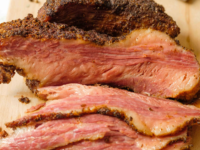
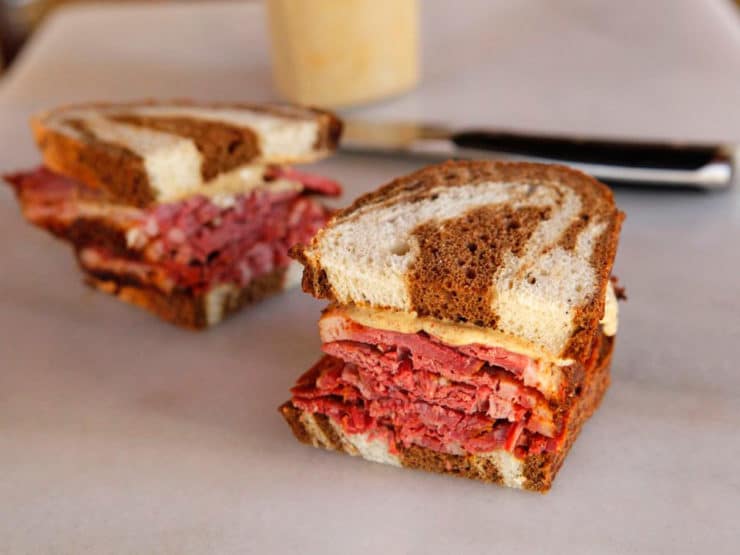
It’s glorious, that first bite of a warm pastrami sandwich on freshly baked rye. If you’ve ever eaten pastrami at a great Jewish deli, you know what I’m talking about. That moist, tender meat topped with spicy mustard is enough to make almost anyone swoon.
When my husband and I took the Queen Mary from London to New York several years ago, we docked at 6:00am and found that we were hungry. Our first stop? Katz’s Deli for a pastrami on rye. It didn’t matter that the sun was barely up. Pastrami is good any time, day or night. When the appetite strikes, you must feed it. Trouble is, many of us don’t live close to a great Jewish deli, and mediocre pastrami can be SO disappointing. What can you do? Make it at home, that’s what!
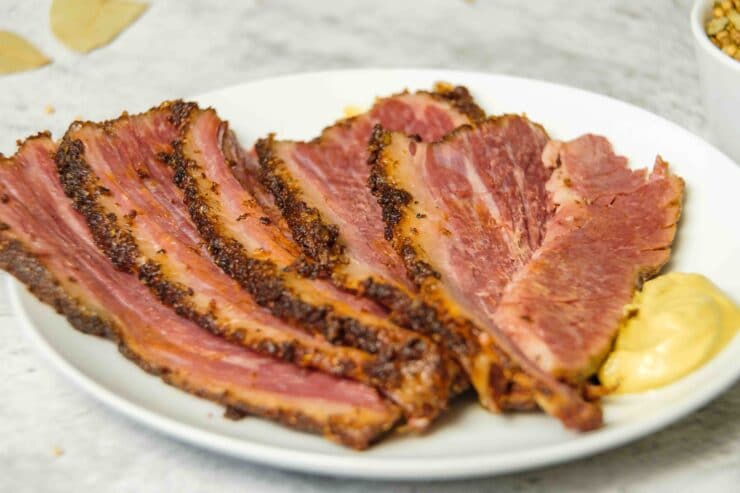
I’ve tried my hand at homemade pastrami several times with varying degrees of success. It wasn’t until a publisher sent me a review copy of The Artisan Jewish Deli at Home that I finally found a recipe worth blogging about.
In their fabulous cookbook, authors Nick Zukin and Michael C. Zusman give workable home kitchen recipes for many Jewish deli favorites. In addition to uncovering the secrets of making these classic recipes at home, Nick and Michael delve into the traditional techniques used in deli kitchens. They also include nostalgic profiles of the most famous deli establishments in North America, including Katz’s in New York and Mile End in Montreal.
Nick Zukin helped to open Kenny & Zuke’s Delicatessen in Portland, one of the first Jewish delicatessens “focused on producing artisanal eats.” Michael C. Zusman is a state court judge who also does freelance food and restaurant writing. His bread recipes are currently used at Kenny & Zuke’s.

Deli-style pastrami emerged in New York during the late 19th century and remains a best seller on most deli menus. Because of its lengthy and laborious process, very few delis still cure and carve their own pastrami. Zukin and Zusman have whittled down the process to a very simple, doable recipe that requires relatively little effort.
After making a simple brine the meat cures in the refrigerator, then it’s rubbed with a spice blend and left to cook in a slow oven for a few hours. According to the authors:
“Delicatessen aficionados might cringe at the idea of making pastrami in the oven, since wood smoking is supposed to be the customary cooking method. At least that’s what they think. In truth, some of the most lauded pastrami and smoked meat involve no wood smoke at all. In his must read chronicle, Save the Deli, David Sax reveals that the smoky flavor in commercially produced pastrami comes from fat dripping down and sizzling on the gas element of the large ovens that are used.”
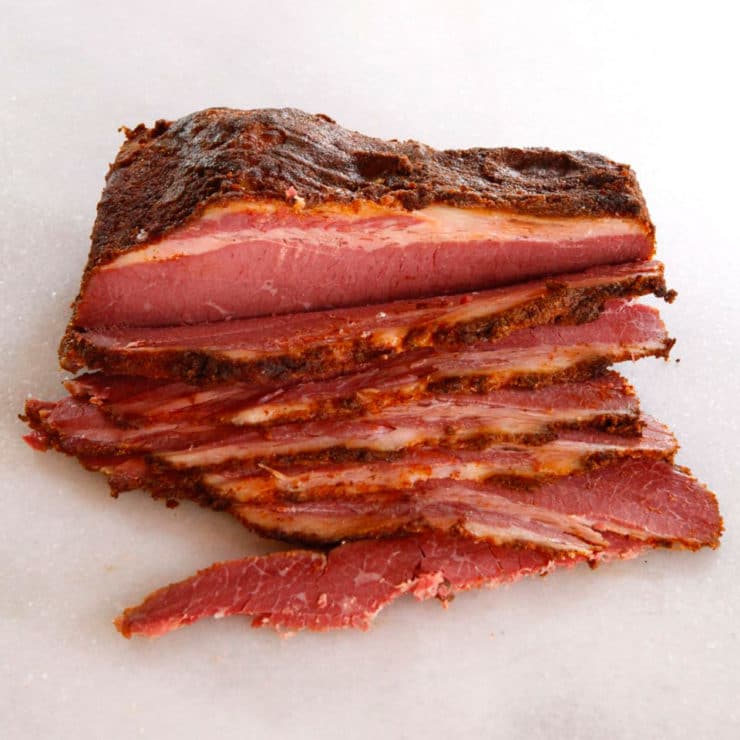
Side note: I love Save the Deli, I actually covered it on the blog a few years back.
To add that smoky flavor to the brisket, Zukin and Zusman use a hefty dose of smoked paprika (one of my favorite spices!). The result is delicious, quality pastrami hot and fresh from your own oven. My house smelled just like a deli while it was cooking. The flavor and texture were delightful– tender and flavorful. I tested the recipe multiple times just to make sure it wasn’t a fluke. It’s not. This is some killer pastrami.
I stayed pretty true to Zukin and Zusman’s recipe, though I did adapt it slightly by cutting back on the salt. My first test round was extremely salty– good for a bite or two, but if I’d eaten a few slices I would have puffed up like a balloon. The next testing round I cut the kosher salt in the brine in half. I thought it might be too much and that I’d have to add some back in, but half the salt actually provided the perfect flavor. My five dinner guests taste-tested it for me, and they all agreed that the lower sodium brine it was plenty salty. So I present the recipe with the kosher salt halved; if you prefer to try it as written in the cookbook, use 2 cups of kosher salt in the brine.
Update: Nick Zukin let me know in the comments that they used Diamond large crystal kosher salt, which has less salt per cup than Morton’s. I didn’t realize that salt content varies from brand to brand. I am updating my recipe instructions to reflect the brand of salt we used. Thanks to Nick for the heads up!
Don’t be daunted by the long prep time, the preparation is actually very simple. Most of the time here is spent on curing the pastrami in the refrigerator. After that it’s no more difficult than roasting a brisket on a rack. The results are totally worth the wait.
I have to hand it to Nick Zukin and Michael Zusman, this is a genius recipe. Their book has a lot of other great recipes for Jewish deli classics including Classic Deli Sandwich Rye, Onion-Poppy Seed Bialys and Cabbage and Smoked Meat Borscht. If you love deli food like I do, check out The Artisan Jewish Deli at Home. You’ll be glad you did!
What’s your favorite place to get a hot pastrami on rye?
Recommended Products:
We are a participant in the Amazon Services LLC Associates Program, an affiliate advertising program designed to provide a means for us to earn fees by linking to Amazon.com and affiliated sites. As an Amazon Associate I earn from qualifying purchases.
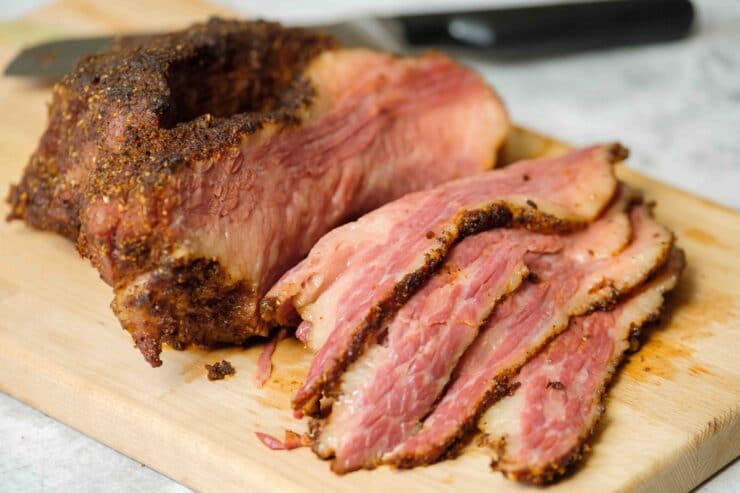
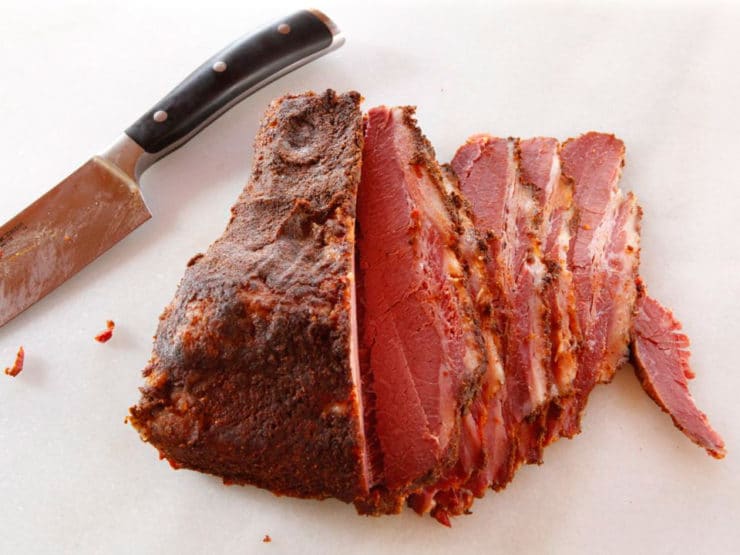
Homemade Pastrami
Ingredients
- 3 quarts water
- 3/4 cup Morton's coarse kosher salt (178 grams) OR 1 1/3 cup Diamond Crystal Kosher Salt (181 grams) - these two brands are NOT interchangeable, the same weight provides two very different cup measurements
- 2 teaspoons pink curing salt (12 grams) - Pink curing salt is also known as Prague Mix #1, Instacure #1 or Curing Salt #1 - NOT Himalayan pink salt. See safety note below.
- 1 cup granulated sugar
- 2 tablespoons pickling spice
- 1 tablespoon whole coriander seeds
- 1 tablespoon whole yellow mustard seeds
- 4 cloves garlic (minced)
- 5 pounds beef brisket
Spice Rub Ingredients
- 1/4 cup ground coriander
- 2 tablespoons freshly ground black pepper
- 2 tablespoons smoked paprika
Instructions
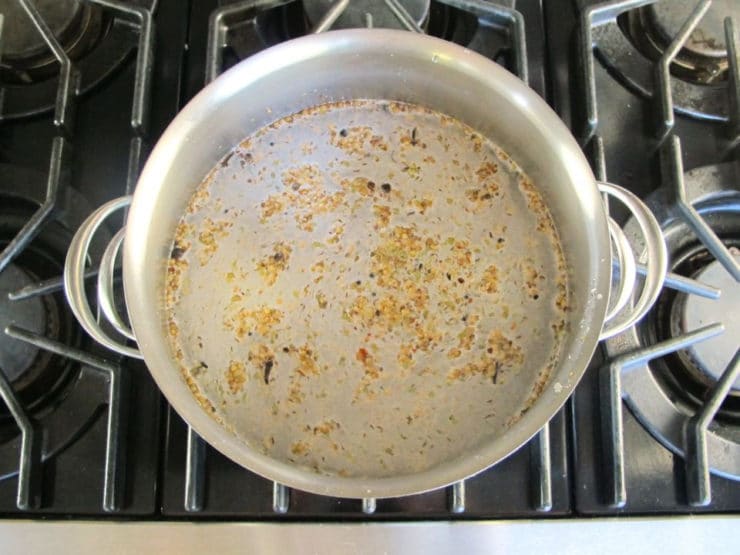
- To make the brine, fill a medium to large stockpot with 3 quarts water. Add the kosher and pink salts, granulated sugar, pickling spice, coriander and mustard seeds, and garlic. Bring to a boil over high heat, stirring often to fully dissolve the salt and sugar in the water. Immediately remove the pot from the heat once the brine boils.Add 3 quarts ice cold water to a 2-gallon or larger food-safe container that will fit in your refrigerator (you can also use a strong sealing 2-gallon marination bag - double bag for extra insurance). Pour the brine into the container and place it uncovered in the refrigerator until completely cool. You can also divide the brine evenly between two separate containers so that it will fit better in the refrigerator.

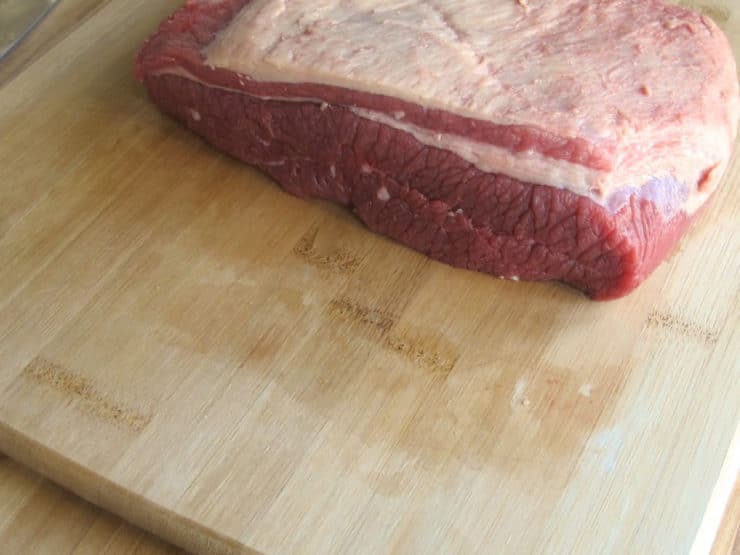
- Trim the fat from the brisket until the fat layer is about 1/4 inch thick.
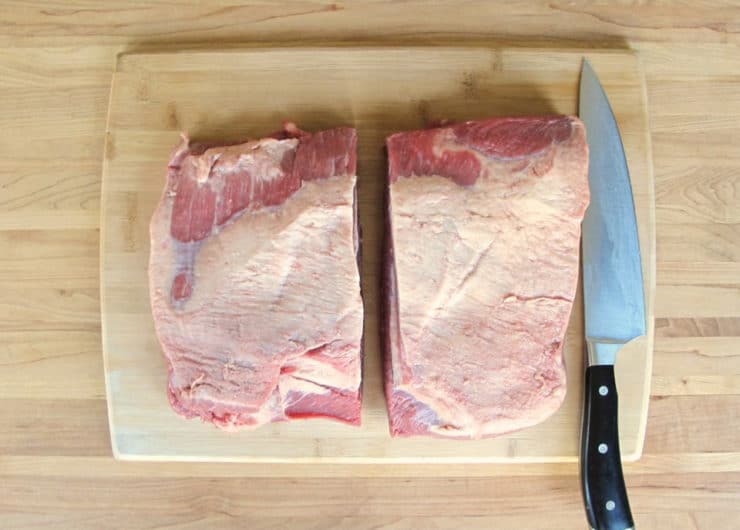
- If necessary, cut the brisket in half so that it will fit into your container(s).

- Submerge the brisket in the cooled brine.Allow the brisket to brine in the refrigerator for 10 to 12 days, flipping it daily top to bottom and stirring the brine. Make sure that if any of the brisket sides are touching one another you regularly turn them away from each other to expose all of the sides to the brine.
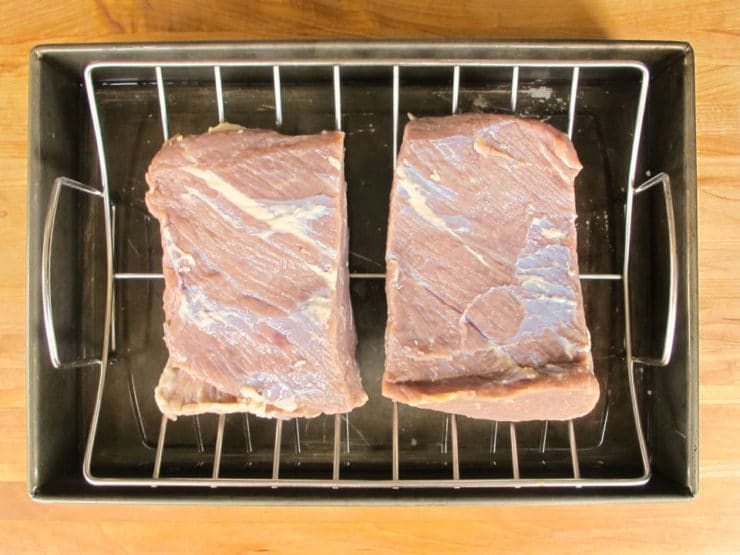
- To cook the brisket, pour 4 cups water into the bottom of a 12 by 15 inch roasting pan. Set a rack inside the pan and place the brisket on the rack, fatty side down.
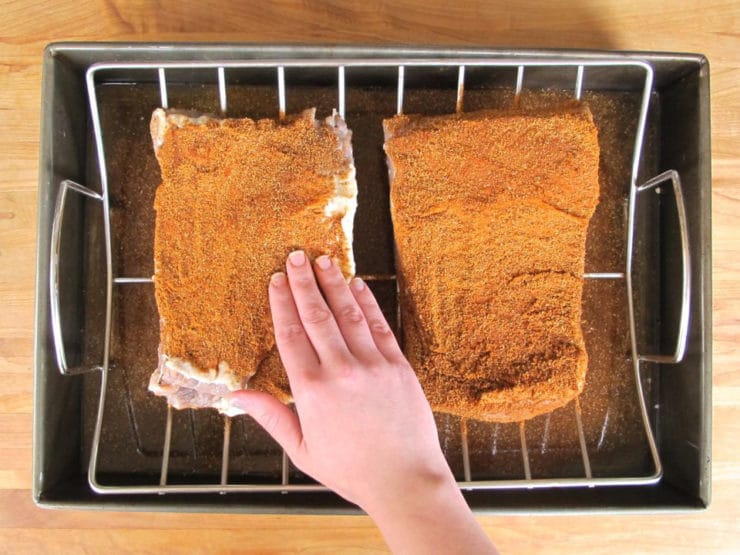
- To make the spice rub, mix together the coriander, pepper and paprika in a small bowl. Evenly rub 1/4 cup of the mixture onto the top of the brisket. Then flip the brisket and rub the remaining spice mixture onto the fatty side. Allow the brisket to come to room temperature, about 2 hours.
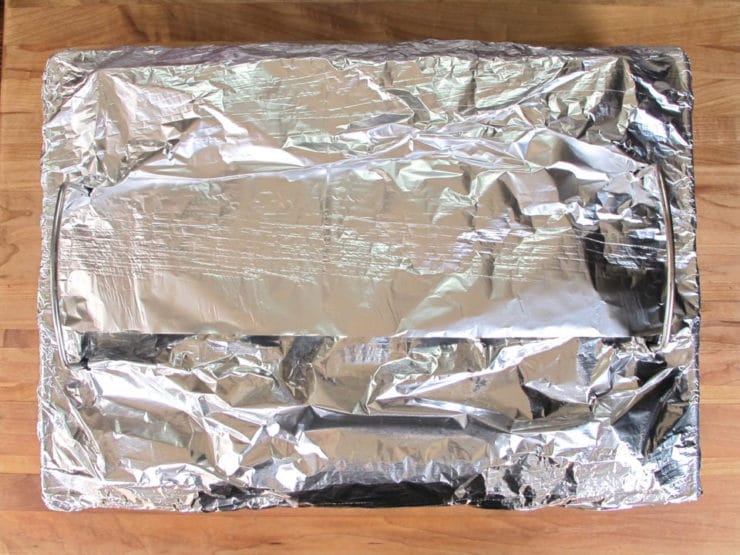
- Preheat the oven to 300 degrees with a rack low enough to fit the pan holding the brisket. Tightly cover the brisket and pan with a double layer of aluminum foil.
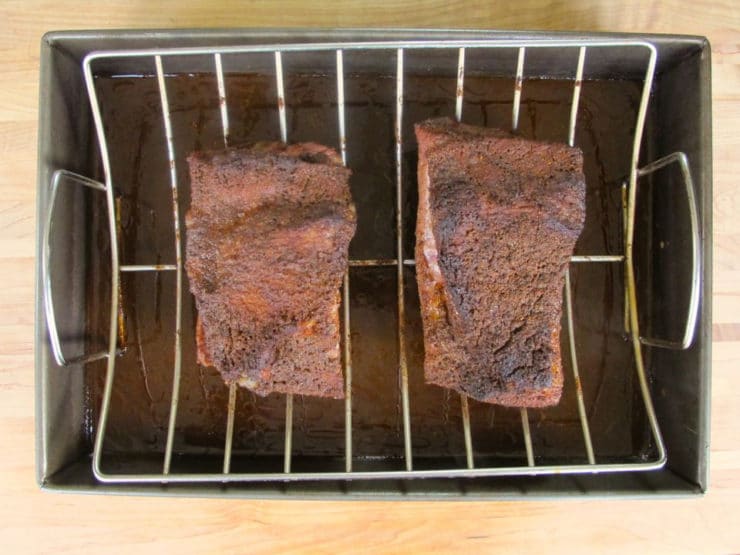
- Bake until the meat reaches an internal temperature of 200 degrees, about 1 hour per pound or 5 hours total. Start checking internal temp at 3 hours and periodically every 20-30 minutes or so to avoid overcooking.
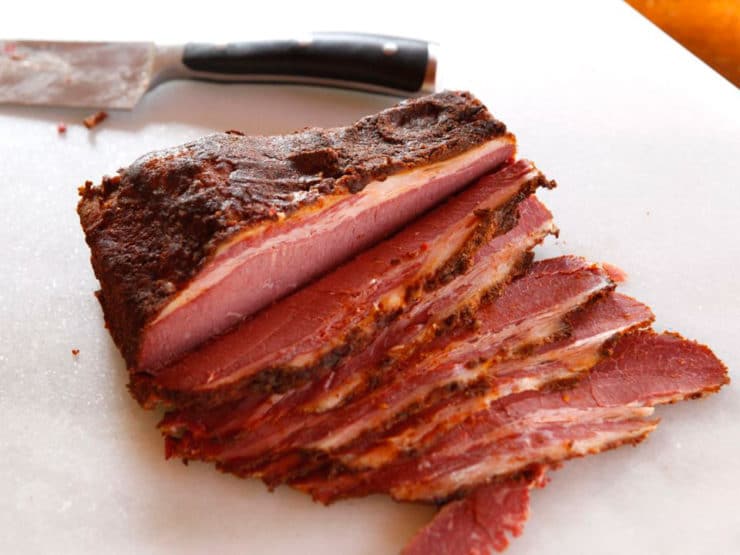
- Without trimming the fat, carve the pastrami into 1/4 inch thick slices, or cut as thin as possible without the meat falling apart. Keep tightly wrapped, or in a sealed container in the fridge, for up to 1 week, or in the freezer for up to 6 months.
- SAFETY NOTE: handle the pink curing salt with care and keep it out of reach of children. It is used in pastrami and other cured meats to kill bacteria, prevent botulism and add flavor. However it is extremely toxic if ingested directly; in fact, it's colored pink to prevent people from mistaking it for regular salt. When used with care in recipes like this, it is very safe and necessary for proper flavor and food safety. That said, you should know the risks and keep the curing salt properly labeled and out of the reach of children.

NOTES
Nutrition

tried this recipe?
Let us know in the comments!

I baked my brisket this morning and brought the result to work today for sampling. It was easily among the best pastrami I’ve had, and everyone that tried it thought it fantastic. Now I have to make another. Thanks!
Fantastic Dave! Glad you enjoyed it as much as I did.
I was under the understanding that pastrami was a smoked product with a dry rub of black pepper. With out either of these you end up with corn beef.
Curt you should read the intro to this post, where your comment is addressed.
Nick and Tori –
I use grain fed kosher beef and place a leaf of iceberg lettuce for moisture when I reheat. Maybe, when baking the pastrami, bake with a lettuce leaf on top?
looks amazing! just quick question- you cook it on the rack but covered? Could I do it in a plain roasting pan instead of a rack?
I tried making this recipe over the week/weekend and it was delicious. The flavour was incredible. I made two briskets, each about 3.5 lbs.
The first one I made according to the recipie, the second I started in the oven and finished in the smoker. There was no noticible difference in taste for the added effort of the smoker.
Two things. One, I could not get the internal temperature of the meat north of 180. 200 seems very high for meat. Do I need to crank up the oven?
Two. The meat came out not as tender as I would have liked. I cut it against the grain. Is the meat supposed to be super tender? Does the getting it to 200 make the difference?
Thanks!
Jared, this may go back to the question I had earlier (and Tori’s answer).
Which cut of brisket did you use? Was it very fatty? While not exactly healthy, that’s one of the keys to the tender moist end-product.
If you weigh the salt, it won’t matter what salt you use, you will always have the same amount. And, the brand is not what makes the cup hold more, or less, salt. It is the size of the grain that determines how much salt is in the cup. So, if you measure the salt by weight (like most of the top chef’s measure flour – weight, not volume), you will achieve consistent results regardless of the brand or grain size. 😉
Meanwhile, I can’t wait to try the recipe!!!
True, but that’s kind of like saying that it’s the patties not the the name Big Mac that makes it bigger. 😉 The two go together. Morton kosher salt consistently has smaller grains of salt than Diamond, just like table salts and pickling salts have smaller grains than kosher salts in general.
Using weight is great. We highly recommend it often in the cookbook. But most home cooks use volumes almost exclusively.
Hope you enjoy the recipe.
Hi Tori….my mom, 89 yrs young, says that when she buys brisket she likes to buy (I think she said) the “point” cut not flat cut. She said that while it’s got a piece of fat running through it it’s actually the fat that makes for a much more juicy piece of meat (though definitely not healthier!).
Have you tried this with different cuts of brisket?
Hi Dave– your mom is correct about fat being the key to a juicy brisket. In my experience the most important thing, no matter what cut you have, is making sure the fat is there throughout the cooking process. A lot of people trim the heck out of their briskets before cooking; this will always result in a dry brisket, because there is no fat there to keep it moist while cooking. Whether using a first cut, second cut or point cut, be sure to keep that fat attached. You can always remove it after the cooking is done (in fact it’s easier after cooking– it’s so soft!). Also I’ve had terrible experiences with grass fed brisket; because it is so lean, it’s really tough to get a good result. While I generally only buy grass fed meat, when it comes to brisket I make an exception.
You should check out this NYT article:
http://www.nytimes.com/2012/09/12/dining/the-tender-second-cut-of-brisket-or-deckle.html
btw, the point has a river of fat that runs between two pieces of the meat. You can actually cut the point into two pieces if you wish along this river of fat and trim it up. 1/8″ to 1/4″ of fat should be plenty to leave to keep it moist. I find this preferable because the “grain” on the point goes in different directions on these two pieces. You’ll also get more even cooking.
I just got a brisket and curing salt from our local butcher and he thought 1/4 c of the curing salt was way too much for 3-4 lbs of meat. Any chance this is a typo? He sold me 1oz of the stuff, which is maybe 1/8 c. Does this seem ok?
Just wanted to say I’ve since looked up a few more recipes for pastrami and everyone of them, that uses curing salt, calls for 1 – 2 tsp of the stuff. Hoping to clarify this before I start the brine…
Hi Dave, it is not a typo. The recipe calls for 1/4 cup curing salt. If Nick checks in with these comments he might be able to comment on this; I don’t generally cure things. All I know is that I used the amount called for in the recipe and it turned out great. 🙂
Use as little as you want. Technically, you don’t have to use any if you’re going to cook it immediately and refrigerate it properly during the curing process. There are several factors that play a part: amount/thickness of the meat, volume of brine, and time to cure. It may very well work fine.
Thanks Tori and Nick! I wanted to use the curing salt as I’ve read it does change the flavor. The butcher just had me worried is all. But after more research, and asking here, I just used the full 1oz package he sold me – which turned out to be nearly 1/4 anyway so I feel good.
Hi Tori,
Can’t wait to make this! I’ve looked for a week to find pink salt. I’m in the west and there just isn’t a big demand for it I guess. I did find it an hour south of me so I won’t be making this for St. Pat’s day but I will soon. My question is about the Coriander seeds. My Pickling Spice seems to be full of Coriander. Should I change up the recipe or use it all? Thanks!
This is a great question for Nick, I’ll let him answer– hopefully he sees it! FYI Lori I have a link to my Amazon store above for pink salt if you prefer to have it shipped to you.
Yep! We really wanted coriander and mustard seed to dominate but still have some of the sweet spice flavors from the pickling spice.
btw, if you can’t find pink salt at a store, try contacting a butcher that makes their own sausage, bacon, or ham. They’ll usually have it and are often willing to sell you some. That’s how I originally started purchasing it.
Amazon will be my last go to…although it’s cheaper than gas! We just don’t have deli’s around here. I tried the meat dept.’s…no go. I found it online at an Italian market a few cities away. I’ll get it at some point and it should last me awhile. I think David L is onto something. His comments about salt weight make a lot of sense and support your original blog comments. I am so ready to try this. I might be making the trip sooner than later. Thanks again for the yumminess! 🙂
Once you’ve had real deli pastrami, the packaged junk just won’t do! Love Kenny & Ziggy’s in Houston TX!!!
Whenever we go back to Long Island to see the “kids” we head to “Pastrami and Friends” in Commack for wonderful Jewish style deli, not available here in Central Florida and sorely missed. I still remember my father taking me to the deli in Brooklyn where we loved digging in to mile high sandwiches with brown mustard and sour pickles straight out of the wooden barrel.
Is there any other spice that may be used instead the coriander?
Thanks
You can use whatever flavorings you wish, but understand that coriander seed, mustard seed, and garlic are the three flavors most associated with Jewish cured beef. This is coriander seed, though, not cilantro. So if you’re worried about that soapy coriander leaf flavor, it’s not that.
If you change the seasoning, just leave the salts and sugars proportions the same for proper curing.
Quick question – do you brine for 5 days in the fridge, or not?
Yes, it should be refrigerated while brining.
Tori
We all have that friend that we are waiting for the announcement of a wedding. I just emailed your recipe to my friend. I told her that if her boyfriend does not set the date after this creation, then dump him for sure!
See what happens 0-)
Fingers crossed for your friend, M! LOL
Oh, my, my goodness.
It seems for days of yore I sought to find a suitable
recipe for the preparation of the fine ‘delicacy’
Pastrami. And, with not a completeness, as the one
above my note, have I found one until now. Tori, thank
you so much. I shall write back in two weeks time
to let you know the outcome. I will be preparing
six, 4 pound, Brisket. One for each of my 5 daughters
and one for the Chef, me, me, me.
Tally Ho,
Geoffrey
Enjoy Geoffrey!
Tory,
I can understand that a commercial eatery would have to use the pink curing salt (sodium nitrate), but why would home cooks have to use this? We would be carefully controlling the temperature of the meat so botulism should not be an issue.
Does it add any special flavor or something else that I’ve missed?
Pink salt also adds a unique flavor to cured meats, it won’t really taste like pastrami without it. More about that on my friend Michael Ruhlman’s blog, scroll down to “The Pink Salt Issue”: http://ruhlman.com/2011/02/meat-curing-safety-issues/
This may be a stupid question, but I want to make sure I’m reading it correctly. You have three quarts of water with the brine and then another three quarts of ice cold water that gets added after the brine is cooked. Is that correct? Sounds amazing!
Hi Ilene– that is correct, the strong brine you cook on the stovetop is stirred into the ice water to make a more diluted brine for the meat. Enjoy!
Can a sugar substitute like Swerve (erythritol and oligosaccharides) be used in place of the sugar?
I also am wondering how this recipe can be adapted to sous vide cooking. Any thoughts?
Hi Barbara, while I haven’t tested it, my gut tells me that using a sugar substitute would not produce a good flavor result here. The sugar is only a part of the brine, though, and most of it gets tossed after the pastrami is finished with brining. As for sous vide, I don’t have a sous vide machine– I tend to stick to the old fashioned way of making things. Maybe another reader will have a suggestion for you. 🙂
Barbara and Tori
The sugar is used to balance out the sharp taste of the salt, as in nova lox.
The pastrami will be baking at 300 degrees, so stevia can be used because it must be used under 325 degrees. Splenda would work, but xlytol might not work because when used in baked items, it will sort of crust it.
We were going to go to Kenny and Zuke’s for pastrami today. Now I don’t have to. Thanks!
I am always thrilled to open my email and discover what yummy things you have to share.
That’s very kind of you Pam, thank you for saying it!