

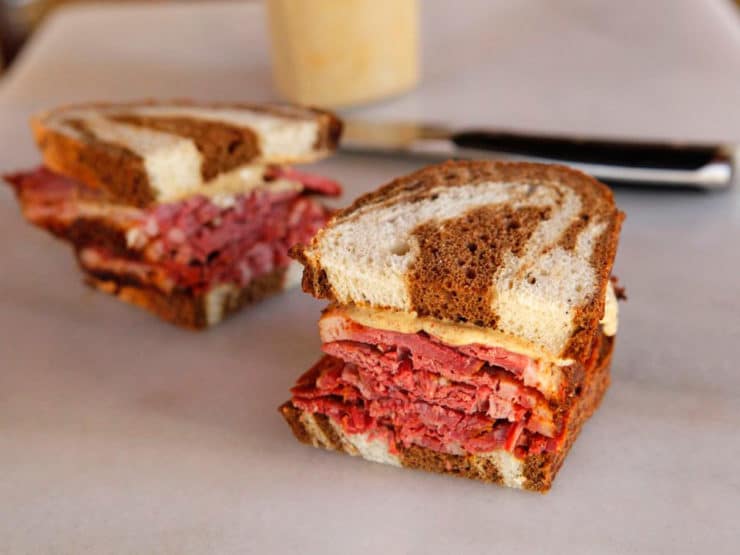
It’s glorious, that first bite of a warm pastrami sandwich on freshly baked rye. If you’ve ever eaten pastrami at a great Jewish deli, you know what I’m talking about. That moist, tender meat topped with spicy mustard is enough to make almost anyone swoon.
When my husband and I took the Queen Mary from London to New York several years ago, we docked at 6:00am and found that we were hungry. Our first stop? Katz’s Deli for a pastrami on rye. It didn’t matter that the sun was barely up. Pastrami is good any time, day or night. When the appetite strikes, you must feed it. Trouble is, many of us don’t live close to a great Jewish deli, and mediocre pastrami can be SO disappointing. What can you do? Make it at home, that’s what!
I’ve tried my hand at homemade pastrami several times with varying degrees of success. It wasn’t until a publisher sent me a review copy of The Artisan Jewish Deli at Home that I finally found a recipe worth blogging about.
In their fabulous cookbook, authors Nick Zukin and Michael C. Zusman give workable home kitchen recipes for many Jewish deli favorites. In addition to uncovering the secrets of making these classic recipes at home, Nick and Michael delve into the traditional techniques used in deli kitchens. They also include nostalgic profiles of the most famous deli establishments in North America, including Katz’s in New York and Mile End in Montreal.
Nick Zukin helped to open Kenny & Zuke’s Delicatessen in Portland, one of the first Jewish delicatessens “focused on producing artisanal eats.” Michael C. Zusman is a state court judge who also does freelance food and restaurant writing. His bread recipes are currently used at Kenny & Zuke’s.

Deli-style pastrami emerged in New York during the late 19th century and remains a best seller on most deli menus. Because of its lengthy and laborious process, very few delis still cure and carve their own pastrami. Zukin and Zusman have whittled down the process to a very simple, doable recipe that requires relatively little effort.
After making a simple brine the meat cures in the refrigerator, then it’s rubbed with a spice blend and left to cook in a slow oven for a few hours. According to the authors:
“Delicatessen aficionados might cringe at the idea of making pastrami in the oven, since wood smoking is supposed to be the customary cooking method. At least that’s what they think. In truth, some of the most lauded pastrami and smoked meat involve no wood smoke at all. In his must read chronicle, Save the Deli, David Sax reveals that the smoky flavor in commercially produced pastrami comes from fat dripping down and sizzling on the gas element of the large ovens that are used.”
Side note: I love Save the Deli, I actually covered it on the blog a few years back.
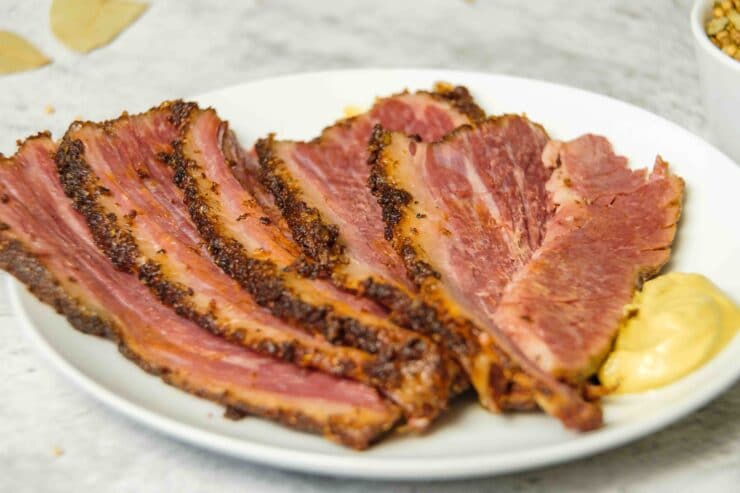
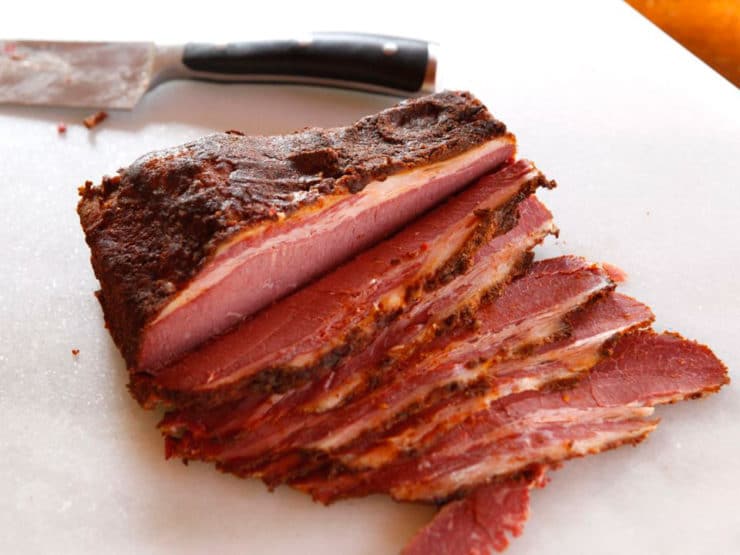
To add that smoky flavor to the brisket, Zukin and Zusman use a hefty dose of smoked paprika (one of my favorite spices!). The result is delicious, quality pastrami hot and fresh from your own oven. My house smelled just like a deli while it was cooking. The flavor and texture were delightful– tender and flavorful. I tested the recipe multiple times just to make sure it wasn’t a fluke. It’s not. This is some killer pastrami.
I stayed pretty true to Zukin and Zusman’s recipe, though I did adapt it slightly by cutting back on the salt. My first test round was extremely salty– good for a bite or two, but if I’d eaten a few slices I would have puffed up like a balloon. The next testing round I cut the kosher salt in the brine in half. I thought it might be too much and that I’d have to add some back in, but half the salt actually provided the perfect flavor. My five dinner guests taste-tested it for me, and they all agreed that the lower sodium brine it was plenty salty. So I present the recipe with the kosher salt halved; if you prefer to try it as written in the cookbook, use 2 cups of kosher salt in the brine.
Update: Nick Zukin let me know in the comments that they used Diamond large crystal kosher salt, which has less salt per cup than Morton’s. I didn’t realize that salt content varies from brand to brand. I am updating my recipe instructions to reflect the brand of salt we used. Thanks to Nick for the heads up!
Don’t be daunted by the long prep time, the preparation is actually very simple. Most of the time here is spent on curing the pastrami in the refrigerator. After that it’s no more difficult than roasting a brisket on a rack. The results are totally worth the wait.
I have to hand it to Nick Zukin and Michael Zusman, this is a genius recipe. Their book has a lot of other great recipes for Jewish deli classics including Classic Deli Sandwich Rye, Onion-Poppy Seed Bialys and Cabbage and Smoked Meat Borscht. If you love deli food like I do, check out The Artisan Jewish Deli at Home. You’ll be glad you did!
What’s your favorite place to get a hot pastrami on rye?
Recommended Products:
We are a participant in the Amazon Services LLC Associates Program, an affiliate advertising program designed to provide a means for us to earn fees by linking to Amazon.com and affiliated sites. As an Amazon Associate I earn from qualifying purchases.
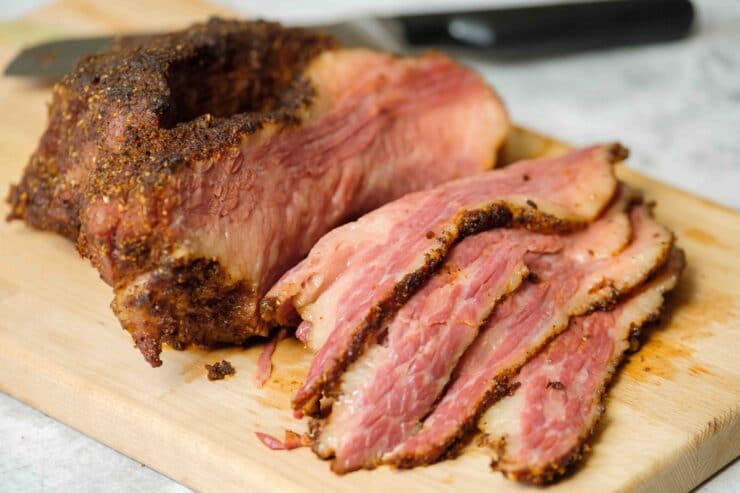
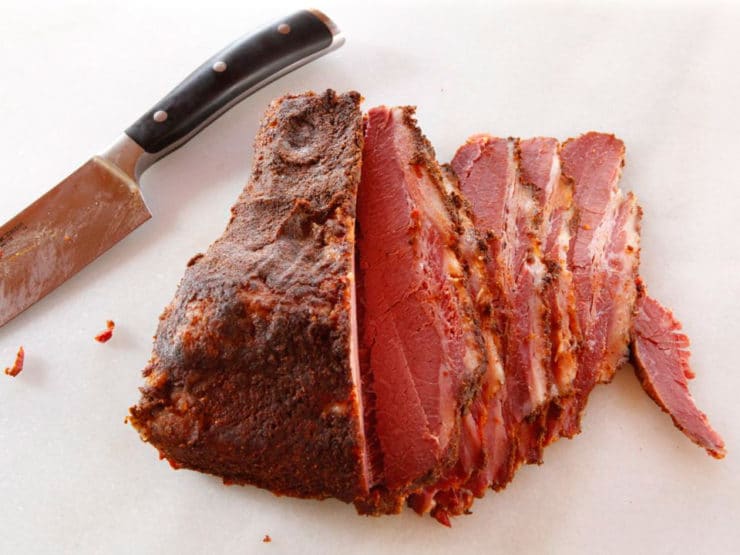
Homemade Pastrami
Ingredients
- 3 quarts water
- 3/4 cup Morton's coarse kosher salt (178 grams) OR 1 1/3 cup Diamond Crystal Kosher Salt (181 grams) - these two brands are NOT interchangeable, the same weight provides two very different cup measurements
- 2 teaspoons pink curing salt (12 grams) - Pink curing salt is also known as Prague Mix #1, Instacure #1 or Curing Salt #1 - NOT Himalayan pink salt. See safety note below.
- 1 cup granulated sugar
- 2 tablespoons pickling spice
- 1 tablespoon whole coriander seeds
- 1 tablespoon whole yellow mustard seeds
- 4 cloves garlic (minced)
- 5 pounds beef brisket
Spice Rub Ingredients
- 1/4 cup ground coriander
- 2 tablespoons freshly ground black pepper
- 2 tablespoons smoked paprika
Instructions
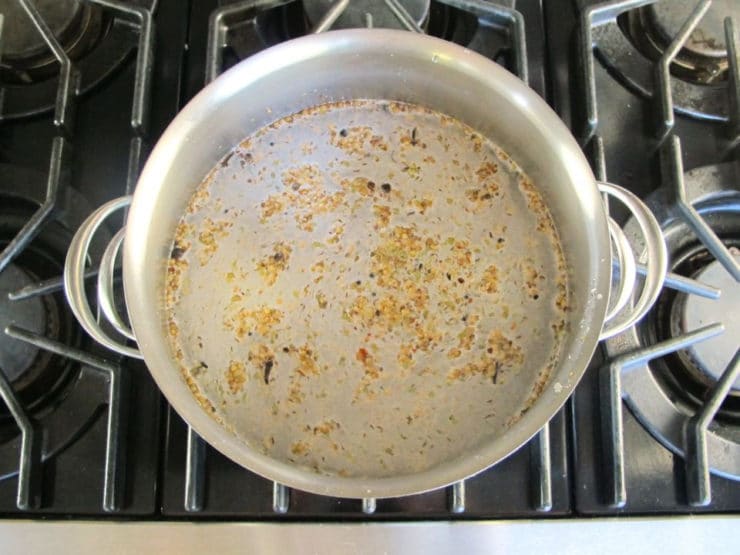
- To make the brine, fill a medium to large stockpot with 3 quarts water. Add the kosher and pink salts, granulated sugar, pickling spice, coriander and mustard seeds, and garlic. Bring to a boil over high heat, stirring often to fully dissolve the salt and sugar in the water. Immediately remove the pot from the heat once the brine boils.Add 3 quarts ice cold water to a 2-gallon or larger food-safe container that will fit in your refrigerator (you can also use a strong sealing 2-gallon marination bag - double bag for extra insurance). Pour the brine into the container and place it uncovered in the refrigerator until completely cool. You can also divide the brine evenly between two separate containers so that it will fit better in the refrigerator.

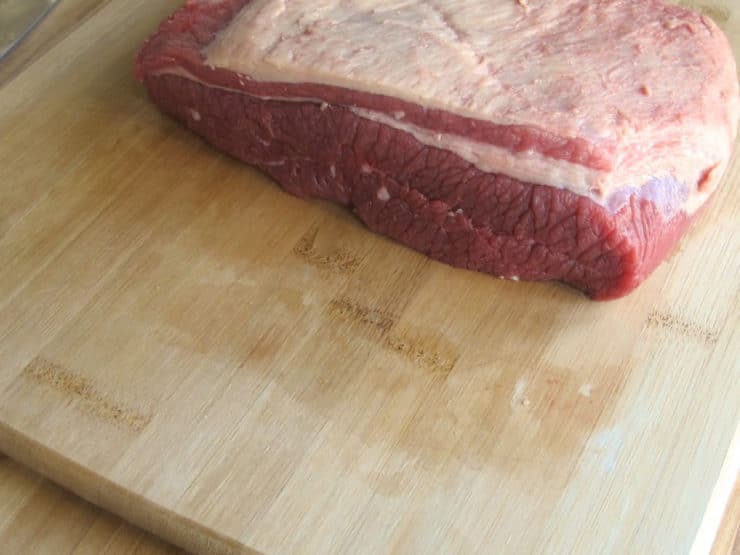
- Trim the fat from the brisket until the fat layer is about 1/4 inch thick.
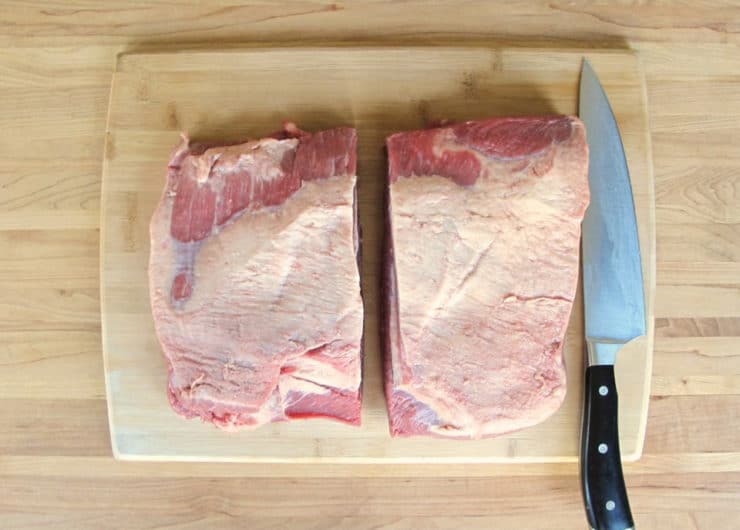
- If necessary, cut the brisket in half so that it will fit into your container(s).

- Submerge the brisket in the cooled brine.Allow the brisket to brine in the refrigerator for 10 to 12 days, flipping it daily top to bottom and stirring the brine. Make sure that if any of the brisket sides are touching one another you regularly turn them away from each other to expose all of the sides to the brine.
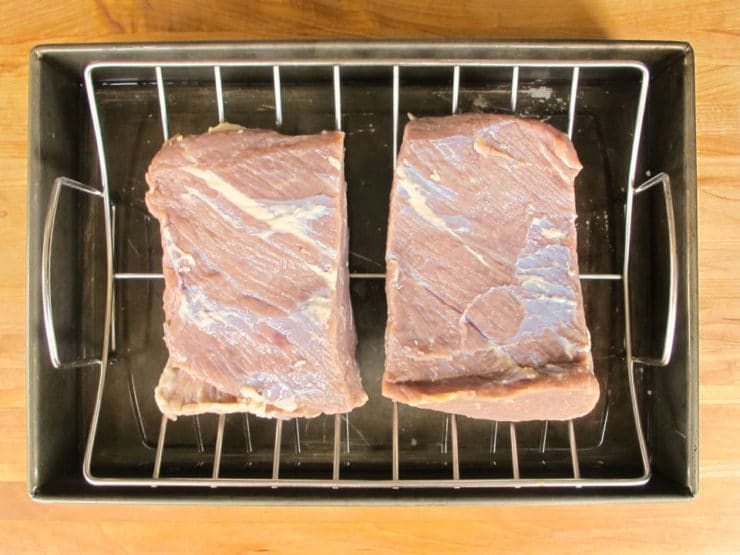
- To cook the brisket, pour 4 cups water into the bottom of a 12 by 15 inch roasting pan. Set a rack inside the pan and place the brisket on the rack, fatty side down.
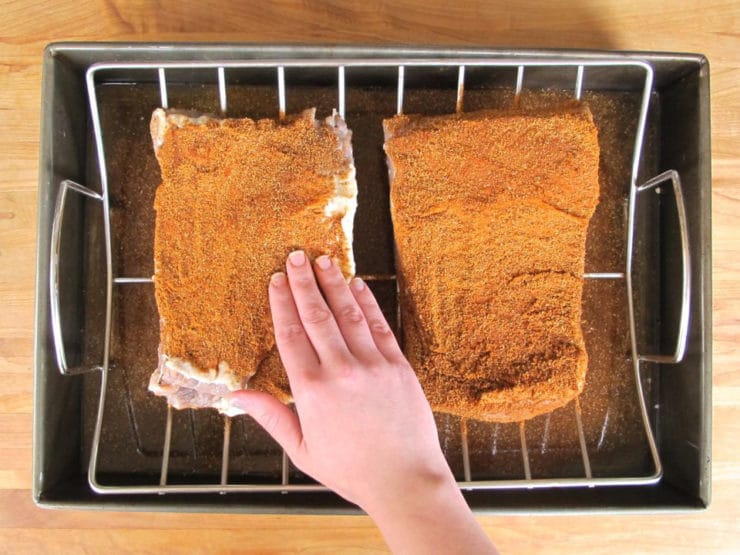
- To make the spice rub, mix together the coriander, pepper and paprika in a small bowl. Evenly rub 1/4 cup of the mixture onto the top of the brisket. Then flip the brisket and rub the remaining spice mixture onto the fatty side. Allow the brisket to come to room temperature, about 2 hours.
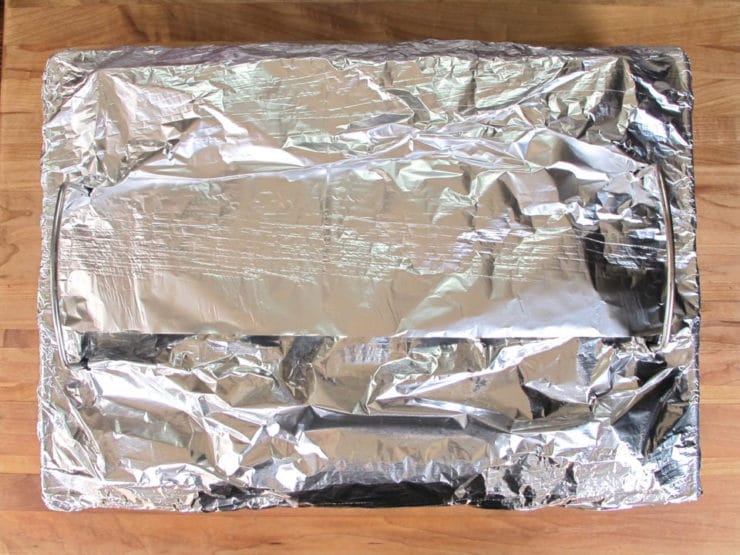
- Preheat the oven to 300 degrees with a rack low enough to fit the pan holding the brisket. Tightly cover the brisket and pan with a double layer of aluminum foil.
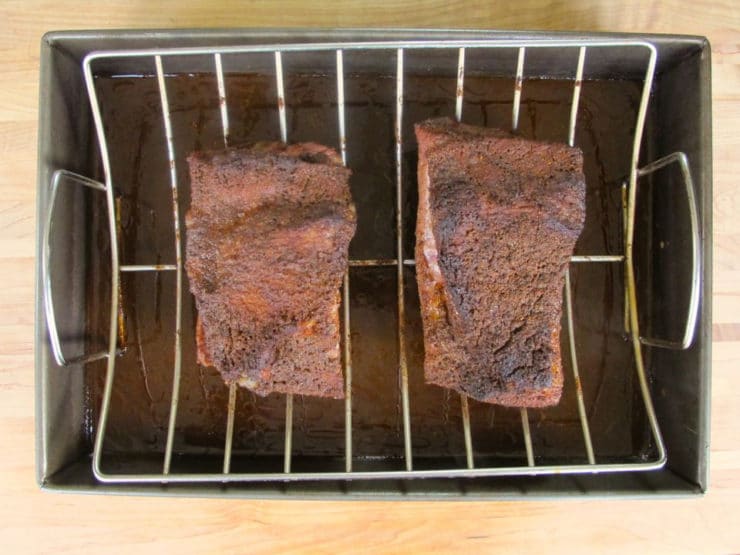
- Bake until the meat reaches an internal temperature of 200 degrees, about 1 hour per pound or 5 hours total. Start checking internal temp at 3 hours and periodically every 20-30 minutes or so to avoid overcooking.
- Without trimming the fat, carve the pastrami into 1/4 inch thick slices, or cut as thin as possible without the meat falling apart. Keep tightly wrapped, or in a sealed container in the fridge, for up to 1 week, or in the freezer for up to 6 months.
- SAFETY NOTE: handle the pink curing salt with care and keep it out of reach of children. It is used in pastrami and other cured meats to kill bacteria, prevent botulism and add flavor. However it is extremely toxic if ingested directly; in fact, it's colored pink to prevent people from mistaking it for regular salt. When used with care in recipes like this, it is very safe and necessary for proper flavor and food safety. That said, you should know the risks and keep the curing salt properly labeled and out of the reach of children.

NOTES
Nutrition

tried this recipe?
Let us know in the comments!

You ask: What’s your favorite place to get a hot pastrami on rye?
Langer’s in Los Angeles! And definitely Katz when we are in NYC.
Seems to me that a lot of people are confused as to what cure is. It is not salt as most people know it. Contains salt and sodium nitrite or sodium nitrate. Prague powder. Either number 1 or 2. Most recipes will use 1. They are Not interchangeable.
When making sausage or dry rub, will usually be about 1 teaspoon per 5 lbs.
For brining cure will be used according to liquid volume. Will look to be a lot. It is diluted in liquid though.
The nitrates or nitrite is what gives us the taste and color we associate with corned beef and pastrami.
Morton’s Tender and some others use more as they contain other ingredients.
Need to follow directions for the cure you are using for safety’s sake.. Hope this helps.
Could you use this recipe for a turkey pastrami
Hi,
If I’m using a 9 lb brisket, should I just double the brine?
Thanks,
I used this recipe this weekend and it turned out great. I used a much larger brisket flat (9 lb), and I used the same brine ingredient quantities that were called for in this recipe (I was scared to double the curing salt in the brine). In hindsite, I probably would have doubled all of the other brine ingredients except for the curing salt.
I brined for 7 days, flipped every other day. When I pulled it out of the brine, the meat had a grayish brownish color, so I was concerned I had done something wrong, but at the end of the day it turned out a beautiful pink color as you’d expect from a nice pastrami. I let it climb up to room temp and let all of the brine drip off (didn’t rinse or pat dry).
I cooked it a little differently than called for in the recipe. I put in electric smoker with hickory chips for about 3 hours. I cooked at 200 degrees with the fat side up so the fat could render down into the brisket. It reached an internal temperature of 150 degrees, then I moved it to the roast pan at 300 degrees in the oven (as the recipe suggested). I think it took about 2.5 hours to get it up to 195 degrees. I removed it from the oven, then let it rest for half hour or so.
I thinly sliced it up, the color looked great! My only real issue was the rub was pretty mushy and most of it came off while slicing. I put the slices on a hot plate, covered in Swiss cheese, served on toasted marbled rye, coarse ground mustard, and a kosher pickle. Phenomenal. Gonna take the rest to a friend and have him slice it using his meat slicer. Probably gonna eat on this for the next month or so!
All in all, fantastic recipe. Highly recommended!
The amount of curing salt stated at 1 Teaspoon per 5 pounds of meat is NOT for a brine cure – rather that is for sausages and a direct dry rub – although a dry rub will require 2 teaspoons for a 3 pound roast – but remember that is rubbed on the outside and then sealed in a bag/flipped for 5 to 6 days – the moisture from the meat creates a semi brine. You will need more because the water effectively dilutes the Nitrite compound.
Greetings from New Zealand!
I made this exactly as directed (mainly just to try), but smoked it in my pellet grill to 205f.
Ran through a meat slicer and it was just OK – probably not worth the hassle/time.
However: I vacuum packed some and left it in the fridge for a couple of days and it was amazing! There’s a hack if you’re playing at home.
I’ll definitely be making it again.
This is an outstanding brine recipe. I coat mine in course black pepper only and smoke it in my electric smoker… PERFECT DELI STYLE PASTRAMI
So just to be clear…you take the meat straight out of the brine to the roasting pan to come to room temperature then you put it in the oven? You don’t rinse or soak it before cooking?
Nope, no rinsing or soaking.
Hi Tori I’ve used Himalayan pink salt instead of pink curing salt or saltpeter. I intend to smoke my brisket to an internal temperature of 230 degrees.. internal temperature And I’m brining it for 10 days in my refrigerator. Do I need to worry about any type of bacteria
Hi Joe, Tori’s assistant Ashley here. Himalayan pink salt is very different from the pink salt used in this recipe. That said, I’m not sure if you’d need to worry about any type of bacteria forming.
Hi, I regularly cure my own corned beef, bacon and ham. I never use the pink salt that they advise, and I have never had any problems. Using the pink curing salt is more for commercial as they deal with more meat.
hi Tori or her assistant…
are you sure about the cooking temerature? 300F isn’t a little too hot?
thanks for answering…
Hi, Tori’s assistant Ashley here. Yes, this temperature is correct as written.
As a champion brisket cook, (barbecue) I advise low heat, low and slow is always the best. No more than 230 degrees, you need to break down the coloegen, which happens at about 185 internal temp. At 190 Remove from oven and rest it for 15 minutes it will be almost 200 by then.
Warren, I too have made many briskets on low heat to help break down collagen but this recipe calls for brining for 5 days which already helps brake down collagen/proteins. So cooking it on 300 will be just fine.
Hi Tori! Cheers from Argentina.
I used regular salt on the water and not a big amount of it. Am I in trouble??
Thanks!
Hi Santiago, Tori’s assistant Ashley here. Did you use regular salt in place of the kosher salt or in place of the pink salt?
Hi, i’ve made it and it tastes great. In the center i didn’t get the typically pink color but the regular brown cooked meat color. Is there anything to do to get the color in the inside? Maybe making some holes in the meat? Thanks
The pink salt is what gives cured meats the pink color.
Your pink salt didn’t seep in properly. It could be caused by a number of things like not enough pink salt in the brine mix, not enough time brineing, you didn’t flip it enough, etc.
Having Problems finding Pink curing salt or Prague powder#1. I live in Nassau County NY, any suggestions or can it be substituted with another product?
Try a quick search on Amazon.
William Sonoma carries it. I’ve swung by my local store in a pinch.
Hi,
I’m in Nassau County too. The spice specialist is fantastic. They are actually a warehouse, mainly selling their spices online, but you can go to the warehouse and get pink curing salt there.
Spice specialist
47 Bloomingdale road, Hicksville NY
Don’t be discouraged by the outside! It’s a hidden gem & everyone working there was extremely helpful!
An awesome recipe! This was our first attempt at cured meat and it turned out lovely! We had quite a large piece of brisket which we brined for about a week (just so we had a day free to cook it!) so kept the brine amount the same as we cut the brisket in half as suggested but increased the rub. We also ran out of smoked paprika so used some regular paprika instead. We cooked it for about 4 hours but left it covered in the oven overnight after turning the oven off. It’s a massive hit in our house and at my husband’s workplace – we will definitely be making this again.
(Serving suggestion – my husband had this pastrami with homemade bagels, American mustard, pickles and Swiss cheese!)
What happens if you brine it longer than 5 days?
I lost track and brined for 7….it’s it still ok?
Don’t worry about it. I have seen brine times as long a two weeks. If you think it is to salty, just soak in cold water for a few hours (6-8) I make my own bacon and at times it turns out to salty and I just soak it to get the salty out.
I just want to say as a disclaimer, I did not use beef brisket. But I did make your pickling spice mix and it gave me the exact flavor I was looking for when I was making my vegan seitan roast. Thank you very much!
I made this last week and OMG it was delicious, call it Pastrami or corned beef (I will call it Pastrami since it doesn’t taste like my corned beef at all) I did reduce the salt because of high blood pressure to about half what the recipe called for and it was still awesome. Right now I have a Brisket in the slow cooker (Your Recipe again) While I am an experienced cook Tori you have saved me a ton of time with your recipes Now that I am middle aged I wish I had known all this 40 years ago when my kids were young…LOL
This is a good corned beef recipe but you need to smoke it for Pastrami. Always rinse your brined meats rather than reducing brining salt. Do reduce sodium nitrate though.
This much Prague Powder is an unneccessary waste. One ounce will cure 25 lbs of meat. For a 3 to 4 lb brisket, not much more than a teaspoon and a half, with the other salt, is necessary.
Can this be made without using the prague powder or salt peter ?
If you do not include the nitrite salt in your brine, the meat will have the grayish brown color common to rany roast. The inclusion of sodium nitrite curing salt accomplishes two very important goals. Firstly, it renders the brined meat safe to smoke at temperatures in the danger zone, ie. between 40-140 degrees Fahrenheit. All meats which will be destined for the smoker must be cured in this way to prevent spores of Clostridium Botulinum from growing and producing their potentially deadly toxin. If it cant be cured, it cant be smoked. Secondly, cured meat has a pretty pink color and a unique flavor which all consumers regard as highly desirable for this product.
I don’t agree with Gary at all. You can certainly smoke foods that haven’t been cured as long as you get them to 140 within 4 hours. You just can’t cold smoke. Maybe that’s what Gary meant.
I brined my brisket without diluting it. Is it safe to cook and eat?