

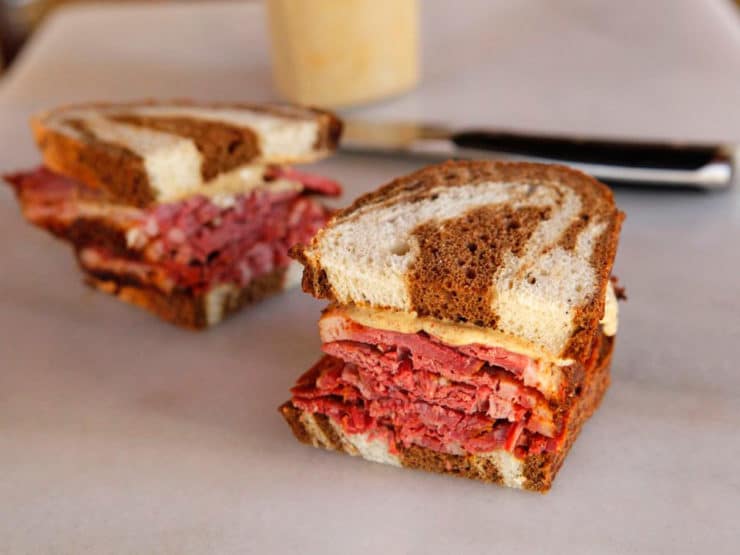
It’s glorious, that first bite of a warm pastrami sandwich on freshly baked rye. If you’ve ever eaten pastrami at a great Jewish deli, you know what I’m talking about. That moist, tender meat topped with spicy mustard is enough to make almost anyone swoon.
When my husband and I took the Queen Mary from London to New York several years ago, we docked at 6:00am and found that we were hungry. Our first stop? Katz’s Deli for a pastrami on rye. It didn’t matter that the sun was barely up. Pastrami is good any time, day or night. When the appetite strikes, you must feed it. Trouble is, many of us don’t live close to a great Jewish deli, and mediocre pastrami can be SO disappointing. What can you do? Make it at home, that’s what!
I’ve tried my hand at homemade pastrami several times with varying degrees of success. It wasn’t until a publisher sent me a review copy of The Artisan Jewish Deli at Home that I finally found a recipe worth blogging about.
In their fabulous cookbook, authors Nick Zukin and Michael C. Zusman give workable home kitchen recipes for many Jewish deli favorites. In addition to uncovering the secrets of making these classic recipes at home, Nick and Michael delve into the traditional techniques used in deli kitchens. They also include nostalgic profiles of the most famous deli establishments in North America, including Katz’s in New York and Mile End in Montreal.
Nick Zukin helped to open Kenny & Zuke’s Delicatessen in Portland, one of the first Jewish delicatessens “focused on producing artisanal eats.” Michael C. Zusman is a state court judge who also does freelance food and restaurant writing. His bread recipes are currently used at Kenny & Zuke’s.

Deli-style pastrami emerged in New York during the late 19th century and remains a best seller on most deli menus. Because of its lengthy and laborious process, very few delis still cure and carve their own pastrami. Zukin and Zusman have whittled down the process to a very simple, doable recipe that requires relatively little effort.
After making a simple brine the meat cures in the refrigerator, then it’s rubbed with a spice blend and left to cook in a slow oven for a few hours. According to the authors:
“Delicatessen aficionados might cringe at the idea of making pastrami in the oven, since wood smoking is supposed to be the customary cooking method. At least that’s what they think. In truth, some of the most lauded pastrami and smoked meat involve no wood smoke at all. In his must read chronicle, Save the Deli, David Sax reveals that the smoky flavor in commercially produced pastrami comes from fat dripping down and sizzling on the gas element of the large ovens that are used.”
Side note: I love Save the Deli, I actually covered it on the blog a few years back.
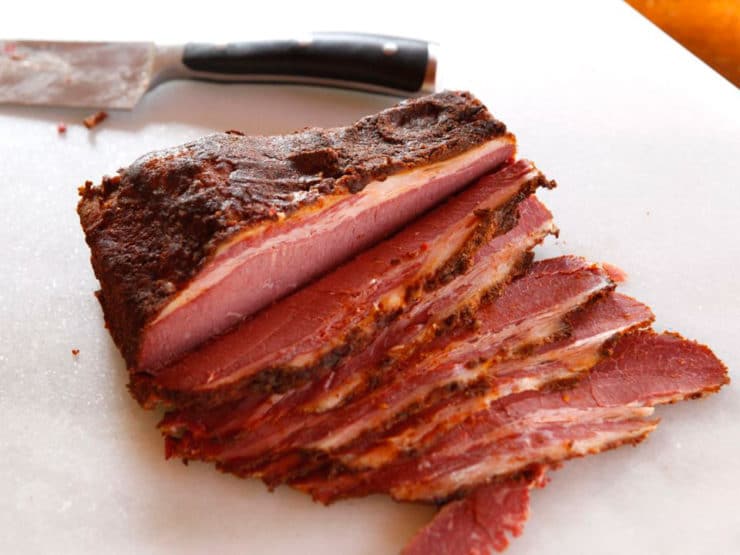
To add that smoky flavor to the brisket, Zukin and Zusman use a hefty dose of smoked paprika (one of my favorite spices!). The result is delicious, quality pastrami hot and fresh from your own oven. My house smelled just like a deli while it was cooking. The flavor and texture were delightful– tender and flavorful. I tested the recipe multiple times just to make sure it wasn’t a fluke. It’s not. This is some killer pastrami.
I stayed pretty true to Zukin and Zusman’s recipe, though I did adapt it slightly by cutting back on the salt. My first test round was extremely salty– good for a bite or two, but if I’d eaten a few slices I would have puffed up like a balloon. The next testing round I cut the kosher salt in the brine in half. I thought it might be too much and that I’d have to add some back in, but half the salt actually provided the perfect flavor. My five dinner guests taste-tested it for me, and they all agreed that the lower sodium brine it was plenty salty. So I present the recipe with the kosher salt halved; if you prefer to try it as written in the cookbook, use 2 cups of kosher salt in the brine.
Update: Nick Zukin let me know in the comments that they used Diamond large crystal kosher salt, which has less salt per cup than Morton’s. I didn’t realize that salt content varies from brand to brand. I am updating my recipe instructions to reflect the brand of salt we used. Thanks to Nick for the heads up!
Don’t be daunted by the long prep time, the preparation is actually very simple. Most of the time here is spent on curing the pastrami in the refrigerator. After that it’s no more difficult than roasting a brisket on a rack. The results are totally worth the wait.
I have to hand it to Nick Zukin and Michael Zusman, this is a genius recipe. Their book has a lot of other great recipes for Jewish deli classics including Classic Deli Sandwich Rye, Onion-Poppy Seed Bialys and Cabbage and Smoked Meat Borscht. If you love deli food like I do, check out The Artisan Jewish Deli at Home. You’ll be glad you did!
What’s your favorite place to get a hot pastrami on rye?
Recommended Products:
We are a participant in the Amazon Services LLC Associates Program, an affiliate advertising program designed to provide a means for us to earn fees by linking to Amazon.com and affiliated sites. As an Amazon Associate I earn from qualifying purchases.
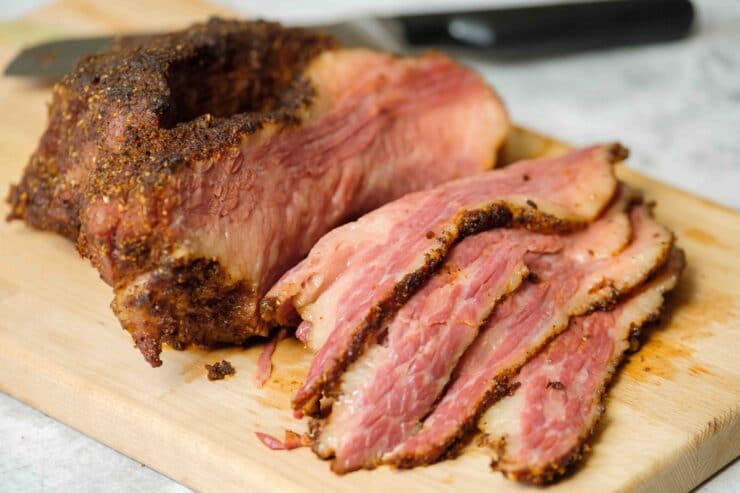
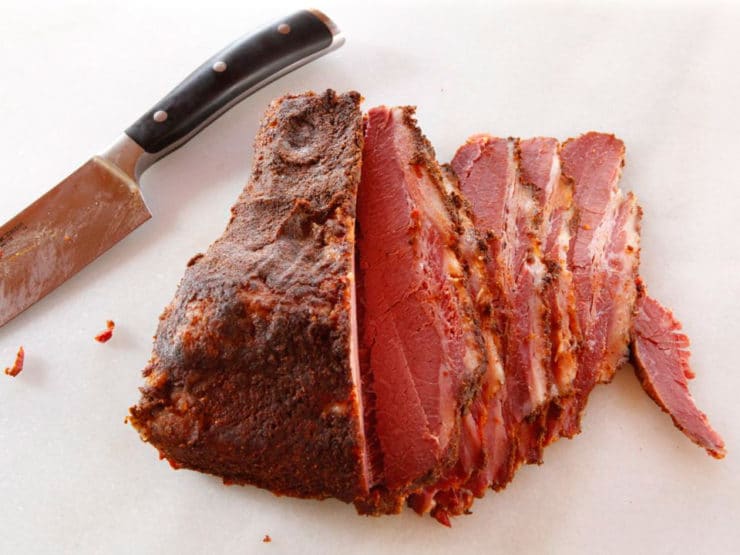
Homemade Pastrami
Ingredients
- 3 quarts water
- 3/4 cup Morton's coarse kosher salt (178 grams) OR 1 1/3 cup Diamond Crystal Kosher Salt (181 grams) - these two brands are NOT interchangeable, the same weight provides two very different cup measurements
- 2 teaspoons pink curing salt (12 grams) - Pink curing salt is also known as Prague Mix #1, Instacure #1 or Curing Salt #1 - NOT Himalayan pink salt. See safety note below.
- 1 cup granulated sugar
- 2 tablespoons pickling spice
- 1 tablespoon whole coriander seeds
- 1 tablespoon whole yellow mustard seeds
- 4 cloves garlic (minced)
- 5 pounds beef brisket
Spice Rub Ingredients
- 1/4 cup ground coriander
- 2 tablespoons freshly ground black pepper
- 2 tablespoons smoked paprika
Instructions
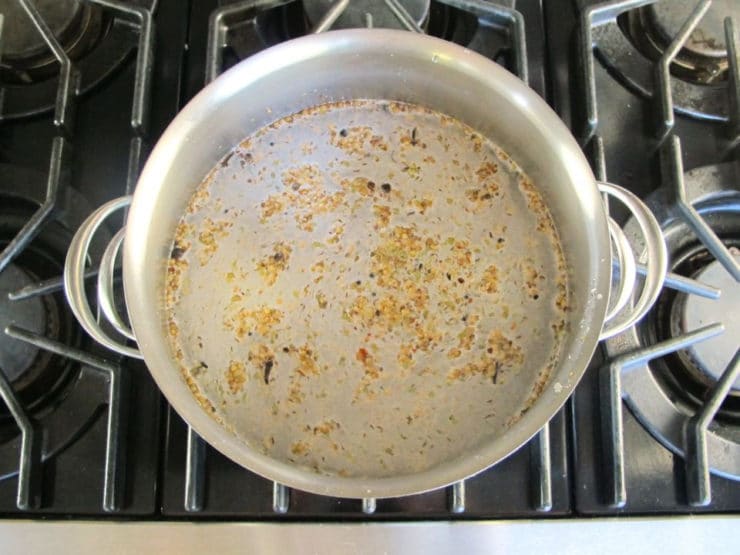
- To make the brine, fill a medium to large stockpot with 3 quarts water. Add the kosher and pink salts, granulated sugar, pickling spice, coriander and mustard seeds, and garlic. Bring to a boil over high heat, stirring often to fully dissolve the salt and sugar in the water. Immediately remove the pot from the heat once the brine boils.Add 3 quarts ice cold water to a 2-gallon or larger food-safe container that will fit in your refrigerator (you can also use a strong sealing 2-gallon marination bag - double bag for extra insurance). Pour the brine into the container and place it uncovered in the refrigerator until completely cool. You can also divide the brine evenly between two separate containers so that it will fit better in the refrigerator.

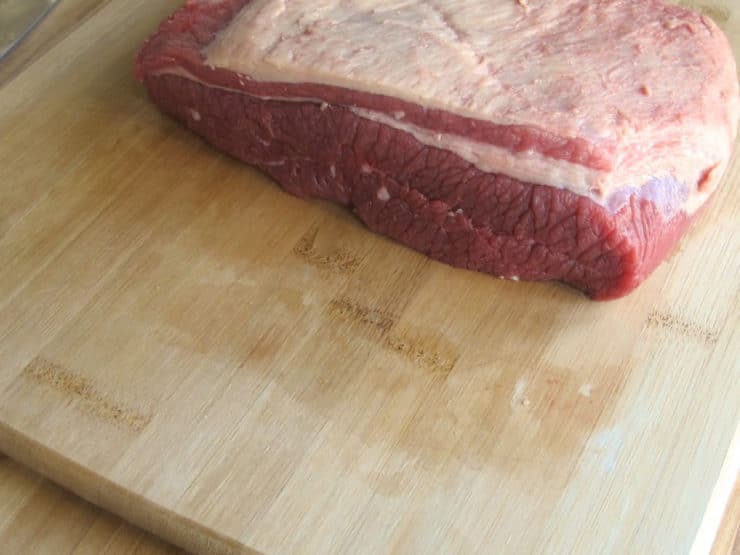
- Trim the fat from the brisket until the fat layer is about 1/4 inch thick.
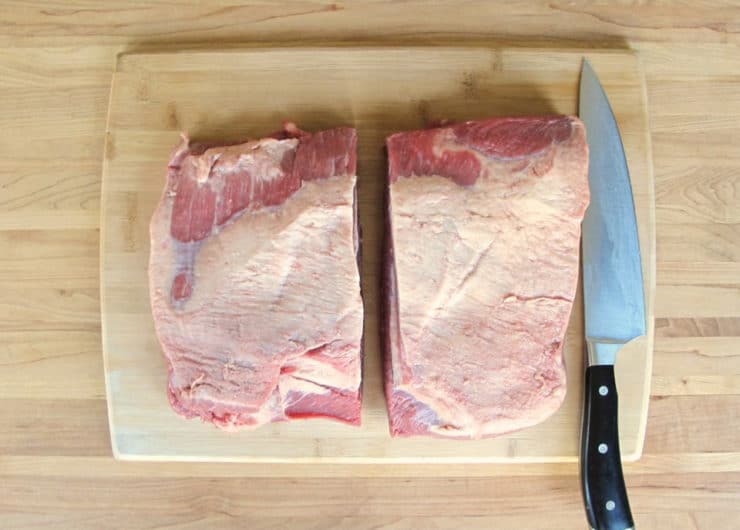
- If necessary, cut the brisket in half so that it will fit into your container(s).

- Submerge the brisket in the cooled brine.Allow the brisket to brine in the refrigerator for 10 to 12 days, flipping it daily top to bottom and stirring the brine. Make sure that if any of the brisket sides are touching one another you regularly turn them away from each other to expose all of the sides to the brine.
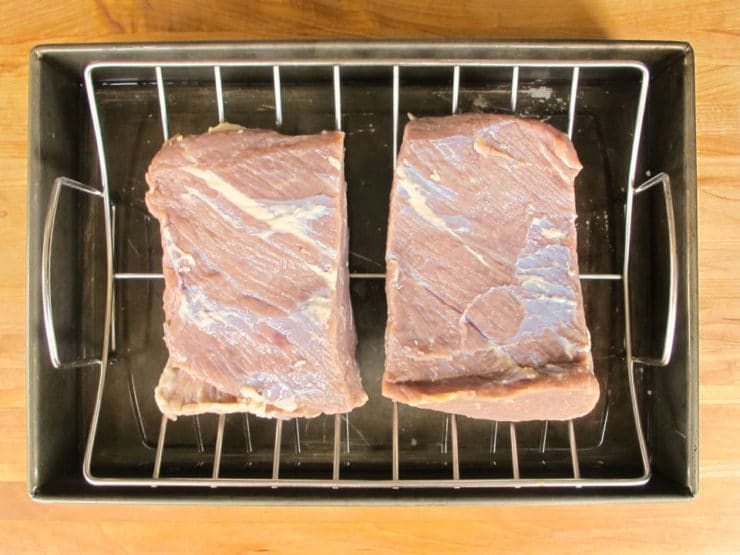
- To cook the brisket, pour 4 cups water into the bottom of a 12 by 15 inch roasting pan. Set a rack inside the pan and place the brisket on the rack, fatty side down.
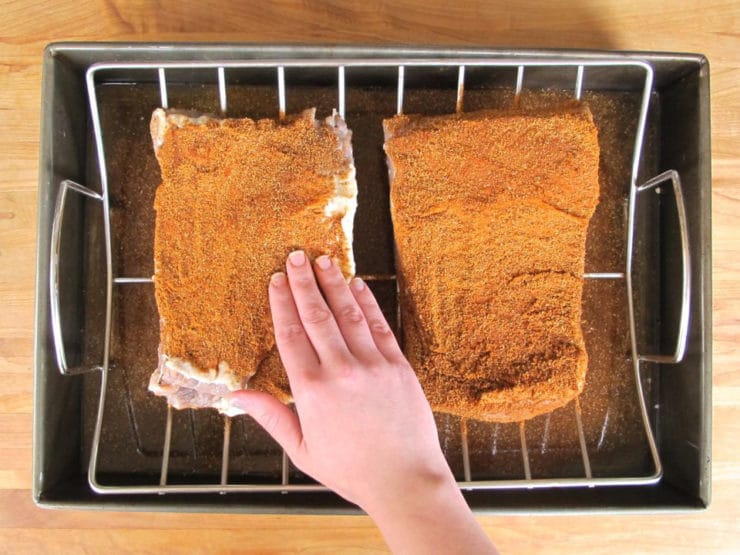
- To make the spice rub, mix together the coriander, pepper and paprika in a small bowl. Evenly rub 1/4 cup of the mixture onto the top of the brisket. Then flip the brisket and rub the remaining spice mixture onto the fatty side. Allow the brisket to come to room temperature, about 2 hours.
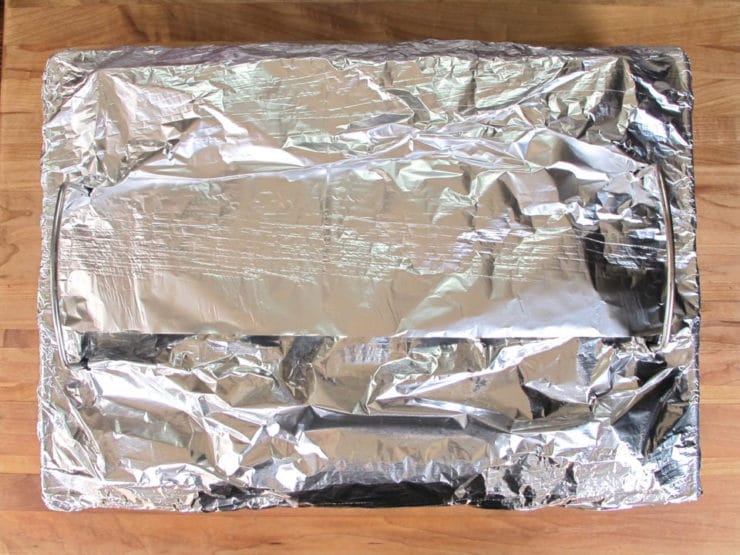
- Preheat the oven to 300 degrees with a rack low enough to fit the pan holding the brisket. Tightly cover the brisket and pan with a double layer of aluminum foil.
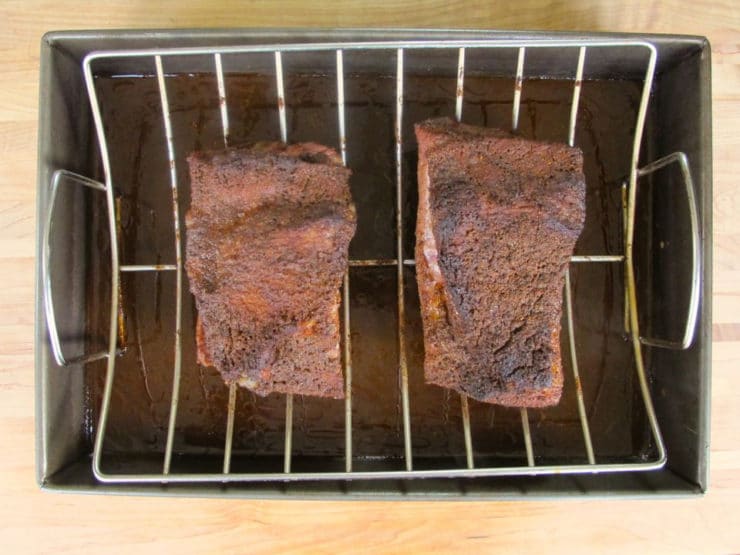
- Bake until the meat reaches an internal temperature of 200 degrees, about 1 hour per pound or 5 hours total. Start checking internal temp at 3 hours and periodically every 20-30 minutes or so to avoid overcooking.
- Without trimming the fat, carve the pastrami into 1/4 inch thick slices, or cut as thin as possible without the meat falling apart. Keep tightly wrapped, or in a sealed container in the fridge, for up to 1 week, or in the freezer for up to 6 months.
- SAFETY NOTE: handle the pink curing salt with care and keep it out of reach of children. It is used in pastrami and other cured meats to kill bacteria, prevent botulism and add flavor. However it is extremely toxic if ingested directly; in fact, it's colored pink to prevent people from mistaking it for regular salt. When used with care in recipes like this, it is very safe and necessary for proper flavor and food safety. That said, you should know the risks and keep the curing salt properly labeled and out of the reach of children.

NOTES
Nutrition

tried this recipe?
Let us know in the comments!

Has anyone brined for 2 weeks instead of 1?
The second time I did this recipe the pastrami was awesome. I like the juicy fat from the pastrami and do not trim them it reminds me of the Jewish Deli in Brooklyn NY that my family used to go to buy pastrami. Thanks for the recipe.
Just making up the brine as I type. Cannot wait to try. Just a few questions….
Do you rinse the meat once you have taken it out of the brine?
When you put it in the fridge can the container have a lid (be sealed)?
Can I make up a bigger batch and save the unused brine for the next week to make another lot?
Thank you
I always keep it covered as it brines. The brine can not safely be reused. The meat absorbs the salt and sugar necessary for corning the beef. Would also loose its flavor. I often brine 2 smaller ones in a large pan. I make sure all the meat is covered. I like doing two: one for plain corned beef and one for pastrami.
Tori, I have been to your site a number of times and appreciate how thorough you are with instructions. I have corned my own beef for years–and used various cuts other than brisket. Is this recipe suitable for an eye of round (one with a sufficient layer of fat)? I have had success with corning eye of round by injecting the cut with brine and extending the brining period. Any thoughts?
Hi Sally– wish I could help you here, but I don’t know the answer to your question. Maybe another reader will!
I’m in the process of making my first pastrami now and researching whether I should steam or not when I came across your recipe. Looks great!
My comment is about the nutritional content, though. I currently follow a keto diet as it has reversed my diabetes. With keto being so popular, can I suggest you research how much sugar remains in the meat during a brine. I believe it is rather small and as a result, your carb content is probably very skewed. Sugar is used in many meats that are cured, like bacon or salami, and leave very little sugar behind.
Thanks for sharing a non steamed recipe. I’m hoping that works out for me!
Hi Caroline, I am not a nutritionist – the nutritional info is auto-calculated based on the ingredients in each recipe. It’s an interesting point though, and for those who are concerned about the sugar content it’s definitely something they should look into!
I have no doubt this probably tastes good. In keeping with the FDA’s 200 ppm limit of soduim nitrate, this recipe would require more like 4.4 tsp (or 24.1 grams) of cure. Feel free to do a search of “FDA limit sodium nitrite” to see for yourself. I shoot below 200 ppm so my rule of thumb is 1 tsp of cure for each 5 lbs of meat plus brine. 6 quarts of water is 12 lbs. add 4 lbs of meat for a total of 16 lbs. I would use 3.2 tsp of cure (or 3.25 or 3.5 tsp depending on what measuring spoons are handy).
Amazingribs has a great explaination of curing with a calculator.
I definitely find value in this page as it has a twist on spices that I will take into consideration on my next pastrami attempt, but I personally will not use 1/4 cup of cure #1. For anybody tinkering with cures, please research and come to your own conclusions on the amount of cure to use. It really does not take much cure to help with food safety and do the pink thing to the meat.
Kevin
Kevin; I have been curing meats for several years and totally agree with your assessment of % of cure to use in this recipe…. I hope Tori will readdress this issue before an actual issue occurs.
Hi guys – this is not my recipe, and I am not a curing expert by any means. I reached out to Nick Zukin, one of the recipe authors, and this is his response:
“Every brine and piece of meat is going to be a bit different… based on the many times I’ve made the recipe and the brisket was not entirely cured and needed to brine an extra day suggests that the absorption rate is slower for our brine… I did a quick calculation. There are about 3 grams of sodium nitrite in the brine. (One-quarter cup of pink salt probably weighs about 50 grams and the nitrites are only 6% of the pink salt, so 3 grams.)… there’s a lot of salt in my brine, 8 times as much as there is pink salt (prague powder #1). That means you’re got about 285 grams of NaCL in the brine and only about 3 grams of NaNO2. Typically, something tastes perfectly seasoned at about 1.5% to 2% salt.That’s what is used for sausages, typically. For 2 kg of meat, that would mean that to reach optimum saltiness of 2%, about 14% of the salts would have to be absorbed and the meat would have about 2% NaCL. If it did that, it would be about 200 ppm NaO2, which is the FDA recommended limit.”
I am adding this to the post above, and hope it clarifies things. At the very least I’m sure it will spark more discussion. 🙂
Wonderful recipe – I’ve made this 5 times with great success! So I’ve acquired a regular syringe (I had to go to several pharmacies because we have a mini opioid epidemic in town) hoping to inject my brisket with liquid smoke while it’s curing in the brine. Has anyone tried injecting things in their brisket? Did it make a difference?
I had an amazing breakfast last year with Pastrami, potatoes and eggs. My goal was to replicate the Patrami. I talked with other foodies, read several recipes and finally decided to use your recipe. After 5 attempts, I had success.
Thanks for the descriptions and many photos.
Due to the size of the briskets, (17 – 22 pounds), I tripled the brining time, rinsed the brisket, rubbed the brisket, smoked the brisket until the internal temperature reached 130°, then placed the brisket in a Dutch Oven until the internal temperature reached 170°.
Thanks again.
Thanks for sharing your tips!
I did this and it was most delicious! This is the best recipe for someone who wants to do it at home with little fuss.
I’m excited to make this recipe! Quick question (and I’m sorry that I couldn’t find if it was asked earlier…): I’m reducing the recipe to make a 2 lbs piece of meat. The calculator on the website reduced the amount of salt, Prague powder, and other spices, but not the amount of water for the brine. Is that correct (meaning I’ll end up with 6 qts of water, or should I make some adjustments? Many thanks!
Water should be adjusted as well, but you’ll need to make sure there is enough water to fully cover the meat with brine.
Tried making twice. Ended up with a brown center both times. Any idea what I’m doing wrong? Thank you!
The curing salt is what keeps the meat pink in the middle, regardless of how long you cook it. I would start there. Make sure you are using real curing salt.
I was wondering if it is okay to rinse off the brine before proceeding with the spice rub. I saw one person said it wasn’t necessary, but I wondered if it compromises the flavor two rinse. We are watching our salt intake. Please comment on if it will compromise the flavor to rinse off the brine. Thank you
Rinsing is fine, it shouldn’t impact the flavor much at all.
Tori
Thanks for sharing a great approach to pastrami. It was tested and came out wonderful.
In a note of (minor) concern – take care in adjusting natural salt amounts in a brining recipie as they are intended to react in tandem with the nitrates during the cure. Having said that – 5 days curing process of 10lbs or less of meat will likely not affect the cure.
Our approach is to vacuume tumble the meat with the brine for 90 minutes and then rest it in the cure for 5 days. We then soak them for 20 minutes in cool water to extract salt (twice if you reall hate salt lol) and then pat dry – season it and head to the smoker or let it rest seasoned in the fridge for 4 hours before hitting the oven. This will help create a better bark on the skin.
We sell a lot of these from our own cattle along with healthy created luncheon cuts.
We are thankful to you for promoting great recipes that reflect on quality food that can be from beef.
Great recipie for sure.
When smoking the pastrami, what temp do smoke at, what wood do you use and what is you finishing internal temp?
Mike! I smoke at around 200-225 defrees until the internal temp reaches about 130. Then to the steam until you’re 165-170 degrees in the middle. I use the lighter cherry or apple woods for smoking these as I’m just looking for a smoked flavor. The paprika should be the star of the show on the crust and a Hickory or mesquite could overpower that. Hope this helps!
this recipe requires 6 quarts of water or 3 ? better to make it all at once if pot size and fridge space not an issue ??
The ice cold water is added to the brine to make 6 quarts total. It is done this way to cool down the cooked brine quickly. It should all be in one container.
How are there 27 grams of carbs in the pastrami? 2.5 oz of pastrami is about 0.3 grams of carbs.
Hi Jon, the nutrition calculations are auto-calculated and take all ingredients into account, including all of the sugar in the brine. The majority of this sugar is washed away/tossed out with the brine. I am not sure how to calculate the actual totals once the brine is removed. Sorry!
This recipe sounds great, and achievable for the home cook. I also appreciate the Metric conversion button as imperial measurements are indecipherable to me as an Australian. Unfortunately the ‘3 quarts water’ still appears in the Metric section, but a quick search reveals a quart is about 950 millilitres (just short of 1 litre).
Now I just have to try and ignore the 298% of daily salt allowance per serve while I enjoy my pastrami!
Thanks again!
Hi Mick, the nutrition calculations are auto-created and take all ingredients into account. The majority of the salt is washed away with the brine. Clearly pastrami is salty, but not THAT salty. 🙂
Thank you for taking away the fear of making my own pastrami. At 12.00 dollars or more a pound buying Pastrami was a rare treat. Now I can buy brisket on sale and make my own. I can hardly wait!!!
It is generally recommended that Cure #1 (Prague powder, pink salt) be added to a wet brine AFTER the brine has cooled to room temp as heat lessons the effectiveness of the cure. (See “Charcuterie” by Ruhlman & Polcyn).
Good looking recipe and I will try it using a tri-tip cut.
How did the tri tip work?
I make this every time I get my hands on a large piece of beef (Eid was just a few weeks ago so a third of a cow?!), and I’m currently on my 5th in as many weeks. Beautiful, beautiful recipe.
If, for some reason, your brisket (or large piece of boneless beef that may or may not be brisket) is still not tender after 6 hours in the oven, I highly recommend putting the boeuf in a pyrex or casserole with an inch of water, cover, and put back in the oven at the low temp it was steaming at before. Maybe it’s the direct contact with water that helps thinks along. The rub does not come off but the end result is incredibly tender.
Great recipe Tori, you’re a national treasure.
SS, you are too kind. All credit here goes to Zukin and Zusman, and The Artisan Jewish Deli at Home.
Hi im from the uk ive followed your recipe but is 1 quart equal 4 cups as ive followed your recipe ive brought my brine to the bowl with 12 cups of water and let cool to pour over my brisket is thiz ok to do as i thought it was alot of pink curing salt.
1 quart equals 4 US cups– not sure if you are using US measuring cups or not. On the recipe you can click Metric (on the brown box below ingredients) and it will automatically convert all of the ingredients to metric. Hope that helps!