

When Jacob had cooked stew, Esau came in from the field and he was famished; and Esau said to Jacob, “Please let me have a swallow of that red stuff there, for I am famished”… But Jacob said, “First sell me your birthright.”
Esau said, “Behold, I am about to die; so of what use then is the birthright to me?” And Jacob said, “First swear to me”; so he swore to him, and sold his birthright to Jacob.
Then Jacob gave Esau bread and lentil stew; and he ate and drank, and rose and went on his way. Thus Esau despised his birthright.
– Genesis 25:29-34
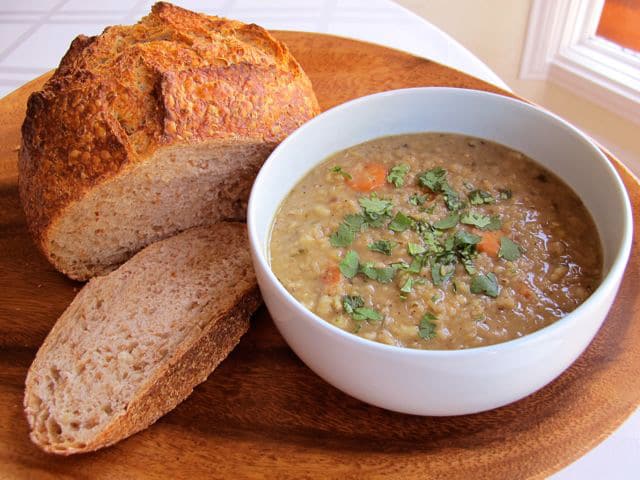
I’m always intrigued by references to food in the Torah, and this passage is one of my favorites. In the passage, Esau sells his birthright to his younger brother Jacob for a bowl of lentil stew.
I’ve often wondered how this stew tasted– it must have smelled delicious for Esau to consider selling his birthright. In ancient times, the birthright was a sacred position belonging to the firstborn. The family name and titles were passed along to the eldest son, as well as the largest portion of the family’s inheritance.
In the case of Esau and Jacob, birthright was particularly significant, since the holder of the birthright was next in line to carry on the family lineage of the patriarch Abraham. Yet Esau sells his valuable birthright to his brother Jacob for a simple bowl of lentil stew. Either Esau was truly famished, or that must have been some stew!

Esau Sells His Birthright by Hendrick Terbrugghen ca. 1625 Source: Wikimedia Commons
This week, I set about recreating Jacob’s famous lentil stew using ingredients and spices that were cultivated during Biblical times. The result is a delicious and comforting stew recipe that you can enjoy at home! I doubt I’d sell my birthright for it, but it’s pretty darn tasty. 🙂
In Jewish tradition, it is said that the lentil stew Jacob cooked was meant for his father Isaac, who was mourning the death of his father Abraham (Jacob and Esau’s grandfather). Lentils are a traditional mourner’s meal for the Jews.
In The Legends of the Jews, Volume 1, Rabbi Louis Ginzberg explains why:
…the round lentil symbolizes death: as the lentil rolls, so death, sorrow, and mourning constantly roll about among men, from one to the other.
Lentils and barley were particularly important in the Biblical diet. In Eat and Be Satisfied – A Social History of Jewish Food, author John Cooper speaks of the importance of lentils in the ancient Israelite diet, as well as how they were cooked:
Bread was in the biblical phrase the staff of life, but next in importance in the diet of the biblical age was pulse, such as lentils, beans, and peas, which could be made into a pottage or used to supplement bread in a variety of ways… Lentils, which are mentioned four times in the Bible, appear to have been domesticated in the Near East, where carbonized seeds have been discovered dating from 7000 or 6000 B.C.E….
During the Israelite period, cooking pots were made of earthenware and were placed on clay stands built in a horseshoe shape, the opening being used to light the fire under the pot, or food was cooked in pots and suspended from tripods. Both stews (nezid) and soups (marak) of pulse and other vegetables were prepared in these vessels, while garlic and onions were probably used in a similar way by the Babylonians to add flavor to the resulting dish.
Barley was a staple food in the diet of the ancient Israelites. During my visit to Israel last summer, I met with ancient foods expert Dr. Tova Dickstein at Neot Kedumim Biblical Landscape Reserve. She explained to me that barley was the chief grain cultivated in Biblical times, and was eaten more frequently than wheat.
Barley was ground and made into bread or cooked into stews. I’ve added a bit of barley to thicken Jacob’s stew and make it a complete protein source, but it you prefer a more soup-like consistency you can leave it out.
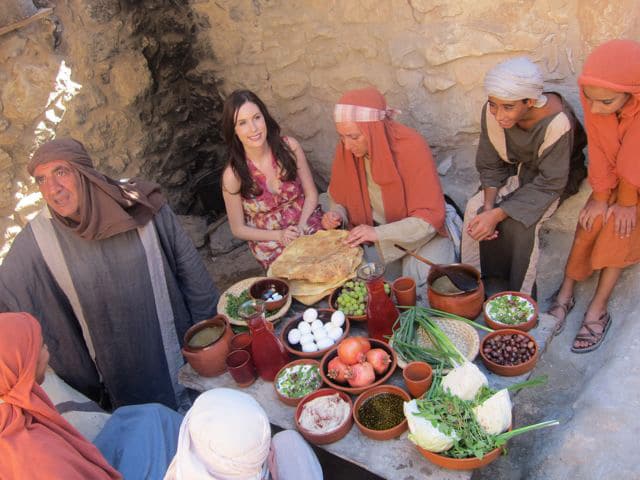
Recreating a Biblical meal at Nazareth Village – Nazareth, Israel
Carrots, celery, and onion have been cultivated since pre-Biblical times and the early Bronze Age in Ancient Mesopotamia. Herbs and spices like cilantro, cumin, hyssop, parsley, sumac and bay leaves were well known to ancient cooks, and used to add flavor to otherwise bland dishes.
In the Handbook of Life in Ancient Mesopotamia, Stephen Bertman writes about the crops that were cultivated in this region:
The raw materials of the Sumerian diet… were barley, wheat and millet; chickpeas, lentils and beans; onions, garlic and leeks; cucumbers, cress, mustard and fresh green lettuce. The gardens of Mesopotamia, watered by irrigation canals, were lush with fruits and vegetables…
As for vegetables, the onion was king, along with its cousin, garlic. Other vegetables included lettuce, cabbage, and cucumbers; carrots and radishes; beets and turnips; and a variety of legumes… To appreciate Mesopotamian daily life our imagination must breath in the pungent aroma of the seasonings that once rose from ancient stoves and filled the air… coriander (cilantro), cress, and sumin; fennel, fenugrek, and leek; marjoram, mint, and mustard; rosemary and rue; saffron, thyme and cumin…
Hyssop and sumac spices were common in Ancient Israel, but they may prove difficult to find in your local grocery store. Hyssop is mentioned in the Torah as a cleansing herb, used for purification rituals.
I buy hyssop in bulk from an online spice company because I love its unique flavor (somewhere between parsley and mint). I’ve never seen it in a grocery store, though, except as an ingredient in za’atar spice blends. If you can’t locate hyssop, parsley makes a fine substitute.
I found sumac at my local Whole Foods– it has a somewhat lemony flavor. You don’t need it in the stew, but it adds a nice layer of flavor. You could substitute 2 tsps of lemon juice if you wish, but be aware that lemons were not known to cooks in Biblical times.
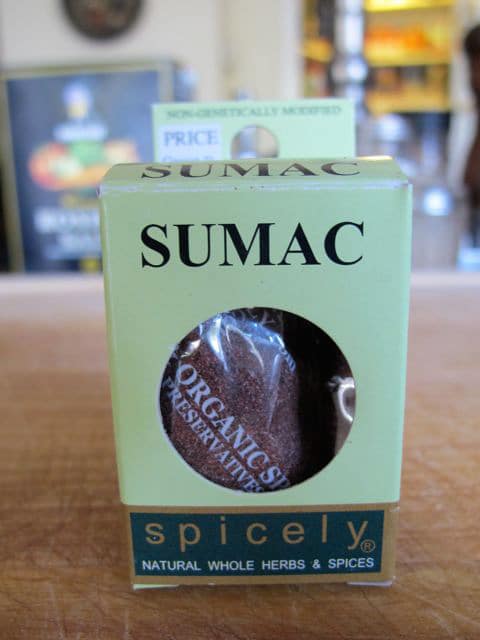
Spicely brand Sumac can be found at Whole Foods. It’s organic and kosher certified, but it contains added salt, so season with care.
While the stew that Jacob cooks is clearly described as “red,” no spices that I know of from this time period would tint the stew red. Sumac has a reddish tint, but it should only be used sparingly because it has a pretty strong flavor.
I have used red lentils for the recipe, but they cook up a light brown color. I suppose you could add some paprika to achieve a more reddish color, but paprika was not a known spice to the ancient Israelites.
At any rate, this stew is delicious. Make it with vegetable broth for a vegetarian pareve meal. Chicken broth adds a nice flavor, though chicken and other meats were considered luxury foods in ancient Israel, so Jacob’s stew was probably vegetarian.
It’s a simple and tasty meal, perfect for a cold winter afternoon. Bete’avon!
Gluten Free Modification: Omit the barley for a more soup-like texture, or substitute 1/4 cup brown rice for the barley. Rice is not a Biblical-era grain, but it makes a delicious substitute for those struggling with Celiac or gluten intolerance.
Recommended Products:
We are a participant in the Amazon Services LLC Associates Program, an affiliate advertising program designed to provide a means for us to earn fees by linking to Amazon.com and affiliated sites. As an Amazon Associate I earn from qualifying purchases.
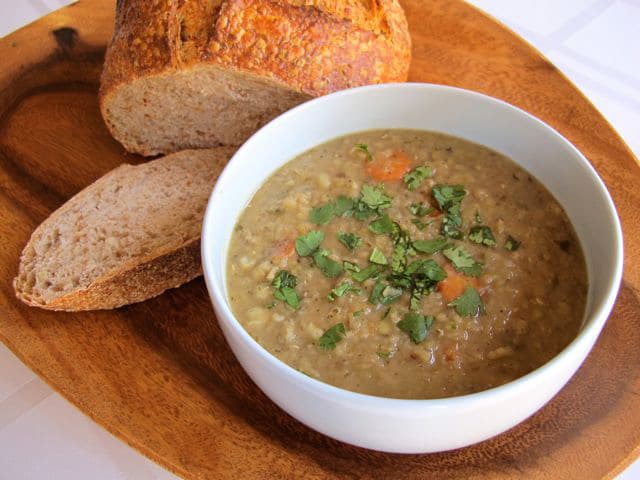
Jacob's Lentil Stew
Ingredients
- 1/2 cup fresh chopped cilantro (coriander), divided
- 3 carrots
- 3 celery stalks, including leaves
- 2 tablespoons extra virgin olive oil
- 1 large onion, diced
- 1 clove garlic, crushed
- 2 cups dry red lentils
- 1/4 cup pearl barley (omit to make gluten free)
- 2 quarts chicken stock (or use vegetable stock to make vegan)
- 1 1/2 teaspoons cumin
- 1 teaspoon hyssop or parsley
- 1/2 teaspoon sumac (optional)
- 1 bay leaf
- Salt and pepper to taste
Instructions
- Roughly chop the cilantro. Scrub the carrots, then cut them into chunks (do not peel). Cut celery into chunks, including leaves. Reserve.

- In a medium sized soup pot, heat olive oil over medium heat. Add diced onion and saute till translucent.
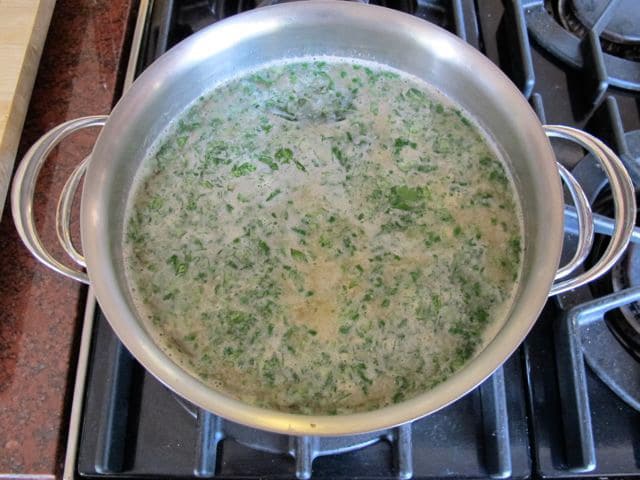
- Add garlic, carrot chunks, and celery. Continue to saute till onion turns golden and ingredients begin to caramelize. Add red lentils and barley to the pot, stir. Cover mixture with 2 qts. of broth and bring to a boil. Reduce heat to a simmer. Add 1/4 cup of the fresh cilantro to the pot along with the cumin, hyssop or parsley, sumac (optional) and bay leaf; stir.
- Cover the pot and let the stew simmer slowly for 1 1/2 to 2 hours, stirring every 30 minutes, until barley is tender and the stew is thickened. Garnish soup with remaining cilantro.
- Gluten Free Modification: Omit the barley for a more soup-like texture, or substitute 1/4 cup brown rice for the barley. Rice is not a Biblical-era grain, but it makes a delicious substitute for those struggling with Celiac or gluten intolerance.



Nutrition




Thanks for the very nice and healthy recipe.
And by the way, sumac works good for a blood pressure.
Lets enjoy the right food eating for the better health…)
You’re welcome Lily 🙂
Wow, it took my 5 seconds to fall in loe with your blog. Not only that you tell the story of the recipe, no you descripe it in the finest way one can untill you offer as the recipe. This Shabbat I`m going to have some Lentil Soup.
Thank you Matthias! I hope you enjoy the soup! 🙂
@stella jones: many brands of mashed potato flakes are kosher and parve, including Idaho and Betty Crocker (I believe). Others are kosher dairy, which is only an issue if you are using chicken broth.
Ok sweetheart, I’d give my birthright for the recipe of that rye bread pictured.
The crock pot worked great! I set the timer for 3.5 hrs and it switches to “keep warm” when it’s done. My pot also cooks on the hot side.
The lentils were still in tact and actually could have been a bit more done. There was still plenty of liquid. I was not able to find pearl barley so added large creamy couscous when I got home. I had also added 6 boneless, skinless chicken thighs. I shredded them and put them back in the stew when the couscous was done. It was fabulous!
Great lesson! I am making a variation of this tonight for a wintry shabbos evening!
This sounds like an excellent recipe. My employer thought that is looked good and suggested I bring it to the office so everyone could enjoy a great soup.
Tori, Do you see any issue with using a crock pot for this? Us working moms need all the help we can get!
Thank you for your kind comments, I do hope you all have a chance to try this stew! Tastes like history to me. 🙂
Sandi, a slow cooker should work fine, although I’m not sure on the timing… it can sometimes take quite a long time for lentils to firm up. If I have a chance to test it I will report back and let you know!
OOH!! I love lentils and can’t wait to try this recipe out. I don’t know why I never thought about making the lentil stew that Jacob made. This sounds SOO good!
This was a really interesting history lesson. I’ve been making this stew for years and never knew I was using ancient ingredients. I’ve never used hyssop or sumac and I’m going to try to find them. Thanks for sharing so much information. I really liked the picture of your Bible time meal. Looks like you had a good time.
I’ve got some mixed lentils, (different types all together) and I’m going to try it with that! Thanks!!
You are so full of love and your dishes reflect this love. Thank you.
Thanks for giving me an alternative recipe that sounds marvelous! I can’t seem to find one that satisfies my Greek husband, but I’m going to give this a whirl. The history lesson was wonderful!
Thank you for this delicious-sounding recipe — it sounds like a perfect use for some of the hyssop in my garden!
I love eating lentils. They are full of protein and very low in fat. Priced right too. How often do you hear that? Thanks. I’ll try it soon.
Glad you all enjoyed this blog! This history behind the food is simply fascinating to me. Stella, there are potato thickeners out there that are kosher, so you could definitely use them in a kosher version of this dish.
Lauren, I can relate! Glad the blog is “feeding” your Jewish side. 😉
Just curious, if beets were grown in the area and at that time, could they have been a factor in making the stew the reddish colour?
Thanks for including gluten free options. I lime the idea of brown rice to replace the barley, I probably would not thought of that but can’t wait to try it!
I’ve been making lentils for as long as I can remember. And my mother use to make them for us as little kids. My kids love them and in my country we eat them a lot.
It looks like agreat recipe to try.
Oh wow! I never thought about how to make the historic stew. It looks fantastic, and easy to achieve. I have to say, there is something in me that says I am meant to be a Jew, and as I have been researching and delving into Judaism, it gets stronger every day. Thank you for feeding the foodie bit of that!
so much like my own recipe that I used for the last 45 yrs except for the barley,sumac,and cumin.However I do use parsley.I know it is not kosher but when I wanted my lentils thickened into a more stew like consistancy (and I do this for my potato soup as well)I use some mash potato flakes.Before I would use a bit of rhue or some cornstarch.Thank you for the history lesson too.This was a most interesting blog today.