

Falafel! It’s one of my all-time favorite snacks. This homemade falafel recipe has hundreds and hundreds of positive reviews. Why? Because it’s just that delicious!
Making authentic, traditional falafel is an interesting process, and it may be brand new to you. Never fear! I am here to walk you through each step, so you can achieve crispy, tender, tasty falafel every single time.
What is Falafel?
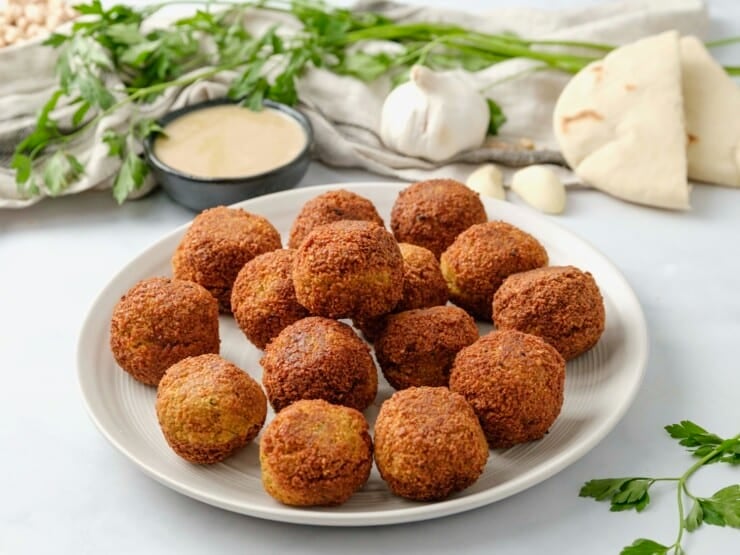
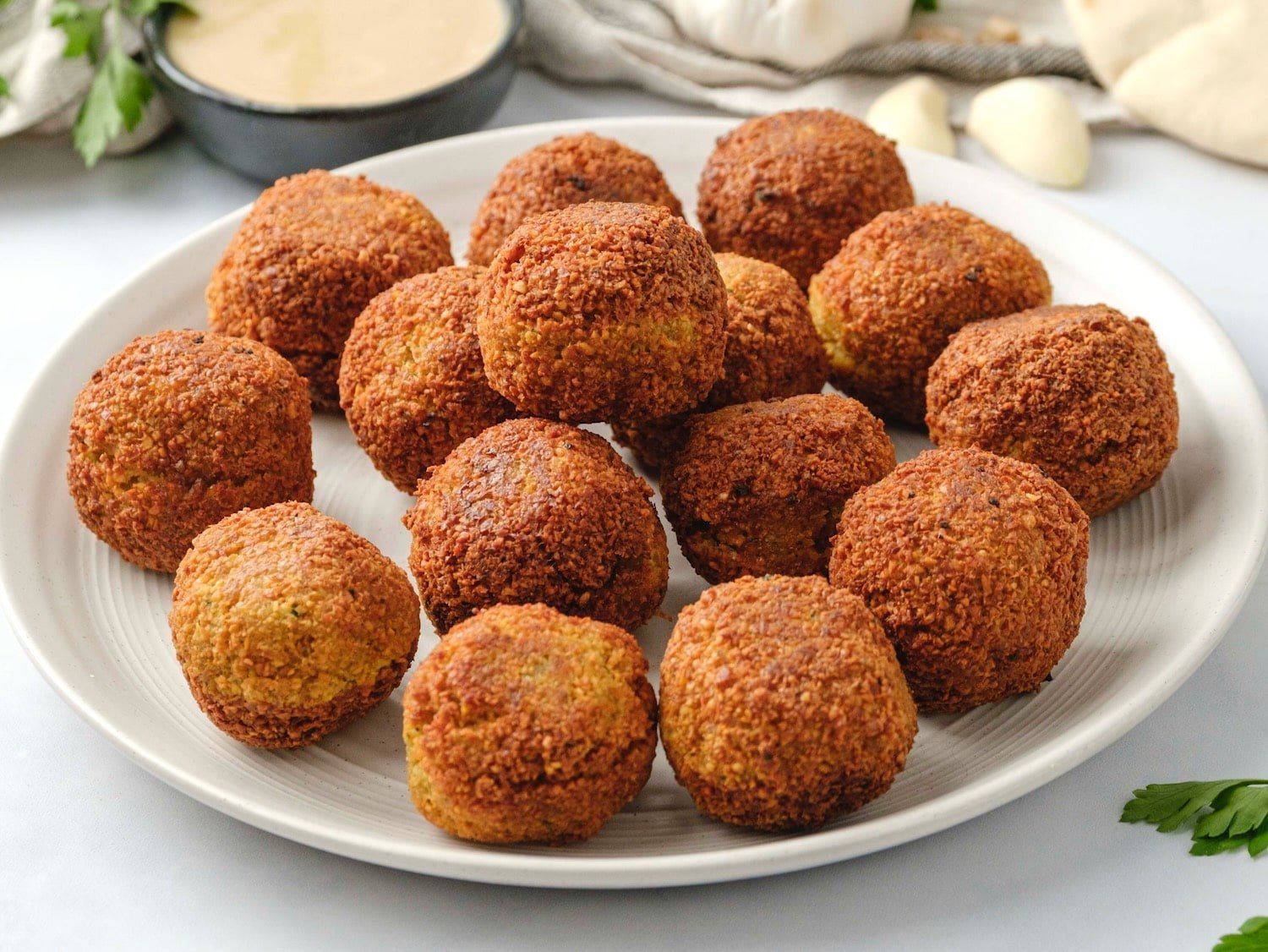
Falafel are crisp and delicious deep-fried legume fritters made with beans, spices, onions, and herbs. Legumes are well-soaked, then ground up and mixed with other ingredients. Next, the mixture is formed into small balls or patties, then fried in hot oil. The pre-soaked legumes are cooked during the frying process.
Most falafel today is made with chickpeas (aka garbanzo beans). However, in Egypt and other areas of the Middle East, fava beans are the legume of choice. It is often served alongside other popular regional Mediterranean recipes like hummus, as well as shawarma made from lamb or chicken.
The History of Falafel
This Middle Eastern food has a very long history. The word falafel may descend from the Arabic word falāfil, a plural of the word filfil, meaning “pepper.” Legume fritters, including versions made with fava beans and lentils, have existed in the Middle East for thousands of years.
According to The Encyclopedia of Jewish Food, written by my friend Gil Marks: “The first known appearance of legume fritters (aka falafel) in the Middle East appears to be in Egypt, where they were made from dried white fava beans (ful nabed) and called tamiya/ta-amia (from the Arabic for ‘nourishment’); these fritters were a light green color inside. Many attribute tamiya to the Copts of Egypt, who practiced one of the earliest forms of Christianity. They believed that the original state of humankind was vegetarian and, therefore, mandated numerous days of eating only vegan food, including tamiya.”
Likewise, the Torah, the Song of Songs, the Mishnah, and the Talmud all mention deep-fried lentil fritters, known as “ashishim.” This means early forms of falafel were enjoyed in this region since biblical times, at least. That’s some pretty ancient falafel!
Ingredients and Notes
Please be sure to scroll down to the recipe card for the complete details!
- Chickpeas – I use chickpeas because they’re easy to find, and they’re tasty! Follow my tips to cook and soak dried chickpeas. Do not use canned chickpeas; they will not give you the proper result – you need to start with uncooked chickpeas. If all you have on hand are canned chickpeas, try this very delicious and falafel-like spicy panko chickpea patties recipe instead!
- Onion and Garlic – These ingredients add a pungent, sweet, savory taste. I like white onion, but yellow onion will also work. Then, I use roasted garlic cloves for extra depth.
- Herbs and Spices – Fresh parsley, salt, ground cumin, ground coriander, black pepper, cayenne pepper, and ground cardamom create the warm, savory flavor found in falafel recipes all over the world.
- Flour – Use all-purpose flour or chickpea flour to keep this recipe gluten-free. This absorbs any excess moisture and helps the falafel balls hold their shape.
- Leaveners – I use baking soda in the soaking water for the chickpeas to help soften them. You can also add baking powder in the falafel balls. This helps to create super tender, fluffy falafel.
- Oil – Use a neutral oil with a high smoke point for frying. I prefer avocado oil, but grapeseed oil, sunflower oil, canola oil, and peanut oil all work.
How to Make Authentic Fried Falafel Balls
Homemade falafel can be a little time-consuming. So, make sure to read through the entire recipe and plan ahead accordingly!
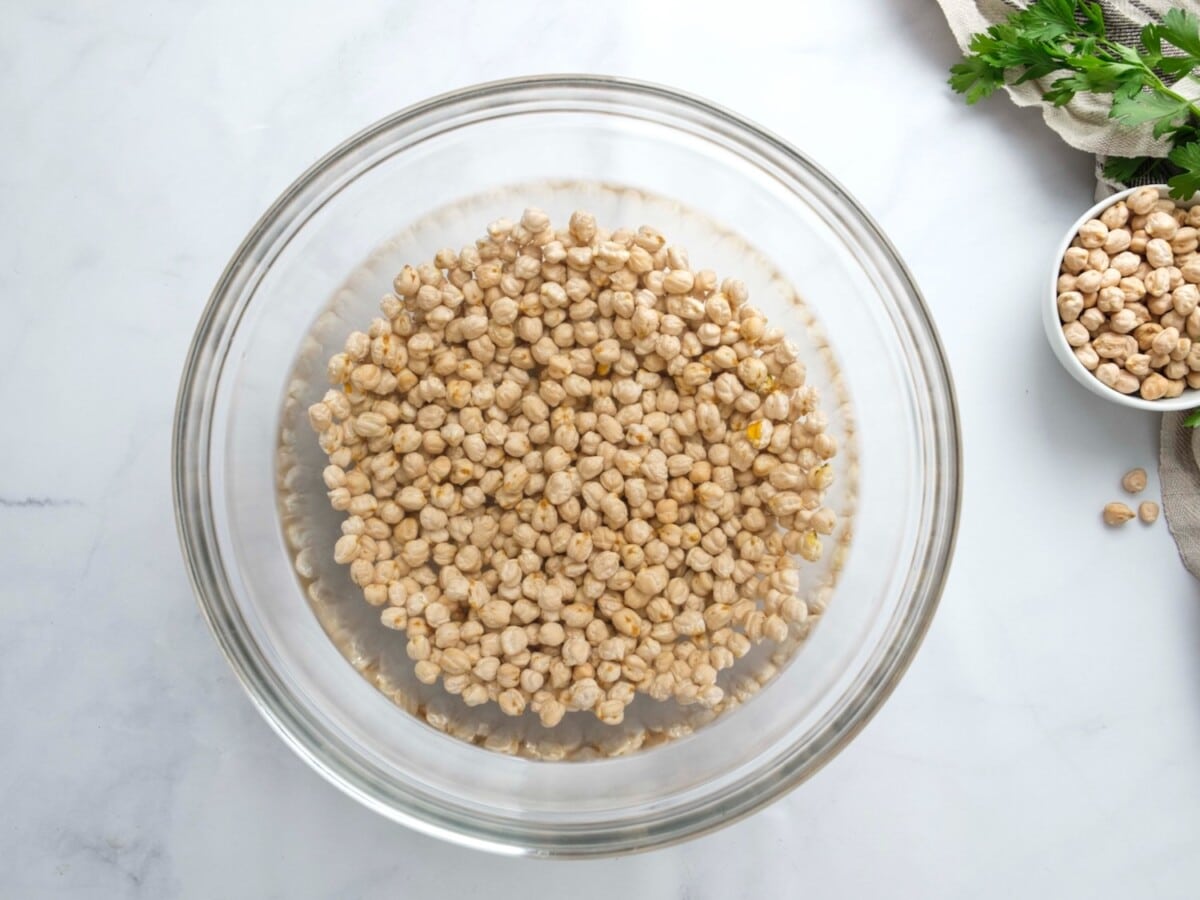
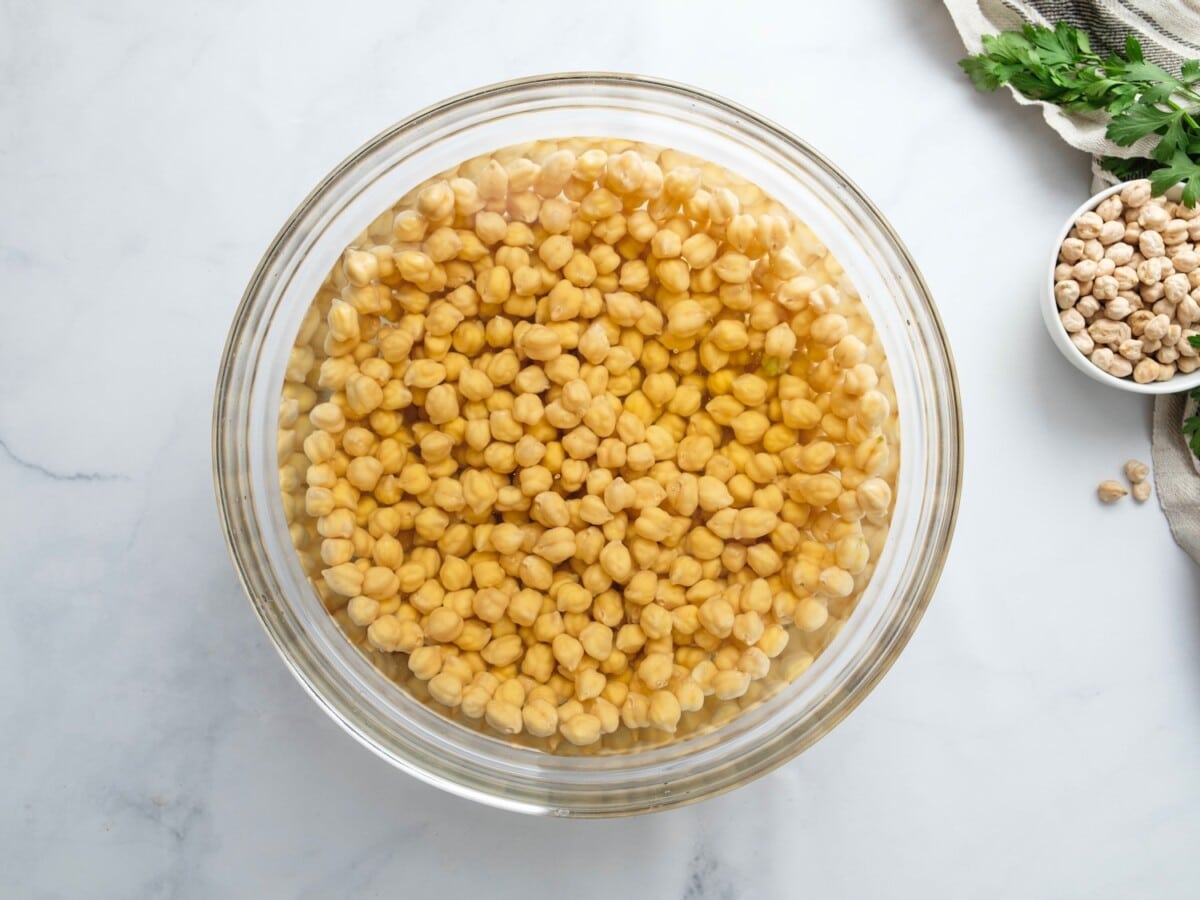
- Soak the chickpeas. Submerge the chickpeas in cold water, and add baking soda. Cover the bowl, and chill in the fridge for at least 12 hours or ideally up to 24 hours. This helps soften them, making them easy to blend.
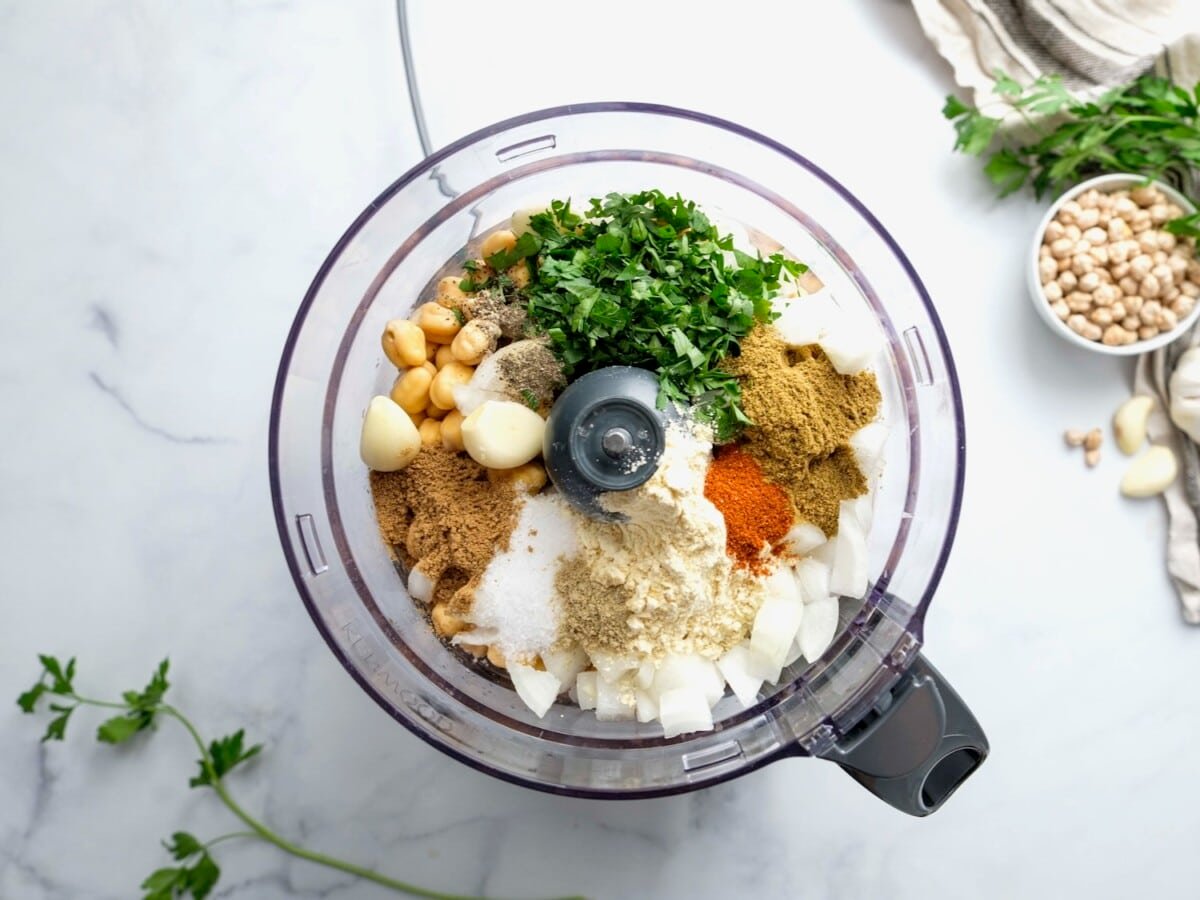
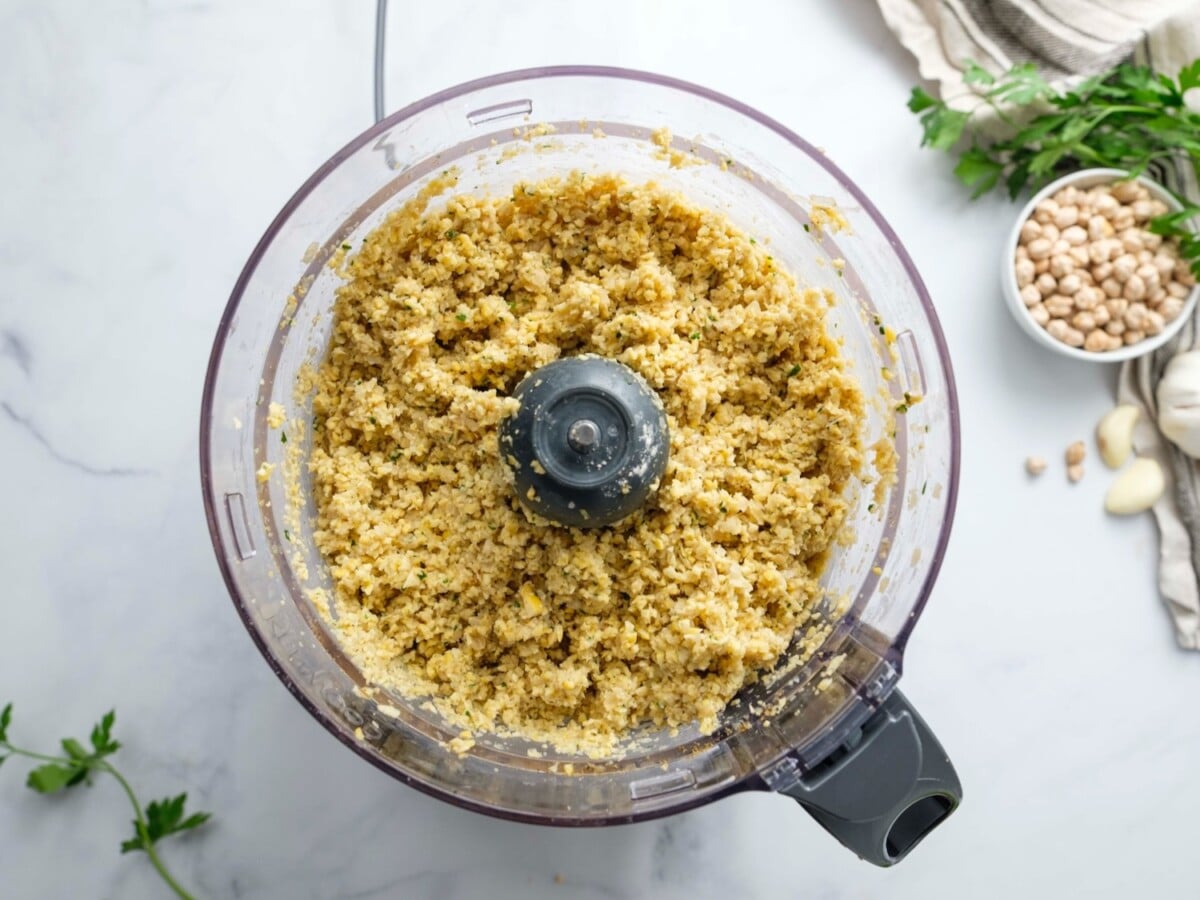
- Combine and blend. Drain and rinse the chickpeas. Then, add them to a food processor along with the other ingredients. Pulse until a rough, coarse meal forms. Stop and scrape the sides of the bowl as needed to ensure all the ingredients are well incorporated. Be careful not to overprocess! The mixture should have a paste-like consistency, but shouldn’t be so smooth that it turns into hummus.
- Chill. Transfer the chickpea mixture to a bowl, and stir with a fork to remove any remaining chunks. Then, cover and refrigerate for 1-2 hours.
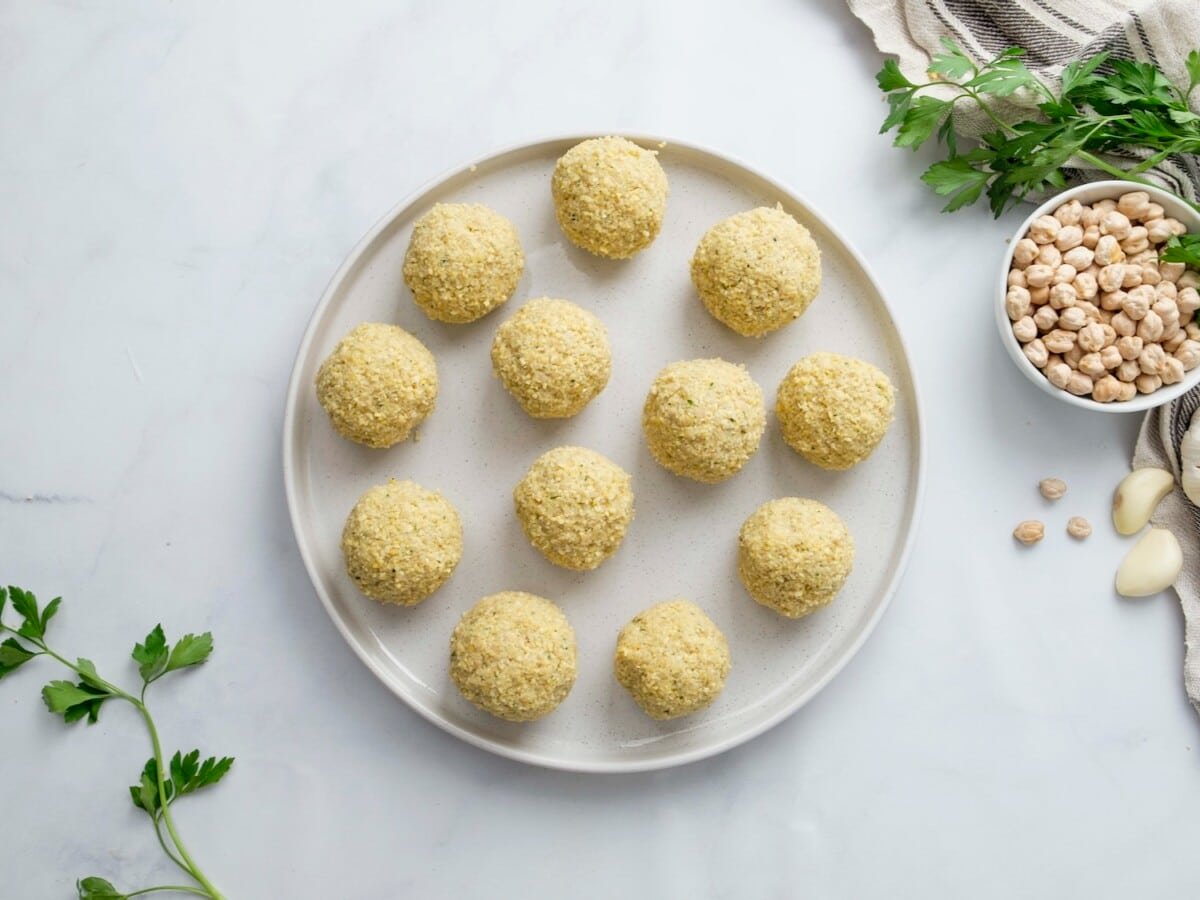
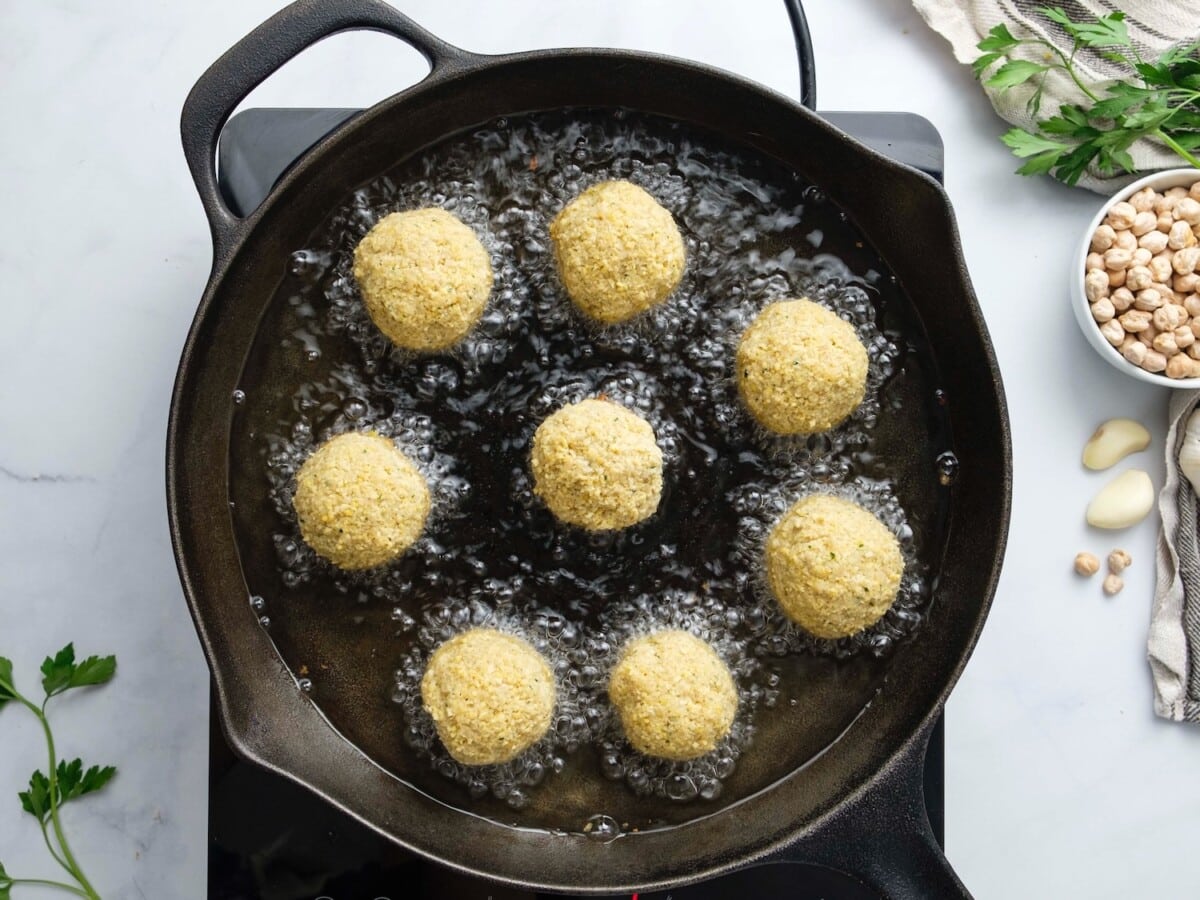
- Fry. Heat oil in a skillet over medium heat. In the meantime, portion the falafel mixture into equal-sized balls or slider-shaped patties. Then, fry on each side until golden brown, working in batches as needed. Drain them on a paper towel-lined plate, and enjoy!
Tori’s Tips for the Best Crispy Falafel Recipe
- Divide the mixture. If you have a small food processor, divide the falafel ingredients in half before pulsing.
- Use a deep fry or candy thermometer. The ideal temperature to fry falafel is between 360 and 375 degrees Fahrenheit. The best way to monitor the temperature is to use a deep fry or candy thermometer to check the oil before frying.
- Portion evenly. I like to use a tablespoon or a falafel scoop to portion the falafel balls into equal-sized pieces and roll them between wet hands.
- Test a single falafel before frying the rest. I like to fry a test one in the center of the pan. If the oil is at the right temperature, it will take 2-3 minutes per side to brown (5-6 minutes total). If it browns faster than that, your oil is too hot, and your falafels will not be fully cooked in the center. Cool the oil down slightly and try again.
- Add flavor. I like to dip my falafel balls in sesame seeds before frying for a little extra crisp and nutty taste. However, I’ve also tested different flavor variations, adding chopped parsley or fresh cilantro or turmeric, and they all taste great. (See the recipe card below for details!)

Serving Ideas
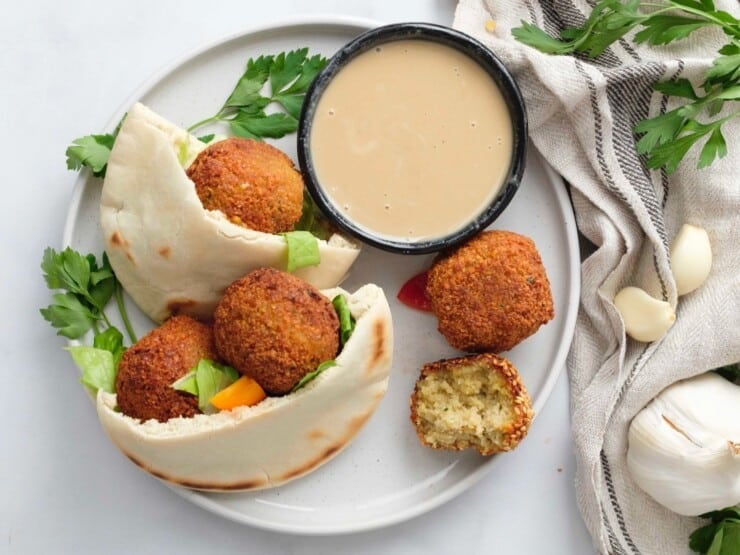
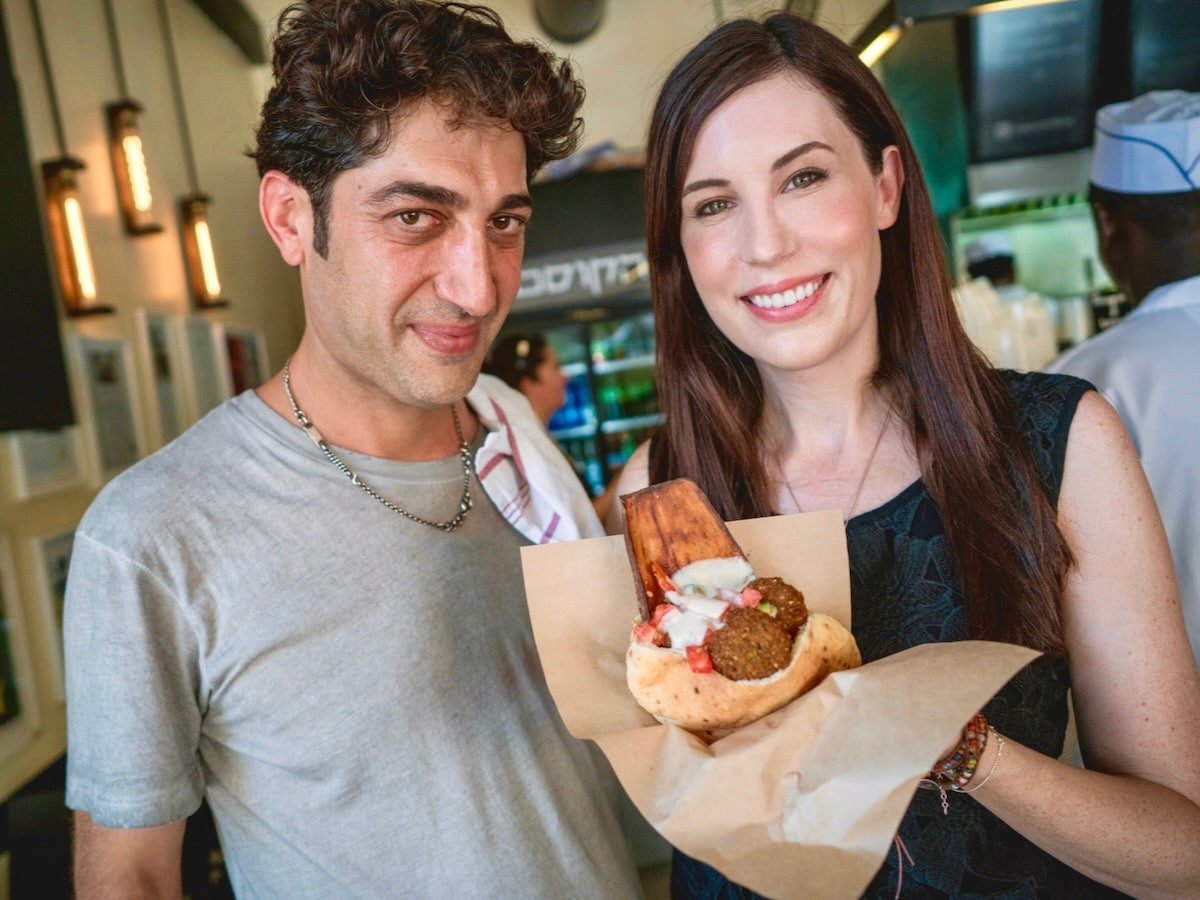
My favorite way to serve homemade falafel is as a falafel sandwich. To do so, I use flatbread or slice warm pita bread in half to form two “pockets.” Then, I stuff them with the falafel balls and add-ons such as tahini sauce, Israeli salad, hummus, baba ganoush, or tabouli, and vegetables like shredded lettuce, tomatoes, red onions, and dill pickles.
Sometimes I also like to add sprouts, cucumber slices, roasted peppers, roasted eggplant slices, sunflower seeds, French fries, feta cheese, and yogurt or tzatziki for extra taste and texture.
Or, start with a large bowl and a base of lemony saffron couscous, cauliflower couscous, quinoa, or saffron rice, then add fresh veggies and all your favorite toppings.
Falafel balls are also great to serve as an appetizer or side dish with dips and main courses. Or, add them to a mezze platter for a party spread.
Falafel
Ingredients
- 1 pound dry chickpeas (also known as garbanzo beans) – you must start with dry, do NOT substitute canned, they will not work!
- 1/2 teaspoon baking soda
- 1 small onion, roughly chopped
- 1/4 cup chopped fresh parsley
- 3-5 cloves garlic (I prefer roasted garlic cloves)
- 1 1/2 tablespoon flour or chickpea flour
- 1 3/4 teaspoon salt
- 2 teaspoon cumin
- 1 teaspoon ground coriander
- 1/4 teaspoon black pepper
- 1/4 teaspoon cayenne pepper
- Pinch of ground cardamom
- 1 teaspoon baking powder (optional – makes the falafel more fluffy)
- Vegetable oil for frying – avocado oil, grapeseed oil, sunflower oil, canola oil, and peanut oil all work well (I prefer avocado oil)
Instructions
- One day ahead: Pour the chickpeas into a large bowl and cover them by about 3 inches of cold water. Add 1/2 tsp of baking soda to the water and stir; this will help soften the chickpeas. Cover the bowl and let them soak overnight in a cool, dark place or chill in the refrigerator. The chickpeas should soak at least 12 hours and up to 24 hours, until tender (change soaking water for fresh water after 12 hours).

- They will double in size as they soak – you will have between 4 and 5 cups of beans after soaking.
- Drain and rinse the chickpeas well. Pour them into your food processor along with the chopped onion, garlic cloves, parsley, flour or chickpea flour (use chickpea flour to make gluten free), salt, cumin, ground coriander, black pepper, cayenne pepper, and cardamom. Note: if you have a smaller food processor, you will want to divide the ingredients in half and process the mixture one batch at a time.
- Pulse all ingredients together until a rough, coarse meal forms. Scrape the sides of the processor periodically and push the mixture down the sides. Process until the mixture is somewhere between the texture of couscous and a paste. You want the mixture to hold together, and a more paste-like consistency will help with that… but don't over-process, you don't want it turning into hummus!
- Once the mixture reaches the desired consistency, pour it out into a bowl and use a fork to stir; this will make the texture more even throughout. Remove any large chickpea chunks that the processor missed.Cover the bowl with plastic wrap and refrigerate for 1-2 hours.Fill a skillet with oil to a depth of 1 ½ inches. Use cooking oil with a high smoke point (oil suggestions can be found in the ingredient list). Heat the oil slowly over medium heat. The ideal temperature to fry falafel is between 360 and 375 degrees F; the best way to monitor the temperature is to use a deep fry or candy thermometer. After making these a few times, you will start to get a feel for when the oil temperature is "right."Meanwhile, form falafel mixture into round balls or slider-shaped patties using wet hands or a falafel scoop. I usually use about 2 tbsp of mixture per falafel. You can make them smaller or larger depending on your personal preference. The balls will stick together loosely at first, but will bind nicely once they begin to fry.
- If the balls won't hold together, place the mixture back in the processor again and continue processing to make it more paste-like. Keep in mind that the balls will be delicate at first; if you can get them into the hot oil, they should bind together and stick. If they still won't hold together, you can try adding 2-3 tbsp of flour or chickpea flour to the mixture. If they still won't hold, add 1-2 eggs to the mix. This should fix any issues you are having.Before frying my first batch of falafel, I like to fry a test one in the center of the pan. If the oil is at the right temperature, it will take 2-3 minutes per side to brown (5-6 minutes total). If it browns faster than that, your oil is too hot and your falafels will not be fully cooked in the center. Cool the oil down slightly and try again.
- When the oil is at the right temperature, fry the falafels in batches of 5-6 at a time until golden brown on both sides. Once the falafels are fried, remove them from the oil using a slotted spoon. Let them drain on paper towels.
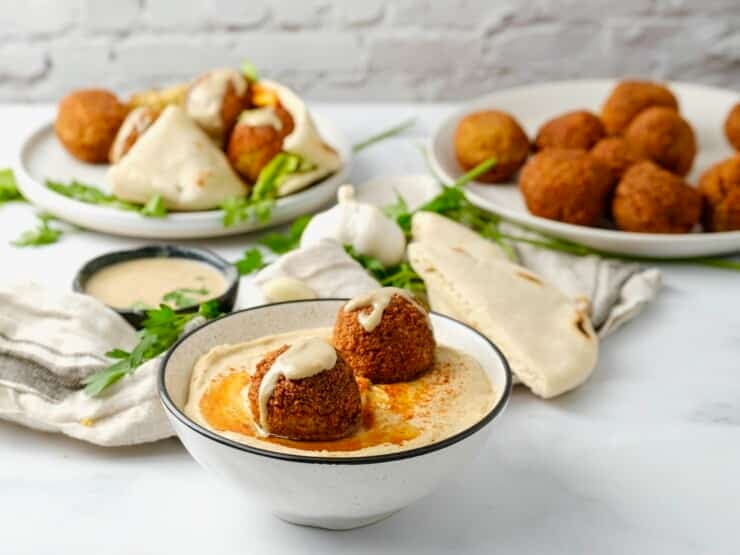
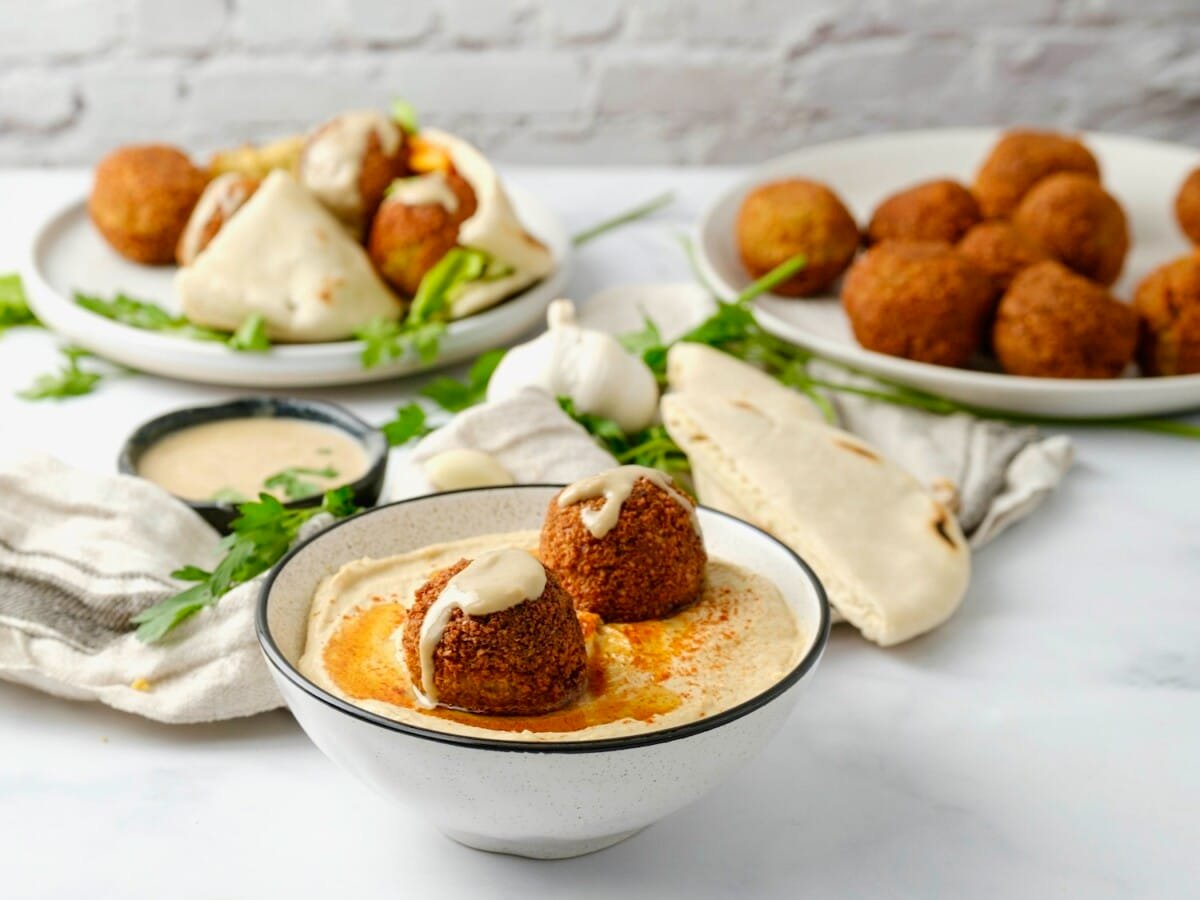
- Serve the falafels fresh and hot; they go best with a plate of hummus and topped with creamy tahini sauce. You can also stuff them into a pita.
- SESAME FALAFEL VARIATION: After forming the balls or patties, dip them in sesame seeds prior to frying. This will make the falafel coating crunchier and give it a slightly nutty flavor.

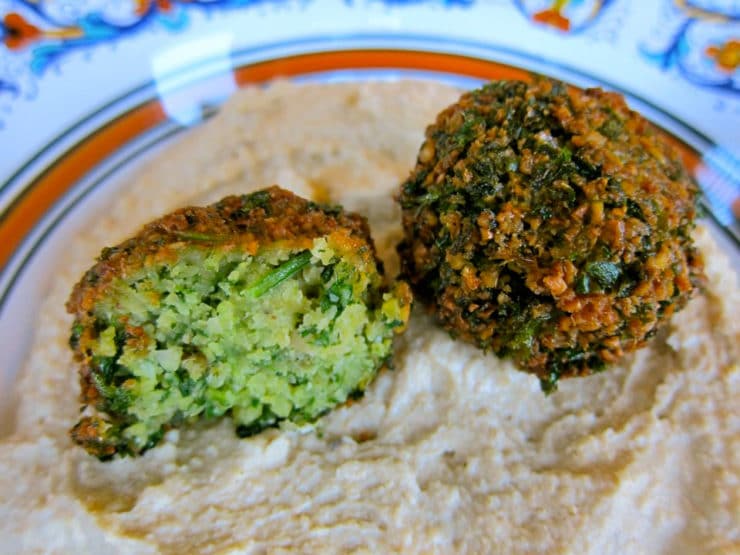
- HERB FALAFEL VARIATION (GREEN FALAFEL): Add ½ cup additional chopped green parsley, or cilantro, or a mixture of the two prior to blending.
- TURMERIC FALAFEL (YELLOW FALAFEL): Add ¾ tsp turmeric to the food processor prior to blending.
- HOW TO MAKE A FALAFEL PITA: Making a falafel pita is actually really simple. The two main ingredients are pita bread and falafel. Cut the pita bread in half to form two “pockets.” Each pocket is a serving size. Stuff the pocket with falafel, as well as any add-ons you fancy.Here are some traditional add-ons that can be added to your pita: tahini sauce, shredded lettuce, diced or sliced tomatoes, Israeli salad, onions, dill pickles, hummus, tabouli.Here are some less traditional add-ons that are also tasty: sprouts, cucumber slices, roasted peppers, roasted eggplant slices, sunflower seeds, french fries, feta cheese, yogurt, tzatziki.




NOTES
Nutrition

tried this recipe?
Let us know in the comments!
If you enjoyed this recipe, I’d love it if you left me a star rating and comment below. Also, don’t forget to share and tag us on Facebook and Instagram!
FAQs
This recipe is best served right away. However, you can store cooked leftovers in an airtight container in the fridge for 2-3 days.
I’ve never tried freezing this recipe, but some readers have had good luck with freezing both the uncooked chickpea mixture and the cooked falafels.
Personally, I don’t like baking this recipe, finding that it tends to dry out. However, if you want to give it a try, prepare and shape the falafel dough into patties as usual.
Then, arrange them on a greased or parchment-lined baking sheet, and brush the top of each falafel patty with extra virgin olive oil. Bake in the oven at 400 degrees Fahrenheit for 20-25 minutes, turning halfway through, until golden. If you read through the comments, you’ll see tips from some readers who have tried this method with some success.

The green version are still made and eaten in the Eastern part of Sinai, especially in El Arish and Sheikh Zuwayed. They are less spherical, more like cookie shaped, but still delicious! Wrap in a warm flat-bread with some salad and fil-fil (pickled chilli or fresh) for a sustaining breakfast.
Can you use gluten free flour as a substitute to make the dish vegetarian and gluten free??
I use chickpea flour and they turn out just fine.
I have made this recipe gluten free. Use an all purpose gf flour and add an egg (possibly two) to make up for the protein loss from no gluten. If it fails to hold together when you are frying, you can always bake the falafel. I would recommend heating stoneware prior to placing the falafel into the oven. It helps to create a slightly crisper texture.
Of course I’ve used gluten freeflour all the time. Can add some flax seed flour to make them sticky too
I used almond flour and it worked! Did end up using more eggs than the recipe called for – i.e 4 eggs
I used coconut flower and “chia & flax eggs” (I.e. just the ground seeds soaked in water) to replace the wheat flour and chicken eggs, it worked out perfectly and was delicious!
Also tried making them both ways – fried and oven baked, both work and are equally enjoyable!
I have never, NOT ONCE, used any flour in falafel; you just don’t need it. Waiting a few minutes gives the starch from the peas time to bind. I’ve made thousands of falafel. Also, depending on air pressure and humidity, egg can help (I never have, but my SIL always does). Use only the white, though. Whole egg makes them too dense and doughy. We make Aleppo style– nothing green, but very spicy. A grinder, not food processor is really the appropriate kitchen appliance for good consistency, though.
I made these again tonight..probably my 3rd time with the recipe. I soaked the beans for 2 days–48 hours–and rinsed them and changed the water about every 8-10 hours. I added Italian parsley, coriander, cardamon, minced garlic. I put it into my Vitamix and added a little of the preserved lemons I put up earlier this year. Perfect. They look perfect, they tasted terrific! I had saved some of the beans to make humus. Best dinner ever! I think Torey’s site has great ideas and I appreciate the time and testing she has done. My family is Italian and from the East Coast, but my friend from Iraq says they are as good as hers. Thank you!
I used to go out for falafel and say “mmmm that’s so tasty!” Then I made these falafel at home. Now when I go out for falafel and I say “eh, my falafel is better.”
What flour do you use?
Hi Mitzi, Tori’s assistant Ashley here. We use all-purpose flour.
I made this recipe and it turned out great for me!
I would now like to try to cook the falafels in the oven rather than frying them, and I’m wondering if anyone has tried that — I’d like to know if it works and if there are tweaks or tips you can share.
Thanks!
Falafel will bake just fine in the oven, but the texture is more dry and dense. Brushing them with oil before putting them in the oven helps a little bit. Try baking them at 375F for 10-15 minutes, flip them over, and then another 10-15 minutes. Good luck!
Have you tried baking them? I tried them once and was very impressed. They were tasty so I am just making a triple batch to freeze but would prefer to bake them. How long at what temperature did you do, if you tried it? Thanks
Thank you for your answers!
I need to go buy garbanzo beans and try it 🙂
I will report back with my experience
Reporting back – yes I did try baking them for my second time making the recipe, turned out perfect!
I baked at 350F, they didn’t take very long, maybe 20 min but i didn’t check the time. Just check on them regularly.
I wish I could add photos to this comment.
This time I also replaced the eggs with “flax and chia eggs” to make it vegan and it was great, they did the job of holding the paste together perfectly.
I also always use naturally gluten free flours and it’s no problem at all
I loved how thorough you were in your description. Thank you.
Best felafel ever ?
Recipe was easy to follow and the falafel tasted superb…I doubt my family is ever going to ‘buy’ their favourites anymore !
Well try this. process the raw but soaked chickpeas and add lemon juice roasted garlic and a good portion of tahini. ( you can add tumeric, curry or any of the other spices mentioned above. Blend it all togther and you end up with a thick hummus like paste. Take a desert spoon of the paste and drop it into hot oil, pat it gently flat and fry it both sides until it is golden brown on both sides – delicious hot or cold.
All the balls disolved in the oil on the pan while frying after a while! Where did I go wrong? I added the flour as described.
🙁
Paul, did you use chickpeas from the can? That is the most common mistake that leads to the issue you are describing. The chickpeas should be soaked but not canned or cooked.
I just did the same things and mine dissolved. I didn’t think I would have time to soak them so I left them in the slow cooker for a couple of hours instead of soaking. 🙁 I tried to fry them and they just dissolved.
I have used this recipe when I had more time and it worked fantastically. At least can see my mistake.
it could also be that you needed to add a little more flour. 3 tbsp worked for me
also, your oil was possibly not hot enough. If you have an instant read thermometer, it should be 350 deg F
I love these recipe, I made it for my boyfriend’s birthday but instead of chickpeas I used lentils (because I used the chickpeas for the hummus) and it worked pretty well. He loved his birthday meal!
Thank you so much for sharing this delicious recipe,
Irma
México
I use the same recipe basically. 1pound Fava beans, 1pound Chickpeas, same spices, instead of tumeric I use curry, but once processed I add one cup of bulghur #2 to the mix… it makes it crunchier. I chop one large onion, 3/4 cup of chopped parsley, caramelize the mixture in Arabic infused ghee, and stuff the felafel croquettes with the mixtrure. Try it 🙂
Is your bulghur cooked?
Beautiful, thanks!
Delicious! I have made it twice. The second time, I used the quick-soak method outlined on the website, and found that initially, my falafels were just turning into hot mush. So I added a whole lot of flour (and extra spices to make up for it) and tried frying them again, and they turned out delicious — much softer on the inside than the first time, actually!
5 Stars. Never thought I could make a falafel so perfect, but here it is.
Thanks. Recipe works pretty good. Even though I made some mistakes it came out tasting 7/10. Next time I’ll give the Chickpeas more time to soak (only 4 hours this time) and use a smaller amount to make the flavor of each one a bit stronger.
Yummy!!! I did it, and it was delicious!!!
Must try.
Fantastic, I finally found a receipe. I was in Israel in 1977 and tried a falafel stand in Tibirius and fell in love with them in a 1/2 pita. Tried other falafels over the years and never found the right ones. Will be trying this for sure. Thanks for the receipe.
I just made these and the recipe is delicious! I had a problem frying though. The first few came out perfectly, but then the fried outside started falling off the rest of them. What do you think the cause of this could be? Did the oil get too hot? I ended up baking them because I was in a rush, but I’m just curious about your input.
Thanks!