


Stuffed cabbage leaves, also known as holishkes or prokes, may just be the ultimate comfort food. A slowly cooked, savory cold-weather dish, stuffed cabbage is a classic, and many families seem to have their own way of making it.
Today, I’m sharing a traditional Jewish stuffed cabbage recipe that’s a favorite for my family.
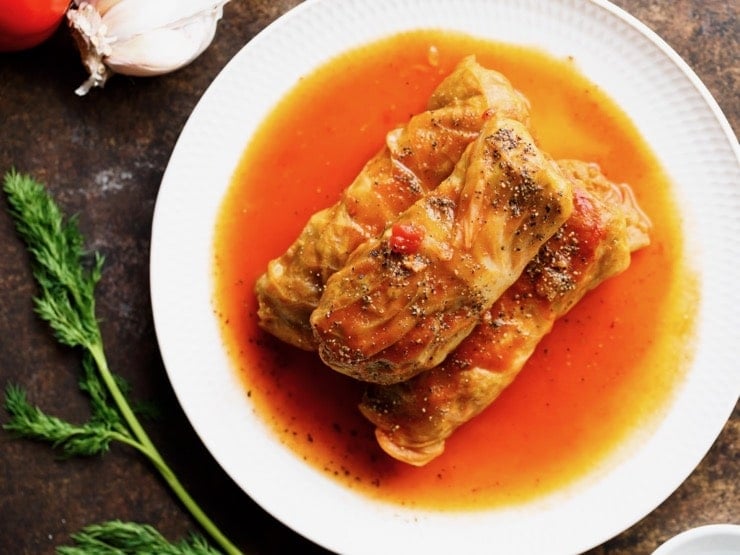
Stuffed cabbage is one of those nostalgic dishes that brings back memories of family, tradition, and comfort. While I didn’t grow up with a Jewish “bubbe” to teach me her version, I’ve spent years diving into the dish’s history and testing recipes from Polish and Israeli friends, classic cookbook authors like Joan Nathan, and even 2nd Avenue Deli.
I’ve made it sweet with raisins and preserves, tangy with sauerkraut and tomato, and everything in between.
My favorite take? A savory, well-seasoned filling with a slightly tart sauce. It’s less sweet than some versions, but packed with flavor. This is the version my husband loves, and the one readers return to again and again.
Everyone’s bubbe has her own way, and that’s the beauty of Jewish cooking. Below, I’m sharing my version, along with a step-by-step video and all my tips and tricks.
Perfect for cozy fall and winter meals, this dish is naturally gluten-free (when using certified GF products), high in protein, and full of fiber. For a quicker take, check out my Unstuffed Cabbage recipe.
Ingredients and Notes
Please be sure to scroll down to the recipe card for the complete details!
-
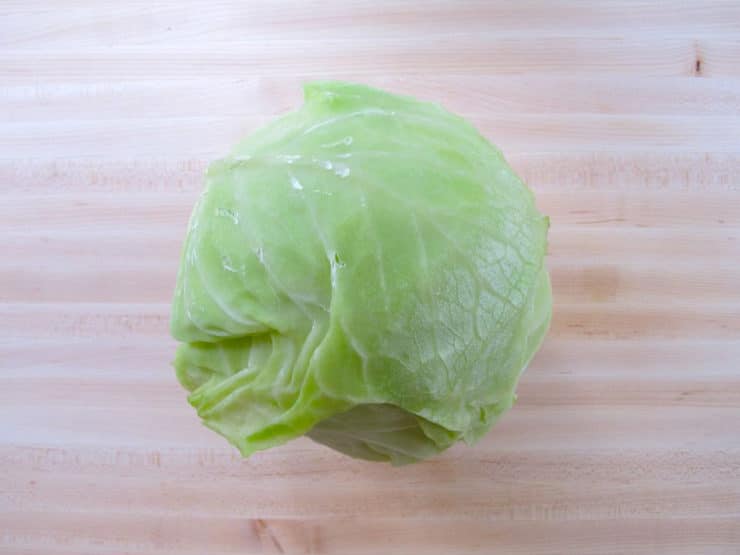
- Cabbage – I prefer to use green cabbage for this recipe. 1 large head of cabbage is typically enough, but you may want to grab a second just in case.
-
- Protein – I like to use a mixture of ground beef and ground chicken, but you can choose one or the other, if preferred. Feel free to use ground pork if not following a kosher diet. I recommend using fairly lean meat to avoid soggy stuffed cabbage rolls.
-
- Rice – Use long-grain, white, or brown rice. Just make sure it’s cooked ahead of time.
-
- Onion and Garlic – This adds a sweet, pungent, slightly savory flavor. I recommend using white or yellow onions and whole garlic cloves, not pre-minced varieties.
-
- Herbs and Spices – Fresh dill, paprika, allspice, kosher salt, and pepper add a savory, warm flavor with bright, herbaceous notes that create a well-balanced bite.
-
- Large Egg – This acts as a binder, holding the filling together.
-
- Sauerkraut – I often have homemade sauerkraut on hand, but any store-bought option will also work.
-
- Tomatoes – A combination of tomato sauce, diced or crushed tomatoes, and tomato paste forms the base of the filling, creating the savory, slightly acidic taste we want in a stuffed cabbage roll recipe.
-
- Lemon Juice – Freshly squeezed lemon juice is best, but bottled varieties also work if you don’t have lemons on hand.
-
- Brown Sugar – This helps balance the acidity of the tomatoes. I find that two tablespoons is plenty, but you can add more if you prefer a sweeter taste.
-
- Stock – I use chicken stock for a slightly more savory flavor, but water will also work, if preferred.
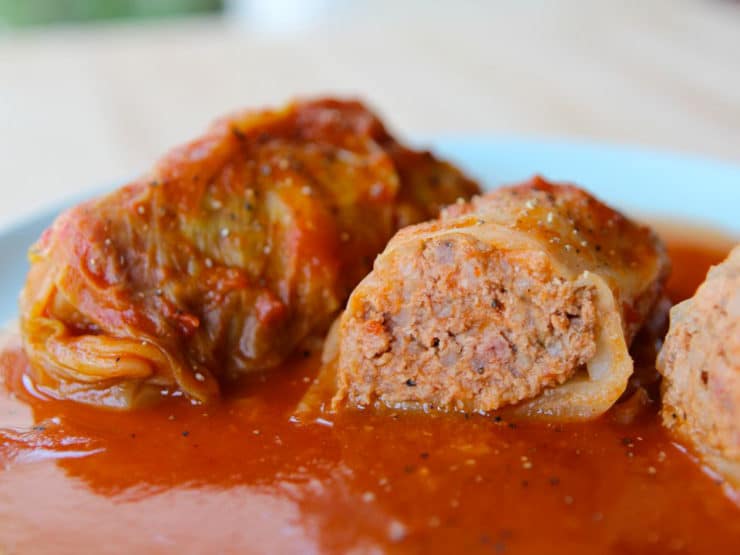
Step-by-Step: How to Make Stuffed Cabbage Rolls (Holishkes)
-
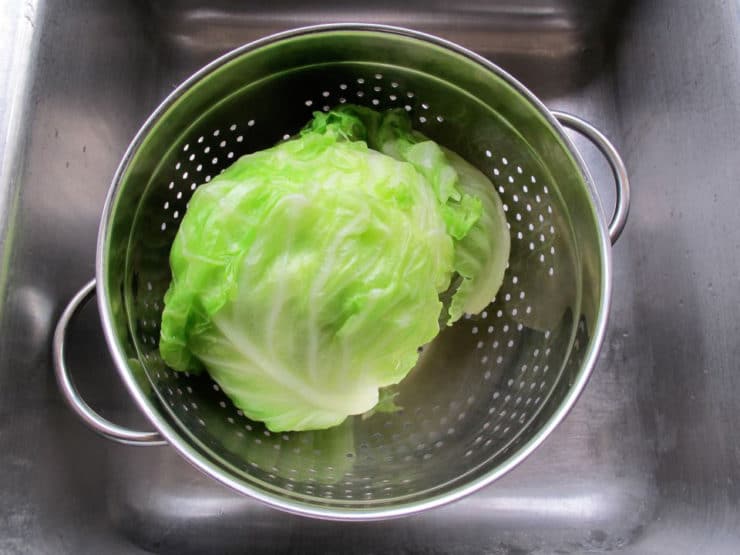
- Soften the cabbage. Rinse the cabbage, and immerse it in a large pot of boiling water until the leaves are soft and pliable. Then, drain the cabbage in a colander and set it aside to cool.
-
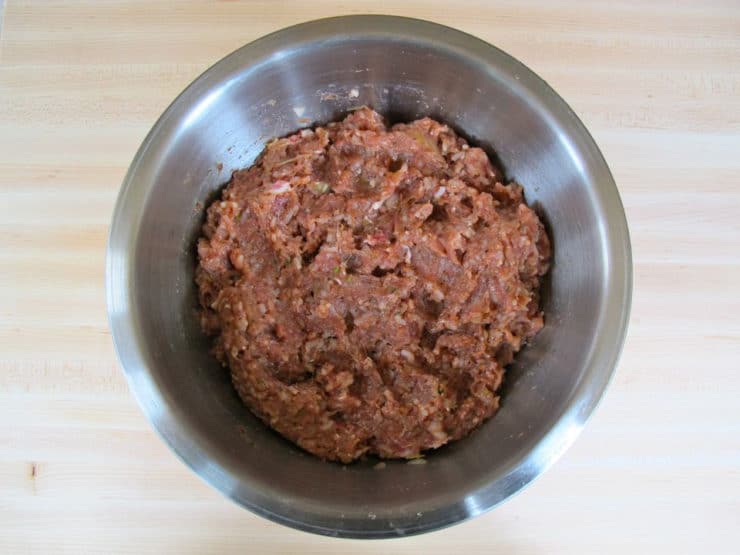
- Prepare the filling. Mix all the filling ingredients in a large bowl. Then, adjust the seasonings if needed.
-
- Roll. Place whole cabbage leaves on a cutting board, and pat them dry with a paper towel. Use a paring knife to shave the tough, thick part of the stem. Then, place about 1/4 to 1/3 cup of filling, depending on the size of each leaf, in the center of the cabbage. Fold the base of the leaf up, covering the filing. Then, fold the edge inward and tuck the loose leaf inward, creating a pocket. Repeat, rolling all the leaves.
-
- Heat. In a small saucepan, combine the tomato sauce, diced or crushed tomatoes, lemon juice, brown sugar, and spices. Warm over medium heat until bubbling and fragrant. Then, season to taste.
-
- Combine. Add sauerkraut and chopped cabbage to the bottom of a pot, and spread the mixture out in an even layer. Pour broth on top, and place half of the stuffed cabbage leaves over the mixture, placing them seam side down. Next, layer the tomato sauce on top, and repeat with the remaining cabbage leaves and sauce.
-
- Cook. Bring the mixture to a gentle boil over medium-high heat. Then, reduce the heat to a slow simmer, cover the pot, and cook until the cabbage leaves are tender.
-
- Serve. Carefully remove the cabbage from the pot. I like to use tongs for this! Then, spoon some of the sauce on top, add a generous sprinkle of black pepper, and serve hot.
We are a participant in the Amazon Services LLC Associates Program, an affiliate advertising program designed to provide a means for us to earn fees by linking to Amazon.com and affiliated sites. As an Amazon Associate I earn from qualifying purchases.
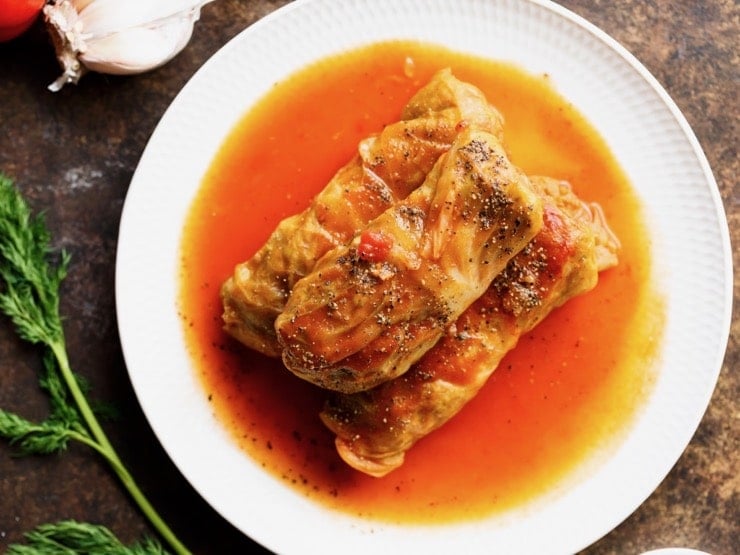
Stuffed Cabbage Leaves
Ingredients
- 1 large green cabbage (3.5-4 lbs.)
- 1 pound ground beef, ground chicken, or a mixture (I use half and half)
- 1 cup cooked long grain rice, white or brown
- 1/3 cup finely minced onion
- 2 tablespoons fresh minced dill
- 1 large egg
- 1 1/2 cups sauerkraut divided
- 28 ounces tomato sauce, divided (2 cans)
- 14 ounces diced or crushed tomatoes (1 can)
- 2 tablespoons fresh lemon juice or more to taste
- 2 tablespoons brown sugar or more to taste
- 2 tablespoons tomato paste
- 1 tablespoon paprika
- 1 clove garlic minced
- 1/4 teaspoon allspice
- 1/2 cup chicken stock or water
- Salt and pepper to taste
Instructions
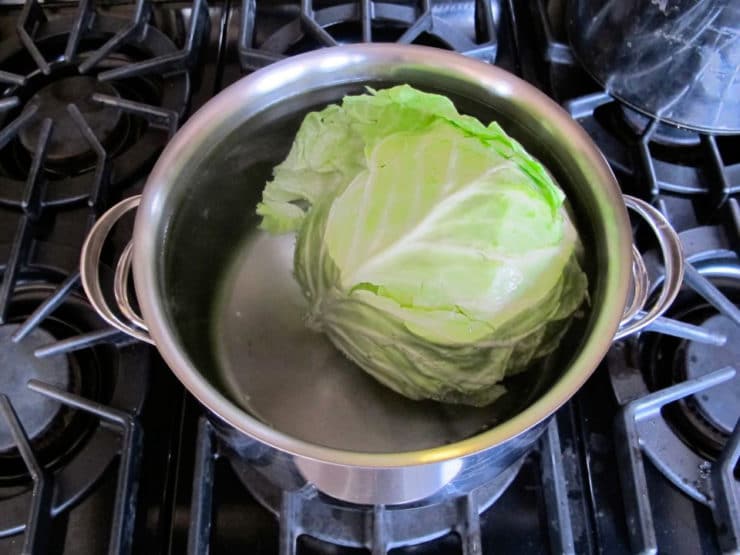
- Rinse the cabbage clean, then immerse it in a large pot of boiling water and cook it for 4-5 minutes until leaves are soft and pliable, but not overly soft.

- Drain the cabbage in a colander and let it sit until cool enough to handle.
- Alternatively, you can freeze the cabbage overnight (or up to 3 days). Defrost the cabbage for about three hours. This will make the leaves pliable in the same way that parboiling does.
- Prepare your filling. In a bowl, mix together ground meat, cooked rice, minced onion, minced dill, egg, ½ cup sauerkraut (drained of juice), 1/3 cup tomato sauce, salt and pepper to taste. I use roughly 1 tsp of salt and 1 tsp pepper—kosher meat needs less salt. To test the seasoning of the meat, you can fry up a small portion in a skillet or pop it in the microwave until it’s thoroughly cooked, then taste it. It’s easy to under-season the filling, so err on the side of adding seasoning. Alternatively, if watching your sodium, you can add much less salt during this step, and season the finished dish to taste.Tip: You can make this filling ahead and refrigerate a few hours to overnight; this will allow the flavors to marinate and make it firmer and easier to handle.
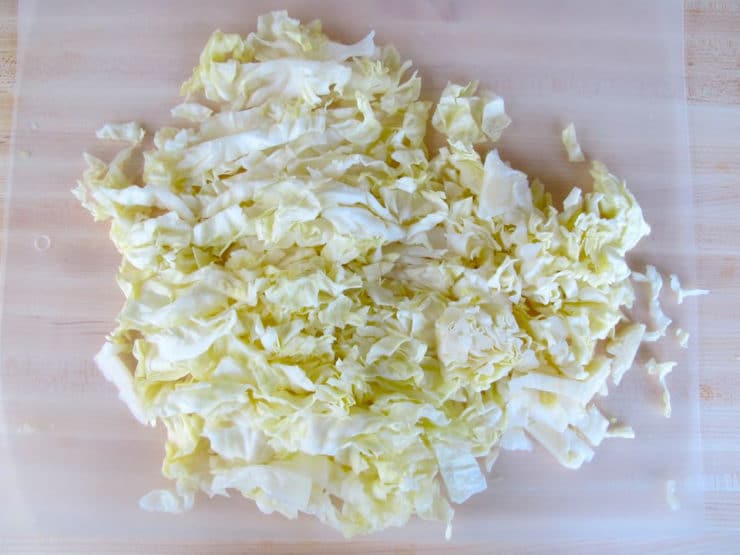
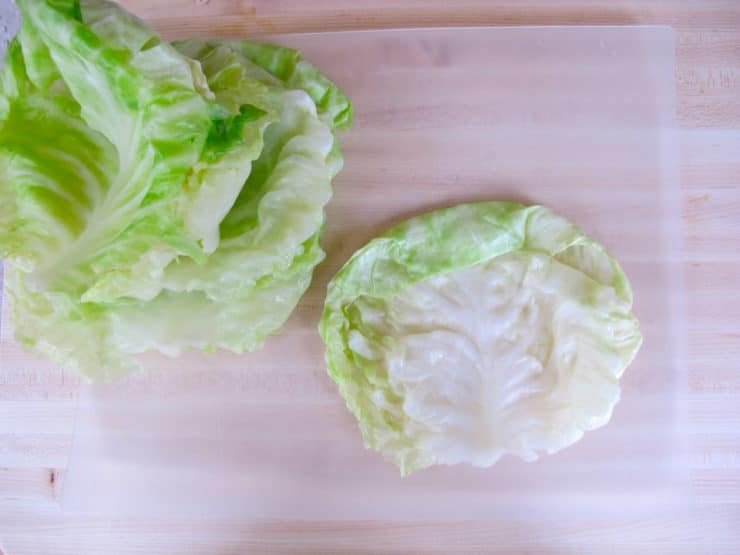
- Peel off the large cabbage leaves from the head of cabbage, keeping only the leaves that are whole/intact and big enough to stuff. Chop up the remaining smaller leaves along with the core of the cabbage. Reserve.
- Place your large leaves on a cutting board.
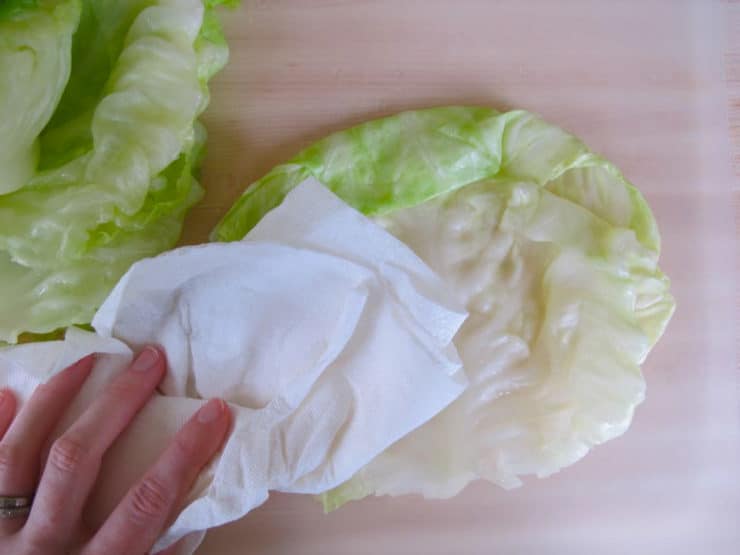
- Take a leaf and pat it dry with a paper towel.
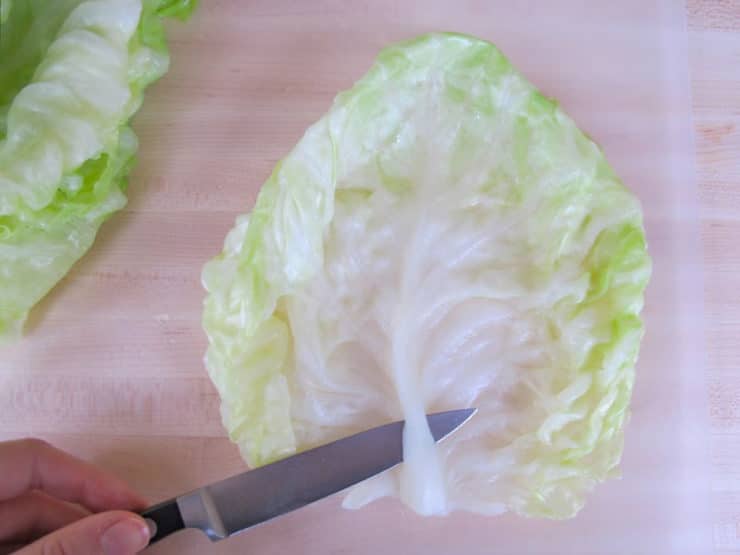
- Shave down the tough, thick part of the stem at the base of each leaf using a paring knife, being careful not to cut through the leaf itself. Repeat process for the remaining leaves.Now it’s time to stuff the leaves. Place a leaf on the cutting board, stem end closest to you. The leaves tend to curl in one direction, so make sure that the curl is facing upward—in other words, it should have a bowl-like shape with edges that curl up, not down.
- Place 1/4 to 1/3 cup of filling at the base of the leaf, centered, about 1/2 inch above the edge. Do not over-stuff the leaves; you want a substantial amount of filling, but a good amount of cabbage leaf around the edges makes for easier rolling.
- Fold the base of the leaf up and over the filling until it’s completely covered.
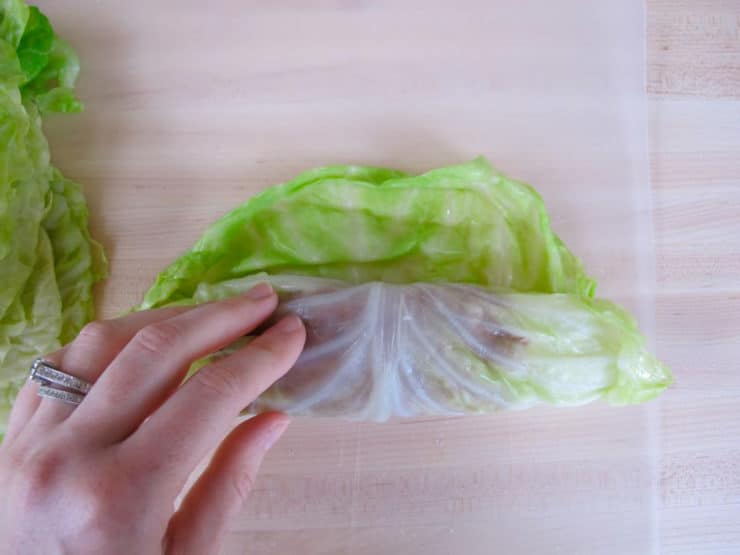
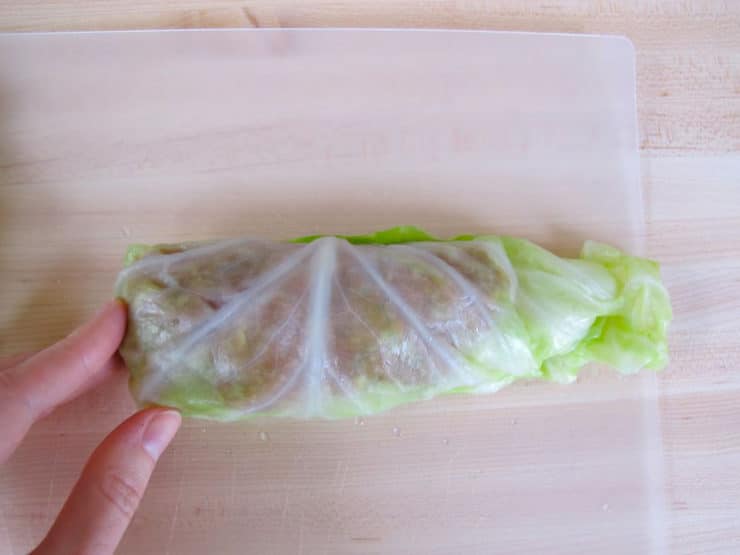
- Fold the left edge of the leaf inward. Leave the right side of the leaf open.
- Continue rolling the leaf until it’s completely rolled up (with the right end still loose/open).
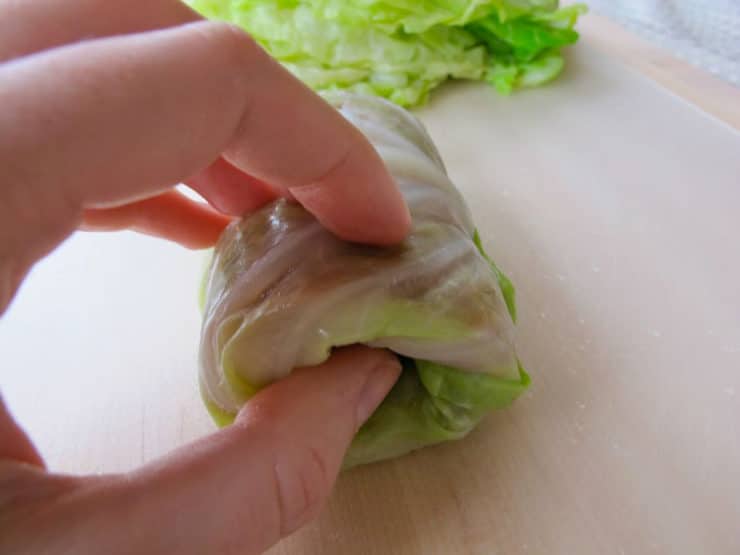
- Tuck the loose end of the leaf inward, pushing it into the filled center of the leaf.
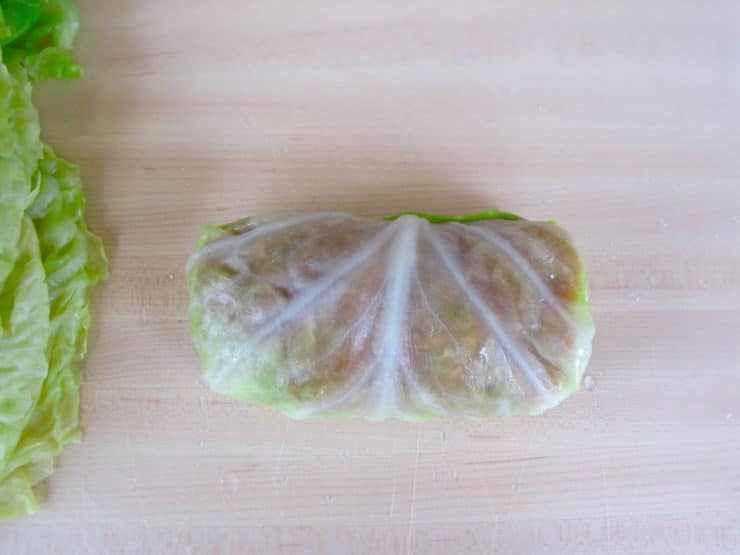
- This will create a neat package that has a better chance of holding together in the pot.
- Continue this process for the remaining leaves. Depending on how many useable leaves your cabbage has, you may find you have some leftover filling. Simply roll that filling into meatballs; you can place them into the pot along with the stuffed leaves, so you don’t waste anything.
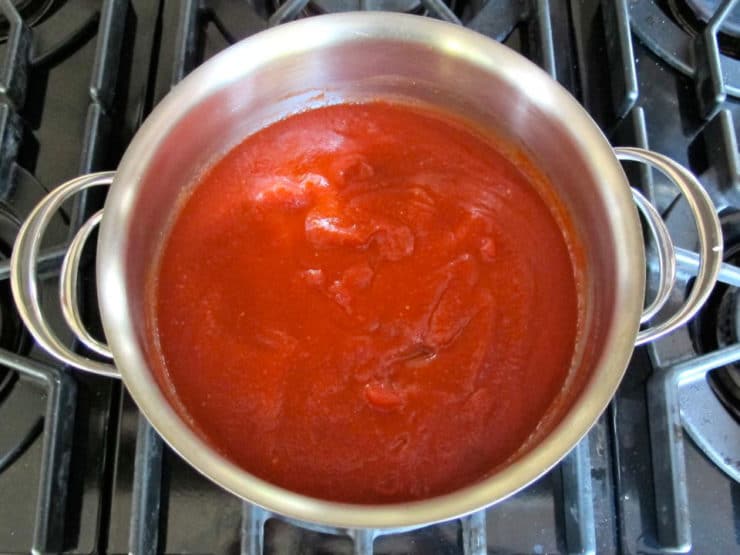
- In a small saucepan, combine the rest of the tomato sauce with the diced or crushed tomatoes, lemon juice, brown sugar, tomato paste, paprika, garlic and allspice. Warm up over medium heat until bubbly and fragrant. Taste the sauce; season with salt and pepper and more brown sugar or lemon, if desired.
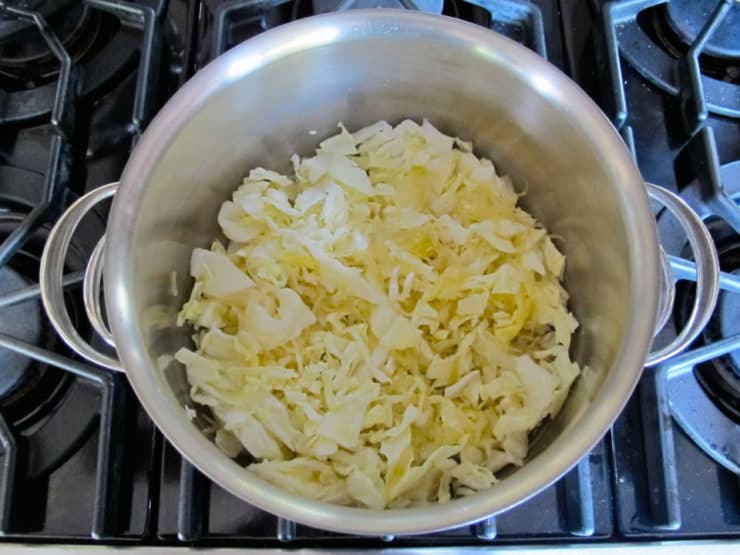
- Put remaining 1 cup of sauerkraut and the chopped cabbage leaves/core into the bottom of a pot. Spread the mixture out to create an even layer, then pour ½ cup of chicken broth or water over the top of the leaves.
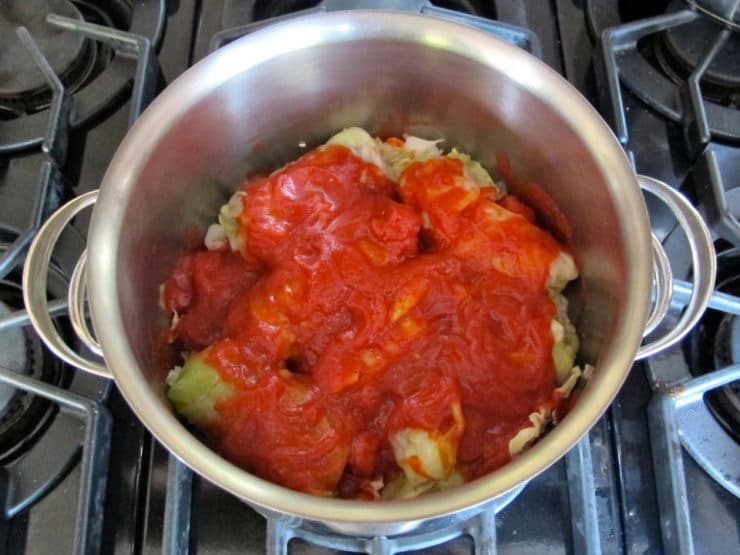
- Place half of the stuffed cabbage leaves on top of the sauerkraut mixture.
- Pour 1/3 of the warmed tomato sauce over the first layer of stuffed cabbage leaves.
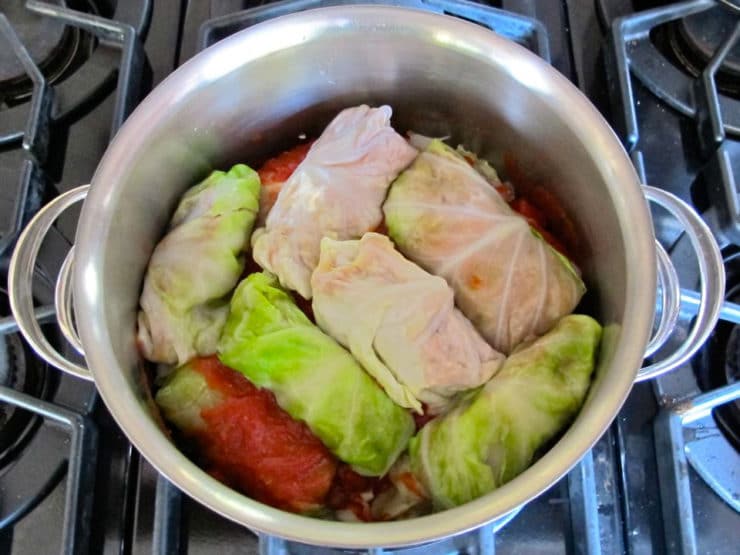
- Put another layer of stuffed leaves on top...
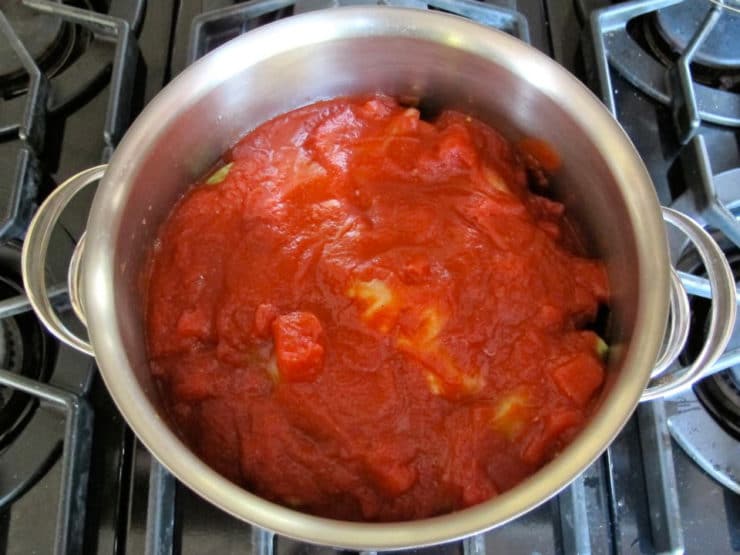
- ...and top with the rest of the sauce.
- Heat the pot over medium high and bring the sauce to a gentle boil. Reduce heat to a slow simmer and cover the pot. Let the cabbage leaves cook for 2-2 ½ hours until the thickest parts of the leaves are tender. Check the pot periodically to make sure it’s not boiling too vigorously—this can make the leaves fall apart. A slow, even simmer works best.When finished cooking, remove the stuffed cabbage leaves from the pot carefully with tongs. Top the stuffed cabbage with some of the sauce and a very generous sprinkle of black pepper. Serve hot. Leaves can be refrigerated for 4-5 days or frozen and reheated before serving.




NOTES
Nutrition

tried this recipe?
Let us know in the comments!
If you enjoyed this recipe, I’d love it if you left me a star rating and comment below. Also, don’t forget to share and tag us on Facebook and Instagram!
FAQs
I like to serve Jewish stuffed cabbage leaves with a starchy side like olive oil mashed potatoes, classic potato latkes, or smoked paprika potatoes. They’re also great with Borscht or matzo ball soup. Or, for a light meal, I pair them with Israeli salad or a crunchy pickled salad.
Yes, I find that leftover stuffed cabbage leaves keep fresh in an airtight container in the fridge for 4-5 days. Or, you can also store them in the freezer for up to 2-3 months. To serve, thaw in the refrigerator overnight. Then, reheat in the oven, microwave, or in a large skillet over medium heat.

The nutritional information for the stuffed cabbage is for 1 serving. Is a serving one or more logs.
It depends on how many cabbage leaves you have stuffed – the recipe allows for however many you can get from your head of cabbage, which will vary from batch to batch. Safe to say this recipe makes roughly 10 cabbage leaves, so a serving would be a little more than 1 leaf. Sorry I don’t have more specific nutritional information for you.
I love this recipe as soon as the days get cooler and the nights draw in I get a new season Savoy cabbage and make stuffed cabbage. It works every time and the chopped cabbage base is used for minestrone. You can freeze it for lunches and it’s a pick me up that never fails to please.
I’m 85 have made stuffed cabbage for years – I
always drop my cabbage head into boiling water
until I know the inner leaves are soft – BUT b4 I
dropped it into pot I first put head on good surface
core end up & with a super sharp knife cut around core THEN wiggled knife to further loosen core &
then just pull it out & discard it softens faster in water & cools faster either on outside deck or just on table while working other ingredients -have never had problem doing it this way & the leaves
are easy to seperate when core is gone & canb stuffed without stopping to do each & every leaf
I make mine on top of stove in Dutch oven -hope whomever try’s it finds it a faster easier – shorter “cut” – Dee
I use a 2.5″ hole saw…. to core the cabbage.
You can’t imagine how easy leaf separation is after that.
Tory , I love this recipe. I made my first homemade holishkes with your recipe. My yyiddeshh nanny would have been proud. She had no written recipes but this recipe was just like hers. I cooked mine in a slow cooker on low and it worked out great. I use many of your recipes and they are fantastic!!
Thanks Bonnie! Glad you liked them 🙂
ps. which side dish is used for holishkes or what do you suggest?
The following options would be nice side dishes:
https://toriavey.com/toris-kitchen/oven-roasted-root-vegetables/
https://toriavey.com/toris-kitchen/spicy-roasted-carrots-fennel-recipe/
https://toriavey.com/toris-kitchen/israeli-salad-with-pickles-and-mint/
https://toriavey.com/toris-kitchen/olive-oil-mashed-potatoes-garlic-rosemary/
Hi, this dish is as well known in south eastern Europe as ‘Sarma’, but also in Poland (‘Golabki’) and Germany (‘Kohlrouladen’ or ‘Krautwickel’), commonly made with a part of ground pork whereas in the Balkany region often pure beef or a mix with veal or lamb, or even vegetarian, is popular. In these countries people prefer the leaves of whole-fermented cabbages (less the fresh pre-cooked ones) as wrapping. The origins of ‘sarma’ go back till the times of the Ottoman Empire.
I am from Germany and always loved the version of my Mum but I’m sure your Holishkes are very delicious too.
Best regards, R.
Can you bake this in the oven vs on the stove top?
You certainly can make stuffed cabbage in a roasting pan with the lid on in the oven set at 300 or 325 degrees.
My first stuffed cabbage. It was superb. And fun. Mixing all those spices made me wonder a little but we both thought the taste was perfect. Thank you for doing all the work and letting me have all the fun. Love your commentary too
Wendy
Glad you liked it! 🙂
Is it okay to leave out the sauerkraut or is it essential for the recipe?
It’s not essential but it adds flavor. You can leave it out if you prefer.
Oh dear ! My grandmother used to make these beauties ! Thank you so much !
is this a sweet recipe? and if not can I just a more sugar?
Hi Chavie, it has a slight sweet/tart flavor, but it is not overly sweet. You can adjust the sweetness by adding more brown sugar to taste.
I have a question… How far in advance can I make this recipe for a holiday?
You can make it several weeks ahead and freeze, it freezes quite well.
What I like to do is freeze the cabbage head in the freezer (or wrapped in the snow outside during the winter) and then thaw on the counter. That way there is theoretically less nutrient loss, but really, it’s just easier than dealing with a giant head and boiling water.
I also suspect it makes the cabbage leaves taste sweeter. However, I also have a solution for this – I just pore boiling water only over separated large cabbage leaves that I intend to use for wrapping.
OMG that loose end package rolling tip is the BOMB. It actually works even for people like me who are really bad with intricate fine motor movements LOL. (can’t sew, cut bangs crooked etc etc) Thank you!
Tori, you are simply wonderful!
Do you serve the sauerkraut/chopped cabbage as well? I’m about to try this but that’s confusing a bit. Does most of the sauce end up in the sauerkraut at the bottom of the pot?
You can if you want to. It’s all tasty 🙂 the rolls will also stand alone if you prefer.
I’m thinking of using the cooked boiled chicken from making chicken soup to stuff the cabbage rolls (I’m going to have an enormous amount of chicken and want to serve it in a more elegant presentation). Have you ever tried this? What do you think about maybe adding an egg for binder in the cooked and finely chopped chicken? What about cooking time, will it be too dry?
I have not tried these subs but they sound like they would work out nicely! The only issue I foresee is the chicken becoming dry, since it will already be cooked prior to adding it to the rolls… so you might have to adjust cook time a bit. Having not tested it myself, I’m hesitant to say yes or no here… but it would be a fun experiment. If you try it please let us know how it goes!
Any suggestions for substitutes for the tomato sauce? Any cooked tomato products give me indigestion. Thanks for your recipes!
No sub for tomato sauce here that I can think of. Sorry!
Your stuffing and how to roll pictures are the best I have ever seen. The ingredients make me think this will be the most delicious recipe. I just made and froze 12 from a different site but soon I will make your recipe and I think I have found my favorite!
Stuffed cabbage. Aah thanks for reminding about this delicious dish. I havent made them for a while & have a hand me down recipe from my mother. Very similar to yours minus sauerkraut & less beef. Thank you for including it.